The Inventory
The lab smelled like nothing. That was the first wrong thing.
Maya had expected chemicals, or at least the sharp clean smell of the science wing at school. But Dr. Russo's lab at the university smelled like an empty room, like air that had been scrubbed of personality. The second wrong thing was that Dr. Russo herself barely looked up when Maya's mom dropped her off.
"Sample prep station is over there," Dr. Russo said, waving vaguely at a counter without turning from her screen. "Gloves. Don't touch the filters without gloves. I'm finishing a grant deadline. You know what a deadline is?"
"Yes," Maya said.
"Good. The sample log is the blue binder. Each filter gets catalogued. You write what's on the label, you note the color, you put it under the scope, you count what you see. Tally marks. Can you do tally marks?"
"Yes," Maya said again, already walking toward the counter.
The blue binder was thick. Someone had catalogued hundreds of filters before her, each page a neat row: sample origin, date collected, particle count, particle color. Maya flipped through. Arctic sea ice, core sample, depth fourteen centimeters. Snowpack, Mont Blanc, elevation three thousand eight hundred meters. Sediment, Mariana Trench, Challenger Deep.
She stopped.
She read it again. Mariana Trench. The deepest place in the ocean. Someone had sent a sample from the bottom of everything, and someone else had sat at this same counter and counted what they found.
The tally marks on that line were not zero.
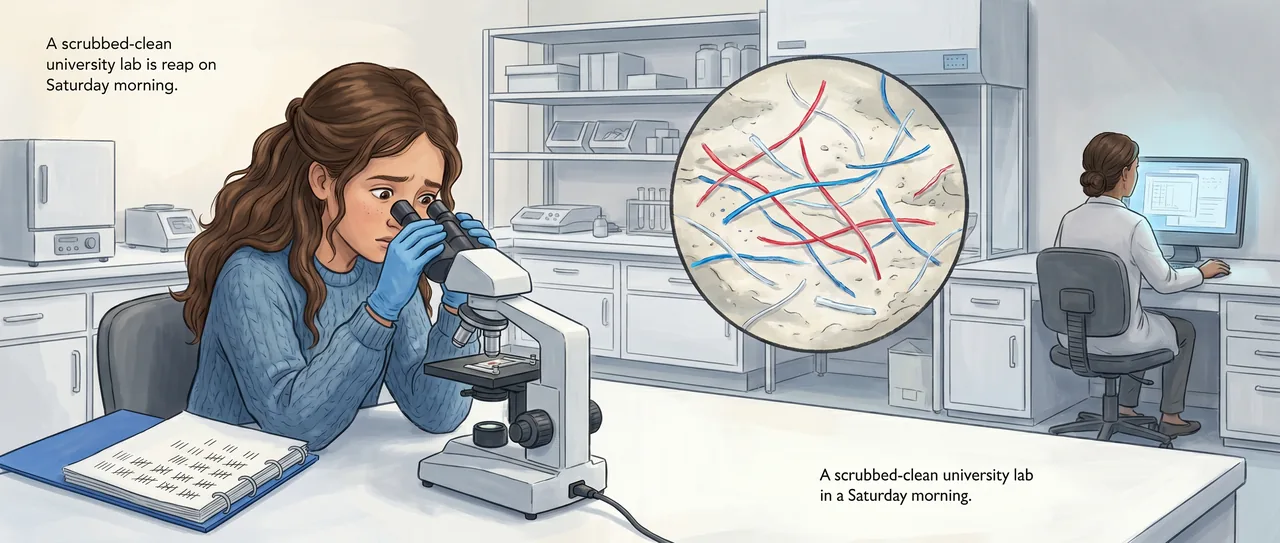
Maya put on gloves and opened the first sample bag waiting for her. The label read: Rainwater, Station 7, Pyrenees, 2200m. She placed the filter on the microscope stage and pressed her eye to the eyepiece.
At first she saw nothing. Then she adjusted the focus, and the filter bloomed into a landscape. Fibers. Tiny, impossibly thin fibers. Blue ones, red ones, clear ones that caught the light like strands of spider silk. They lay scattered across the white filter like a child's drawing of pickup sticks.
She counted. She made tally marks. Eleven fibers on a filter from rain that had fallen on a mountain in France.
"Dr. Russo?"
"Mm."
"Where do they come from? The fibers in rain."
"Clothes, mostly. Washing machines. They go airborne. They travel."
Dr. Russo said this the way someone says the bus comes at eight fifteen. A fact that had stopped being remarkable to her a long time ago.
Maya opened the next sample. Antarctic snow, McMurdo Station. She counted nine fibers and two fragments, bright blue, the kind of blue that does not exist in snow.
The next. Fog water, collected from a cloud on a peak in Switzerland. Seven fibers.
She kept going. She stopped reading the labels before looking, because she wanted to see if she could guess the count first. She could not. There was no pattern she could find. Remote places had them. High places had them. Cold places, hot places. The fibers were everywhere, and they did not care about altitude or temperature or distance from a road.
An hour in, she reached a different kind of sample. The label read: Human lung tissue, non-occupational exposure, donor age 67, non-smoker.
Maya's hand paused above the microscope stage.
She looked across the lab at Dr. Russo, who was still typing.
"These are from a person," Maya said.
"Mm-hm. Autopsy samples. Consented donation to research."
"And you found them in lungs."
"We found them in lungs, in blood, in placentas." Dr. Russo typed a few more words, then stopped. She turned her chair halfway. "In people who never worked in a plastics factory. In people who lived ordinary lives."
Maya placed the filter. She adjusted the focus.
There they were. Not as many as the rainwater. But there. Red and blue fibers caught in what had once been the inside of a person who had breathed them in without knowing, the way you breathe in anything, the way you breathe in air.
She made her tally marks. She moved to the next sample. Placental tissue.
She did not want to look at this one. She looked anyway.
Three fibers. In the organ that connects a mother to a child before the child is born. Three fibers in the first home a person ever has.
Maya sat back from the microscope. She looked at the blue binder, at the hundreds of pages of tally marks that were never zero. Arctic ice. Trench sediment. Cloud water. Lung tissue. Placental tissue. Human blood.
"Dr. Russo. Is there anywhere they haven't been found?"
Dr. Russo finally turned all the way around. She looked at Maya for the first time, really looked, and her expression was not sad and not scared. It was the expression of someone who has been carrying something and has just realized there is another person in the room who can feel its weight.
"No," she said. "Not yet. We keep checking new places, and they keep being there."
"So they're part of the system now," Maya said. "Like carbon. Like water."
Dr. Russo opened her mouth, then closed it. She tilted her head. "That's not how I'd put it. But I don't think you're wrong."
"I didn't say it was okay," Maya said.
"I know you didn't."
Maya turned back to the microscope. She had nineteen more samples to catalogue. She picked up the next filter, and this time she read the label first.
Mariana Trench. Challenger Deep. Ten thousand nine hundred and twenty eight meters below sea level.
The deepest place a human being had ever thought to look.
She focused the lens and the fibers appeared, bright against the dark sediment. Colors that had no business existing at the bottom of the ocean. Colors from someone's jacket, someone's carpet, someone's washing machine, carried by currents that never see light, settling into mud that had been undisturbed for millennia.
She counted them carefully. She entered the number in the binder. She turned to the next blank page.
The column for the next sample was empty, waiting. Somewhere in the world there was a place no one had checked yet, and Maya already knew what they would find there. She knew it the way she knew her own breathing, which was happening right now, in this clean lab that smelled like nothing, pulling air in and pushing air out through lungs that were not, had never been, empty.
She pressed her eye to the lens again.
Read the interactive version, listen to the narration, and earn a gold star →
A science-verified short story for curious kids · Curiosity Land