The Catalog of Helpless Things
Soren's mother had a rule about the mammal hall: don't touch the taxidermy. She had a second rule: don't complain about being bored, because the museum was literally full of things.
She was behind the diorama wall, reattaching fur to a mule deer with tiny dabs of adhesive, her radio playing something with a lot of violins. Soren had the whole hall to himself.
He wasn't bored. He had his notebook, and he had a question.
It had started that morning, when his aunt had brought the new baby over. Cousin Ellie. Seven weeks old. She couldn't hold her head up. She couldn't roll over. She couldn't do anything except exist, loudly, and grab fingers with a grip that seemed way too strong for someone who couldn't even focus her eyes on your face.
His aunt had said, "She's so helpless," in that warm voice people use about babies, and Soren had nodded. But walking through the mammal hall now, he kept stopping.
The horse foal in the prairie diorama was painted standing. The label said foals walk within an hour of birth.
One hour.
Ellie was seven weeks old and couldn't hold her head up.
Soren wrote that down. Then he walked to the next case. Wildebeest. The label said calves can run with the herd within minutes of being born.
Minutes.
He walked faster. The white-tailed deer fawn was shown curled in grass, but the text said fawns can stand in twenty minutes. Dolphins, in the ocean life wing, swim immediately. Elephants walk within two hours.
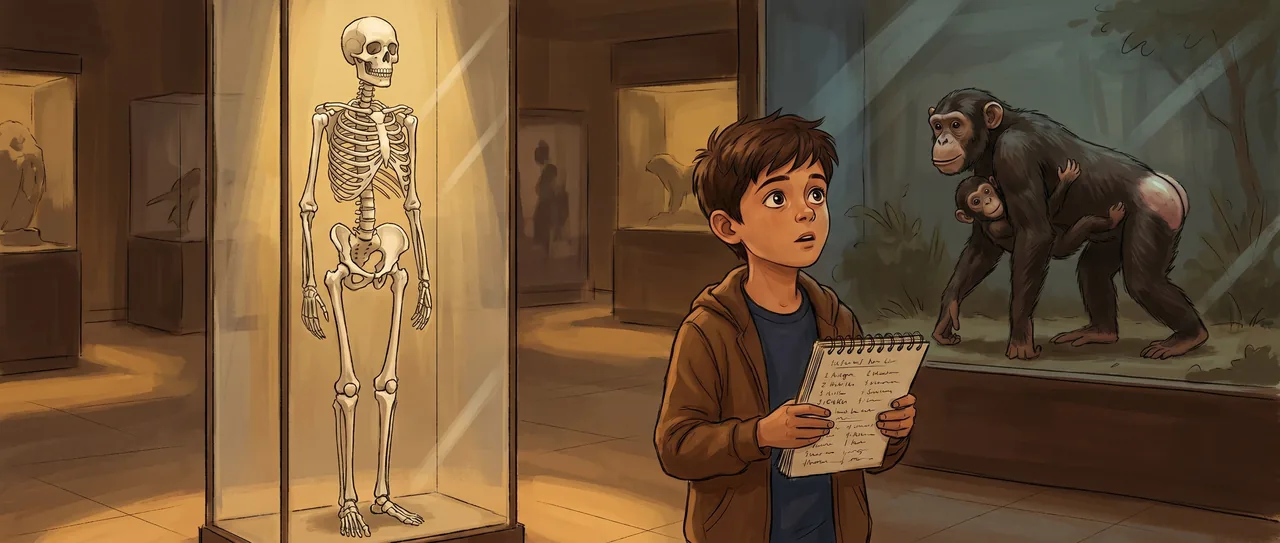
Soren stopped in front of the primate case. A chimpanzee mother with an infant clinging to her chest. He read the label twice. Chimp infants cling to their mothers from day one. They can grip fur, hold on during travel, support their own heads.
Day one.
He looked at his list. Horse: one hour. Wildebeest: minutes. Deer: twenty minutes. Dolphin: immediately. Elephant: two hours. Chimpanzee infant: clings from birth.
Human infant: seven weeks, can't hold head up.
Something was wrong with humans.
Not wrong. Different. Extremely, enormously different, in a way that had to mean something.
He went behind the diorama wall. His mother was bent over the deer, wearing magnifying glasses that made her eyes huge.
"Mom. Why are human babies so useless?"
"Gee, thanks," she said. "I was in labor with you for twenty-two hours."
"No, I mean. Compared to everything out there." He pointed at the hall. "Everything else can walk or cling or swim right away. Human babies can't do anything for months."
His mother set down her brush. "That's a real question. I don't know the answer." She pulled off the magnifying glasses. "There's something about it, though. Something about heads being too big. I read it years ago. The pelvis and the head, they don't quite fit. That's why labor is so hard."
"Too big for what?"
"Too big for the birth canal. Because we walk upright. The pelvis had to narrow when we stood up." She picked up her brush again. "That's all I remember. I'm not a biologist, Soren. I just glue fur back on."
He stood there, thinking.
Big head. Narrow pelvis. Walking upright.
He went back to the primate case and looked at the chimpanzee. It was mounted on all fours. Its hips were wide. He looked at the human skeleton in the corner of the hall, the one posed mid-stride. Its pelvis was narrow, a bowl tilted forward, shaped for balance, shaped for walking on two legs.
Soren pressed his forehead against the glass of the skeleton case and thought about it like a problem. Like an engineering problem.
If you need to walk upright, you need a narrow pelvis.
If you need a big brain, you need a big skull.
Big skull. Narrow opening.
Something has to give.
He looked at his notebook. All those animals, ready to go the moment they were born. Foals running, calves sprinting, dolphins swimming. Their brains were done. Finished. Ready to operate the body.
But if a human baby's brain were finished, the head would be too large. It wouldn't fit. It couldn't be born at all.
Soren felt something shift in his chest, like a lock turning.
Human babies were born early. Not premature. Not sick. Just early, on purpose, every single one. Born before they were done, because if they waited until their brains were finished, they could never make it out. The helplessness wasn't a flaw. It was the cost. The cost of walking upright and having a brain large enough to look at a museum case and wonder why.
Ellie couldn't hold her head up because her brain was still building itself. Right now, at seven weeks, her neurons were connecting. She was being assembled in the open air, in the light, in her mother's arms, because she couldn't be assembled inside anymore. There wasn't room.
He thought about his aunt saying, "She's so helpless."
She wasn't helpless. She was unfinished. There was a difference so enormous he had to sit down on the museum bench.
Every single human who had ever lived had been born too soon. Every brain that had ever thought a thought had been too large to be born complete. Every person who had ever walked upright had paid for that posture with a pelvis too narrow for a finished skull. And so every human infant was launched into the world mid-construction, skull bones not yet fused, brain still wiring itself, completely dependent.
Which meant that every person Soren had ever met had only finished becoming themselves because someone held them. Every scientist, every musician, every astronaut, every single person in every photograph on every wall had once been unable to lift their own head.
The bigness of it pressed against the inside of his skull.
He thought about chimps clinging from day one, brains nearly complete, ready to go. Efficient. Elegant. But they don't build museums. They don't write things down. They don't stand in hallways at nine thirty at night with their hearts pounding because they just understood something about themselves.
His mother called from behind the wall. "You okay out there?"
"Yeah," he said.
He looked at the human skeleton, mid-stride, going nowhere and everywhere, its narrow pelvis gleaming under the lights.
Then he looked down at his own hands, which seven weeks after he was born could not have held a pencil, and which now opened his notebook to a blank page.
Read the interactive version, listen to the narration, and earn a gold star →
A science-verified short story for curious kids · Curiosity Land