Every Way Home
The bird was wrong.
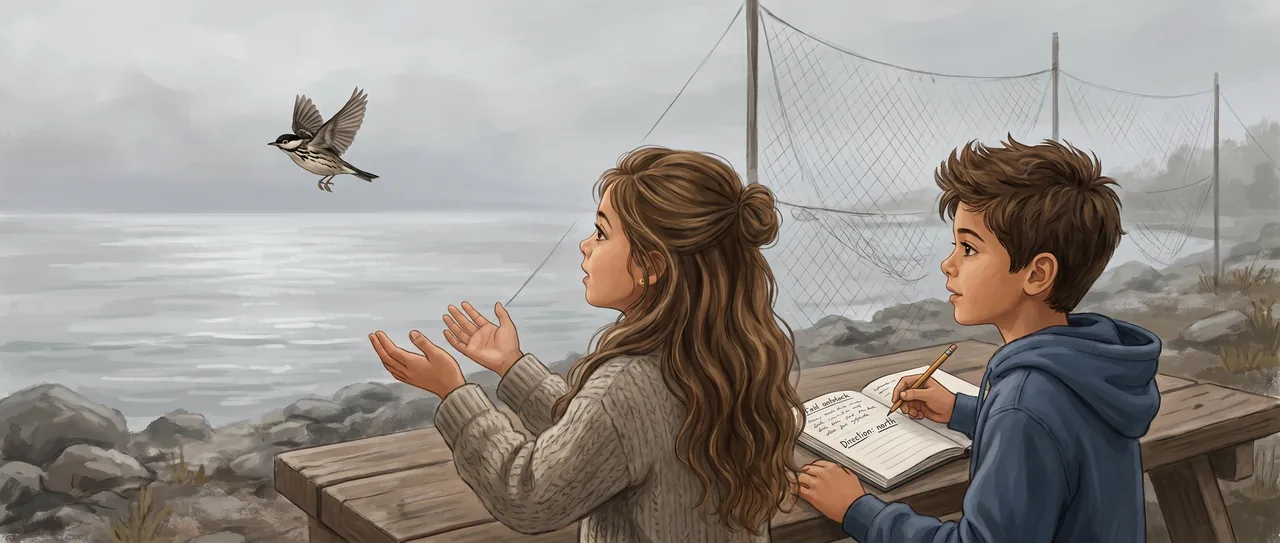
That was the first thing Soren noticed. Dr. Kalani had just released a banded white-throated sparrow into the gray morning, and it flew north. Not south. North, over the lake, into the low clouds, like it had forgotten the whole point of October.
"It'll correct," Dr. Kalani said, already reaching for the next bird from the volunteer who held it. She was banding fourteen species today and had no time for one confused sparrow. "They circle. They find it."
But Soren wrote it down. Direction: north. He underlined it.
Maya was holding the next bird, a Swainson's thrush, her fingers curled exactly the way Dr. Kalani had shown them, the bird's head between her index and middle finger, body resting in her palm. It was impossibly light. She could feel its heart going so fast it was almost a vibration, like a phone set to silent.
"This one's a hatch-year," Dr. Kalani said, reading the feather patterns. "Born this spring. First migration."
"So it's never been south," Maya said.
"Nope."
"And it knows where to go."
"It will fly roughly four thousand kilometers to Central America, and it will get there." Dr. Kalani said this the way she said everything, like a fact that had stopped being remarkable to her about six hundred birds ago. She closed the band with a click. "Release it toward the clearing, please."
Maya opened her hands. The thrush sat for half a second, then launched. South-southwest. It did not circle. It did not hesitate.
Soren looked at her. She looked at him.
"How," Soren said.
It wasn't really a question. It was the start of a list.
They had both read the laminated handout Dr. Kalani kept at the station. Birds navigate using the sun's position. They navigate using star patterns at night. They sense Earth's magnetic field, probably through proteins in their eyes called cryptochromes, so they might literally see the magnetic field as a kind of overlay on their vision. They use landmarks. They use smell, actual olfactory maps of the landscape below. They can detect infrasound, the low-frequency hum that mountains and ocean waves press into the atmosphere, sounds too deep for human ears, and they use that too.
Six systems. At least six.
But here was the thing that had made Maya's list of things that don't make sense yet: the hatch-year bird had never seen the route. Never flown over the Appalachians. Never crossed the Gulf of Mexico. Never smelled the forests of Honduras. It had no landmarks to recognize, no memories to follow. Many juvenile songbirds migrate alone, not in flocks with experienced adults. And they arrive.
"It's not learning," Maya said. "It's not remembering. It already knows."
"The direction and approximate distance are inherited," Soren said. He had read this three times. "Encoded genetically. The bird is born with a program that says fly this direction for this long."
"But which compass is it using? Right now, today, with the clouds covering the sun and the stars not out yet?"
Soren looked up. Thick overcast. No sun visible. No landmarks over the lake, just gray water vanishing into gray sky.
"Magnetic," he said. "Has to be."
"But what if it's not just magnetic? What if it's using infrasound? The lake makes infrasound. So do the wave patterns on the shore."
"We can't test that."
"No," Maya said. "But think about it. If you had six ways to know which way was south, and someone took away three of them, you'd still have three."
Soren stopped writing. He looked at the sparrow's entry. Direction: north.
"The sparrow," he said slowly. "Dr. Kalani said it would correct."
"What if the release just confused one of its systems? Like, the motion of being handled, the spin, and for a second its magnetic sense said one thing and its other senses said something else. So it flew the wrong way. But only for a second. Because the other systems were still saying south."
"Redundancy," Soren said.
"Not just redundancy. Disagreement. And the bird can hold the disagreement and sort it out in flight."
Dr. Kalani had moved to the other end of the banding table and was talking into a voice recorder about molt patterns. She was not listening to them.
Maya picked up the laminated sheet. "They've done experiments. They shifted the magnetic field around caged birds with Helmholtz coils, and the birds changed their orientation. But when they could also see the sunset, some of them ignored the fake magnetic field and oriented by the sun instead. The systems argue with each other. And the bird decides."
"Decides," Soren repeated.
"Weighs. Chooses. Whatever word you want. A hatch-year bird that has never been anywhere, with a brain that weighs less than a gram, is running six navigation systems at once and arbitrating between them when they conflict."
The wind came off the lake, and the mist nets swayed. Somewhere above the clouds, the sun was tracking its arc, and somewhere beneath their feet, the liquid iron core of the Earth was generating a magnetic field that wrapped the entire planet, and somewhere out over the water, waves were pressing infrasound into the air at frequencies so low they could travel hundreds of kilometers, and right now, at this moment, thousands of birds were reading all of it simultaneously.
Soren's pencil was still.
"I need six systems to find my way home from the library," he said quietly. "Street signs. My phone. The parking garage I recognize. The smell from the pizza place on Fifth. Counting blocks. And if it's late enough, I know the sun sets behind the hills west of my house."
Maya stared at him.
"You navigate like a bird."
"Everyone does. We just don't notice because we always have enough systems working."
"But we're not born knowing which way to go."
"No," Soren said. And that was the part that wouldn't fit into his notebook, the part that was too large. A thrush chick cracks out of an egg in a Vermont forest, and already written inside it, somehow, is a direction and a distance to a place in Honduras it has never seen, and it has six ways to read that instruction from the world around it, and it goes, alone, at night, and arrives.
Dr. Kalani called them over. Another bird in the net, a young blackpoll warbler, barely twelve grams, about to attempt a three-day nonstop flight over the open Atlantic.
Maya untangled it carefully. She could feel the fat deposits under its feathers, fuel for the crossing, and beneath that, the frantic impossible engine of its heart.
She opened her hands, and the warbler flew south over the lake and did not look back.
Read the interactive version, listen to the narration, and earn a gold star →
A science-verified short story for curious kids · Curiosity Land