The Oldest Medicine Cabinet
Soren's grandmother would not stop chewing the twig.
She sat in her lawn chair at the edge of the community garden, a piece of bark between her teeth, eyes half-closed against the August sun. She had a headache. She had refused the bottle of aspirin Maya offered from the first aid kit.
"My mother chewed willow bark," she said. "Her mother chewed willow bark. The aspirin can stay in the box."
Maya looked at Soren. Soren looked at the twig.
"Baba," Soren said carefully, "that's a willow twig?"
"From the tree by the creek. Go get your water samples. I'll be fine."
They walked down the slope toward the creek, buckets in hand. Maya was quiet for about four steps.
"She's basically taking aspirin anyway," Maya said.
Soren stopped walking. "What?"
"Willow bark. That's where aspirin comes from. I mean, not exactly, but the thing in it that works. Salicin, I think it's called."
Soren set his bucket down and pulled out his notebook. Not because he doubted her. Because the inside of his head had just gotten crowded.
"Okay. So if your grandmother takes a pill and my grandmother chews a twig, they're both doing the same thing?"
"Sort of the same thing. The pill is the cleaned-up version. Someone figured out the chemical and made it pure."
"When?"
Maya frowned. "Eighteen hundreds, maybe? I read it somewhere."
Soren wrote that down, then wrote a question mark next to it. He looked back up the hill at his grandmother. She had not moved. The twig was still in her mouth.
"She says her mother did this," Soren said. "And her mother's mother."
"That's not very far back."
"No, but she says it like it goes further."
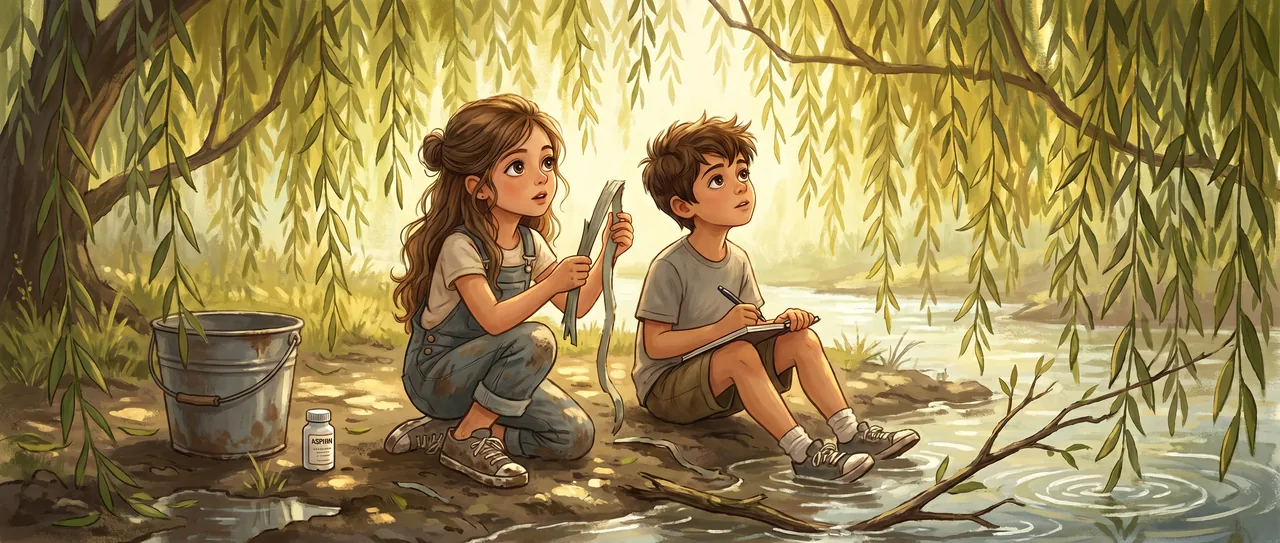
Maya knelt at the creek bank and filled her bucket, but she wasn't really thinking about water samples anymore. She was looking at the willow tree. It hung over the creek with its curtain of thin branches, and some of them trailed in the water. The bark was rough and gray-green.
"How would someone even figure that out?" she said. "The first person. You have a headache, and you look at a tree, and you think, I should eat that?"
"You wouldn't," Soren said. "Not on purpose. Not the first time."
They were both quiet. The creek made its small sounds.
"Maybe you were just hungry," Maya said slowly. "Or thirsty. And you peeled bark because that's what you had. And your headache went away, and you noticed."
"And then you'd have to try it again," Soren said. "To see if it was the bark or just time passing."
"So you'd wait for another headache."
"And chew bark again. And it works again. And you tell someone."
Maya pulled a thin branch toward her. She turned a piece of bark in her fingers. It didn't look like medicine. It looked like a stick.
"Three thousand years," she said. "At least. I remember now. The Egyptians used it. Written on papyrus. Instructions for willow bark and pain."
Soren wrote: Egyptians. Papyrus. Willow = pain relief.
"And nobody knew why it worked," he said. Not a question.
"Not for thousands of years. They just knew it did."
Soren capped his pen. He looked at the willow tree, really looked at it, the way he looked at things that were behaving differently than he expected. But the tree wasn't behaving differently. The tree was just being a tree. The strange part was everything else.
"That means," he said, "for most of human history, the best medicine anyone had was observation. Somebody noticed something. And somebody else believed them enough to try it. And somebody else wrote it down. And it just kept going. Person to person to person. For three thousand five hundred years. Without anyone understanding the chemistry."
"And then someone in a lab figured out the molecule," Maya said. "And suddenly you can make it in a factory. Aspirin. Billions of tablets."
"But the knowing came first. The knowing was always there."
Maya sat down on the bank. Her shoes were muddy. She didn't care.
"Do you think there's other stuff like that?" she asked. "Things people have known for thousands of years that work, and we just haven't found the molecule yet?"
Soren sat down next to her. "There has to be. Think about how many plants there are."
"Think about how many grandmothers there are."
He almost laughed. But it wasn't funny, not exactly. It was enormous. Every culture, every place where people lived, somebody had been the first to notice that this root or that leaf or this bark did something, and they had passed it on, and most of it was never written down, and some of it was lost, and some of it was still right there in someone's mouth on a Saturday afternoon in a lawn chair.
The science wasn't in the lab. The lab was just where the science got its name.
The science was in the noticing.
"We should ask her," Maya said.
"Ask her what?"
"What else she knows. What else her mother told her. Not just willow bark. Everything."
Soren looked at her. "You want to make a list."
"I want to make a big list. And then I want to find out which ones have been studied and which ones haven't."
"That's a lot of chemistry."
"That's a lot of chemistry that somebody already did the first experiment for. Thousands of years ago. We'd just be catching up."
Soren looked at the aspirin bottle still sitting in the first aid kit by Maya's bucket. White pills in a white bottle. He looked at the willow tree, old and ordinary and full of something that people had needed since before they could write.
He stood up and offered Maya a hand. She took it and pulled herself out of the mud.
They left the buckets by the creek and walked back up the hill to where Soren's grandmother sat, eyes still half-closed, the willow bark still between her teeth.
"Baba," Soren said. "What else did your mother know?"
She opened one eye.
Then she smiled, and pulled over two chairs.
Read the interactive version, listen to the narration, and earn a gold star →
A science-verified short story for curious kids · Curiosity Land