The Clocks on the Shelf
The argument started because of the clocks.
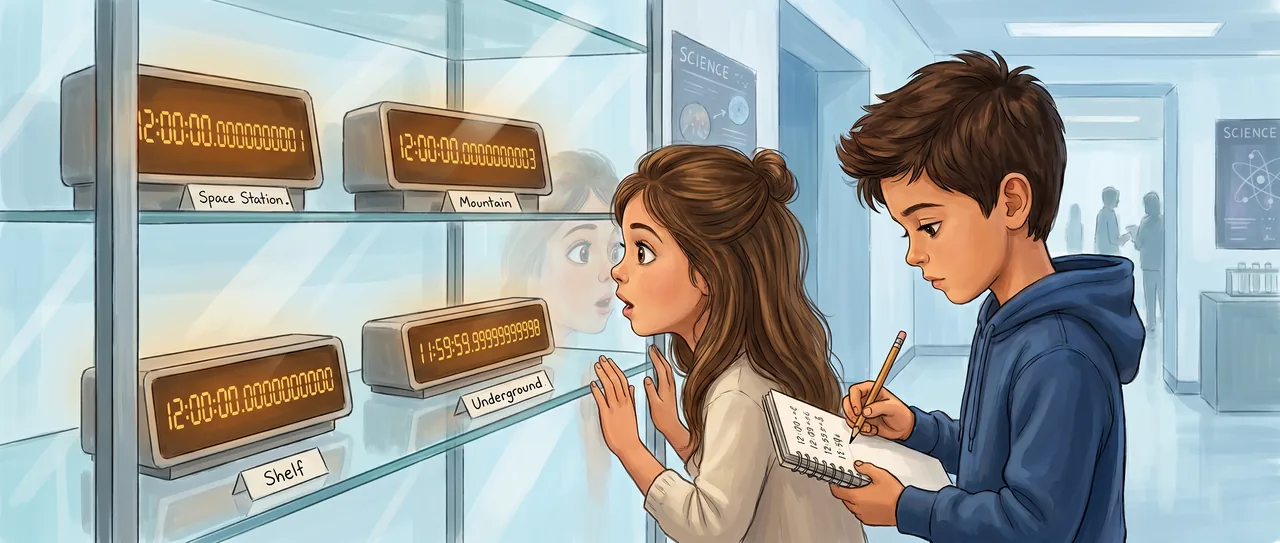
Not just any clocks. Four atomic clocks, sitting on a glass shelf in the physics building lobby, each one accurate to a billionth of a second. A sign beneath them read: THESE CLOCKS WERE SYNCHRONIZED ON JANUARY 1ST. They were part of the university's weekend open house, and Maya and Soren had wandered away from the tour group twenty minutes ago.
"That one's wrong," Maya said.
Soren looked. The four clocks showed nearly identical times, but the one on the far left was behind the others by a tiny fraction. The display showed time to eleven decimal places, and around the ninth decimal, the numbers diverged.
"Maybe it's broken," Soren said.
"It's an atomic clock. It counts the vibrations of cesium atoms. Nine billion vibrations per second, every second, perfectly. They don't just break."
"Everything breaks."
"Read the card underneath it."
Soren leaned closer. The small card read: THIS CLOCK SPENT 90 DAYS ON THE INTERNATIONAL SPACE STATION, ORBITING EARTH AT 27,600 KM/H. IT WAS RETURNED TO THIS DISPLAY ON OCTOBER 14TH.
The card under the second clock read: THIS CLOCK SPENT 90 DAYS AT THE NIST LABORATORY IN BOULDER, COLORADO. ELEVATION: 1,655 METERS.
The third: THIS CLOCK REMAINED ON THIS SHELF. ELEVATION: 98 METERS.
The fourth: THIS CLOCK SPENT 90 DAYS IN A LABORATORY 800 METERS UNDERGROUND IN THE SANFORD MINE, SOUTH DAKOTA.
"So they separated them," Soren said slowly. He pulled out his notebook. "One high and fast, one high and still, one here, one deep underground." He wrote the numbers down from all four displays. "They're all different."
"Not broken," Maya said.
"Not broken," he agreed. "But that doesn't make sense. A second is a second."
"Apparently not."
A woman in a lab coat walked past carrying a box of cables. She glanced at them, glanced at the clocks, and kept walking. Then she stopped. She set the box down on the floor.
"You found the interesting part," she said. Her name tag said DR. PETROV. She looked tired, like someone who had been setting up displays since five in the morning.
"The space station clock is behind," Maya said. "It ticked slower."
"How much?" Dr. Petrov asked.
"We were just about to figure that out," Soren said, already comparing his numbers.
Dr. Petrov nodded. She picked up her box. "I'll be in room 214 if you want to tell me what you find." She left.
Maya watched her go. "She didn't explain anything."
"Good," Soren said. He was writing. "Okay. The space station clock is behind the shelf clock by about point zero zero three seconds over ninety days. That's tiny. But it's real. It's not noise."
"It moved faster, so it ticked slower," Maya said. She was pacing now, three steps left, three steps right. "Speed slows clocks down."
"But look at this." Soren tapped his notebook. "The Boulder clock. It was sitting still on a mountaintop. It's ahead of the shelf clock."
Maya stopped pacing. "Higher up ticks faster?"
"By a smaller amount. But yes." He wrote both numbers down side by side. "So the space station clock has two things happening to it. It's moving really fast, which slows it down. But it's also high up, far from Earth, where gravity is weaker, which speeds it up."
"And the underground clock," Maya said. She was already looking at it.
The underground clock was behind the shelf clock, but by a different amount than the space station clock. Deeper in Earth's gravity. Ticking slower.
"Gravity slows time," Soren said. He said it like he was testing the words, checking if they could bear weight.
"Not slows. That makes it sound like the clocks are struggling. They're not. The cesium atoms are vibrating at their normal rate. They're perfect. Every one of these clocks thinks it's keeping perfect time."
"Then what's different?"
Maya pressed her forehead against the glass case. "Time itself is different. A second next to something heavy is a different length than a second far away from it. They're not the same second."
The lobby was quiet. Somewhere down the hall, the tour group was learning about something else.
Soren stared at his notebook. He had written the numbers in a column. Space station clock, slow. Mountain clock, fast. Underground clock, slower still. Shelf clock, in between.
"My notebook is higher than my shoes," he said.
"What?"
"Right now. My notebook is higher than my shoes. It's farther from the center of the Earth. The gravity is weaker, by a tiny amount. So time at the height of my notebook is passing faster than time at the height of my shoes."
"By a ridiculously small amount."
"But by a real amount. My head is older than my feet."
Maya laughed. Then she stopped laughing, because she was doing the same thing she always did, which was running ahead, and this time the thing she had run into was larger than she expected. "Soren. The speed of light. It's not just how fast light goes."
"What do you mean?"
"Three hundred thousand kilometers per second. That number. It's not just a speed limit. It's the thing that connects space and time. If you move through space faster, you move through time slower. If you sit deeper in gravity, time runs different. One number controls all of it."
Soren looked at the clocks. "So time isn't a backdrop. It's not the stage that everything happens on. It's part of the set. It bends. It stretches."
"And these clocks are the proof. Not theory. Not math. Four clocks, four shelves, four different nows."
They stood there for a while. Soren wrote something, crossed it out, wrote something else.
"I want to tell Dr. Petrov," Maya said.
"Tell her what?"
"That the space station clock lost to the underground clock, but for completely different reasons. The station clock lost time because of speed. The underground clock lost time because of gravity. Two different causes, one number connecting them."
"She already knows that."
"I know she knows. I want to see if we're right."
They found room 214. Dr. Petrov was untangling cables. She looked up.
"The speed of light isn't just a speed," Maya said. "It's the conversion rate between space and time."
Dr. Petrov set down the cables. She looked at them for a long moment, the way you look at someone who has said something you did not expect to hear today.
"How old are you two?"
"Eleven," Soren said.
"Eleven," Dr. Petrov repeated. She rubbed her eyes. She almost smiled. Then she pulled over two chairs.
Read the interactive version, listen to the narration, and earn a gold star →
A science-verified short story for curious kids · Curiosity Land