The Brightest Dark
The argument started because Maya said the photograph was broken.
"It's not broken," Soren said. He was sitting at the imaging terminal in the observatory's basement, where it smelled like old carpet and cold coffee. Their assignment was simple. Photograph galaxy SDSS J1148+5251. Measure its brightness. Compare it to a reference star. Write it up. Go to bed.
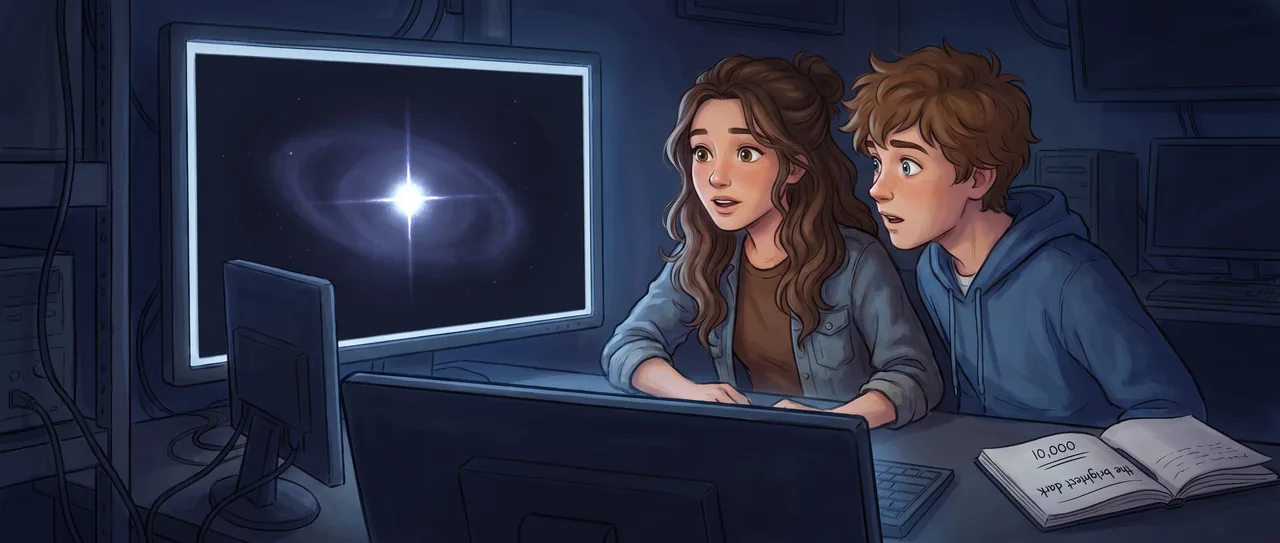
But the photograph showed a single blazing point of light where the galaxy was supposed to be.
"Galaxies aren't dots," Maya said. "Galaxies are smears. We've taken eleven tonight. They all look like smudges. This one looks like a star."
"So maybe we pointed at the wrong coordinates."
"I checked. Twice."
Soren pulled up their reference chart. He'd written the coordinates by hand in his notebook and then typed them in himself. Right ascension, declination. Everything matched. He ran the pointing verification. The telescope was aimed exactly where it should be.
"Then it's a star between us and the galaxy," he said. "A foreground star. We're seeing something in the way."
Maya leaned closer to the screen. The dot was so bright it had bled into the surrounding pixels, creating a small cross-shaped pattern from the telescope's diffraction spikes. Just like a star. Except.
"Pull up the field chart for that region," she said.
Soren did. No cataloged star at those coordinates.
"So it's an uncataloged star."
"At exactly the same position as our galaxy? Exactly?"
Soren was quiet for a moment. He pulled up one of their earlier galaxy photographs. A soft, elongated smudge. Messier 82. Then he put the new image beside it.
"Okay," he said slowly. "That's weird."
Dr. Kaur was upstairs recalibrating the secondary mirror. She'd told them she'd be busy for an hour and to work through the target list without her. She had a way of giving instructions while already walking away, her mind clearly on whatever problem she was actually interested in, which was never the same problem the students were working on.
Maya said, "Take a longer exposure."
"Why?"
"If it's a galaxy, a longer exposure should show the faint stuff around it. The outer arms, the halo. Stars don't have halos."
Soren set up a three hundred second exposure instead of the sixty they'd been using. Five minutes. They sat in the dark basement and waited. The building hummed. Somewhere above them, the telescope tracked slowly against the rotation of the Earth.
When the image downloaded, Maya made a sound. Not a word. Just a sound.
The blazing point was still there, still blinding. But now, at the very edges, almost invisible, there was a faint ghostly glow surrounding it. Not round. Slightly elongated. The barest suggestion of structure.
"That's the galaxy," Maya said.
"That can't be the galaxy," Soren said. But he was already measuring. He selected the bright central point and read its pixel value. Then he drew a careful circle around the faint outer glow and read that value. He did the subtraction in his notebook.
He stared at the numbers.
"Maya. The bright thing in the center is something like ten thousand times brighter than everything else combined."
"Ten thousand times brighter than the whole galaxy?"
"That's what the numbers say. One thing, in the middle, outshining everything. Every star in the entire galaxy, all together, and this one dot is ten thousand times more."
They looked at each other.
"How many stars are in a galaxy?" Maya asked. Not because she didn't know. Because she needed to hear it out loud.
"Hundreds of billions," Soren said.
"And one thing is brighter than all of them. Ten thousand times brighter than all of them."
Soren opened the catalog database and typed in their coordinates. The entry came up immediately. It had a classification he'd seen in his textbook but never thought about until now.
Quasar.
"It's a black hole," he said. "A supermassive one. At the center of the galaxy. It's eating."
He read aloud, and his voice had gone strange and careful the way it did when something was too large for the inside of his head. Matter falling toward the black hole, accelerating, heating to millions of degrees, releasing energy as it spiraled in. The material screaming with light on its way to a place from which no light could ever escape.
"Wait," Maya said. She pressed her hands flat on the table. "The black hole itself isn't bright. Black holes are dark. The darkest things there are. Nothing gets out."
"Right."
"So the brightest thing in the entire universe is made by the darkest thing in the universe."
Soren put his pencil down.
The room felt different. The hum of the building felt different. Maya was staring at the image on the screen, at that blazing point with its faint galactic halo, and she understood something she couldn't quite put into words. That the most extreme darkness and the most extreme light were not opposites. They were the same event. The light existed because of the dark. Hundreds of billions of stars, and they were nothing, a whisper, next to the brilliance of matter falling into a place of absolute nothing.
"This is the brightest object in the universe," Soren said quietly. "Not a star. Not an explosion. A drain."
"How far away is it?" Maya asked.
"The catalog says... twelve point nine billion light-years."
Maya's chair creaked as she leaned back. Twelve point nine billion years ago, the universe itself was less than a billion years old. They were looking at something that had burned when the universe was an infant. And it was still, across all that emptiness, the brightest thing in their photograph.
Dr. Kaur's footsteps thumped on the stairs. "How's the target list coming? Did you get 1148?"
"We got it," Soren said.
"Good. Mark the brightness and move on to the next one."
She was already walking back upstairs.
Maya looked at Soren. Soren looked at Maya. Mark the brightness. As though it were just a number. As though they hadn't just watched the darkest thing imaginable outshine three hundred billion suns.
"She doesn't know what we saw," Maya said.
"She probably sees them all the time," Soren said. Then, after a pause, "I don't think that would make it smaller, though."
"No."
He picked up his pencil and wrote the brightness value in his notebook, neatly. Then, beneath it, he wrote: the brightest dark. He underlined it once and closed the notebook.
Maya reached for the telescope controls and entered the next set of coordinates. The machinery above them groaned softly, swinging toward a new patch of ancient sky.
Read the interactive version, listen to the narration, and earn a gold star →
A science-verified short story for curious kids · Curiosity Land