The Thousand-Year River
The water sample was wrong.
Soren held the temperature readout in one hand and the salinity chart in the other and looked back and forth between them until his eyes ached. The numbers from the deep sensor did not match the numbers from the surface sensor, which was fine, that was expected. But neither set matched the numbers from yesterday, and yesterday's numbers had not matched the day before.
"It's dropping again," he said.
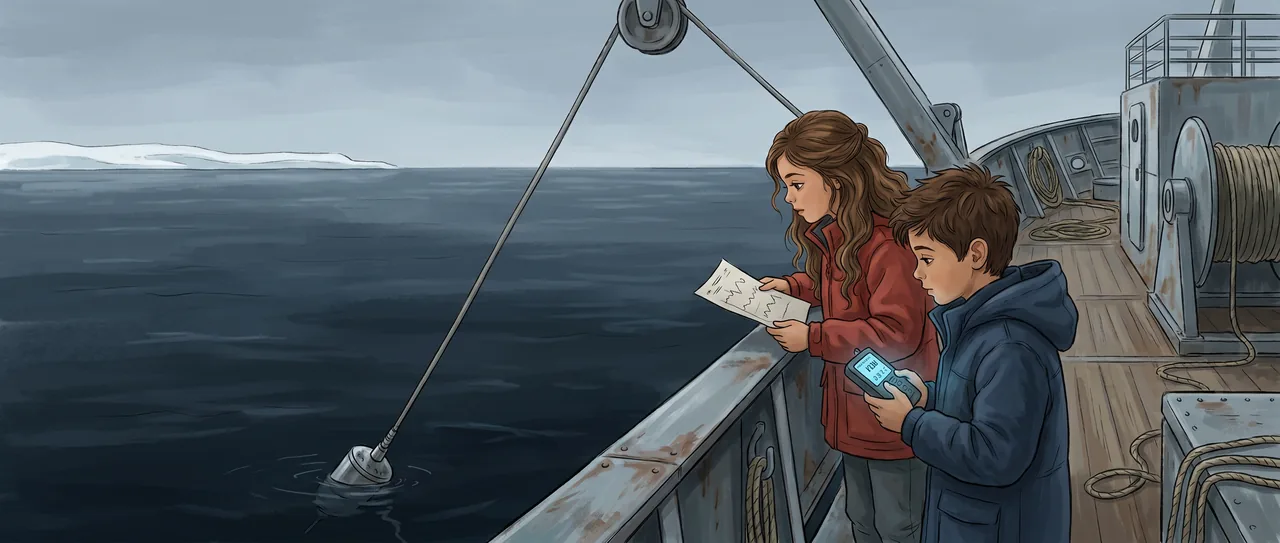
Maya was leaning over the starboard rail of the research vessel Halldora, watching the cable unspool into water so dark it looked like ink. Greenland was a white smear on the horizon. The wind smelled like iron.
"The temperature or the salinity?" she asked.
"Both. But not the same amount."
Maya turned from the rail. "Show me."
He held up the chart. Three days of readings, each one slightly different. The surface water was warmer than the models predicted. The deep water was less salty. Dr. Inuuteq, the expedition's chief oceanographer, had looked at the first day's data and said the sensors probably needed recalibration. He had been in the wet lab ever since, recalibrating things that Soren increasingly suspected did not need recalibrating.
"What if the sensors are fine?" Maya said.
Soren had been thinking the same thing for two days. He had not said it because saying it meant something enormous, and he wanted to be careful with enormous things.
"Then something changed in the water."
"Not something." Maya pointed at the surface temperature. Then at the deep salinity. "Two things. And they're connected."
She said it with that particular certainty she got, the kind that arrived before her reasons did. Soren had learned to take it seriously.
"Walk me through it," he said.
Maya pulled a folding chair to the data table and sat on it backward. "Okay. So. The whole point of this spot is that warm water comes up from the south, right? Gulf Stream water. Salty, because it traveled through the tropics and a lot of it evaporated on the way. When it gets up here to the cold air near Greenland, it cools down. Cold and salty means dense. Dense water sinks."
"That's the downwelling," Soren said. "That's what starts the deep current."
"Right. And then that cold, dense water crawls along the bottom of the Atlantic, all the way south, around Africa, into the Indian Ocean, into the Pacific. It takes something like a thousand years to make the full loop."
"A thousand years," Soren repeated. He wrote it down. He always wrote down numbers that made his chest feel strange.
"So here's what's wrong." Maya tapped the chart. "If the surface water is warmer than expected, it's not cooling down enough to get dense. And if it's also less salty, that's double. Less dense on both counts. Which means it's not sinking as fast."
Soren stared at the numbers. "The conveyor belt is slowing down."
"At this spot. Right now. By a little."
They sat with that for a moment. The Halldora rocked gently. Somewhere below the hull, in the absolute dark, water that had last touched the surface when Viking longships sailed was still creeping south along the ocean floor.
Soren said, "If the sinking slows here, does less cold water reach the tropics?"
"Eventually. In like, centuries."
"And does less warm water get pulled north to replace what sank?"
"Yes."
"So Northern Europe gets colder. And the tropics get warmer. Because of what's happening right here, right now, under this boat."
"In a thousand years," Maya said. "Give or take."
Soren looked at the dark water. He tried to hold the whole thing in his head. A single river, no banks, no bed, winding through every ocean on Earth. Not flowing because something pushed it, but because cold salty water was heavy and warm fresh water was light, and gravity did the rest. A machine with no moving parts except the water itself. And right here, at this one spot in the Labrador Sea, was one of the places where the whole thing turned over. Where the surface became the deep.
The wet lab door banged open. Dr. Inuuteq came out wiping his hands on a towel, looking irritated.
"Sensors check out fine," he said. "Every single one. I don't understand it."
"We do," Maya said.
Dr. Inuuteq raised an eyebrow. He was a large man with a face that defaulted to skeptical. Maya did not seem to notice.
"The surface inflow is warmer and less salty than the model predicts. So the downwelling rate is lower. That's why the deep readings are off too. Less new cold water is arriving at depth."
Dr. Inuuteq opened his mouth, closed it, and looked at Soren.
"She's right," Soren said. "I checked the math twice. The density differential has dropped every day since we started measuring."
Dr. Inuuteq took the chart from the table. He studied it for a long time. The skepticism on his face shifted into something more complicated.
"Three days is not a trend," he said slowly. "But three days is a reason to keep measuring." He looked at them. "You understand what you're suggesting? If the formation rate at this site is declining, that's data the whole circulation modeling community needs."
"We know," Maya said.
"It's a thousand-year system," Soren said. "Small changes now are big changes later."
Dr. Inuuteq set the chart down and rubbed the back of his neck. "I was so sure it was the sensors," he muttered, and went back into the wet lab to write an email.
Maya and Soren stayed at the rail. The cable had stopped unspooling. Somewhere far below, a monitoring float was beginning its slow descent, sinking through layers of water that grew colder and older the deeper it went. It would ride the deep current south, reporting data as it traveled, for years. Maybe decades. A message in a bottle that could talk.
"Someone is going to read that float's data in a hundred years," Maya said.
"Someone is going to read it in five hundred years," Soren said.
The cable trembled once in the cold wind, then went still, and beneath it the dark water accepted the float without a ripple, carrying it down into a current that had been flowing since before either of them had a name for the sea.
Read the interactive version, listen to the narration, and earn a gold star →
A science-verified short story for curious kids · Curiosity Land