The Third State
The screen had been dead for two weeks before Maya pried it open.
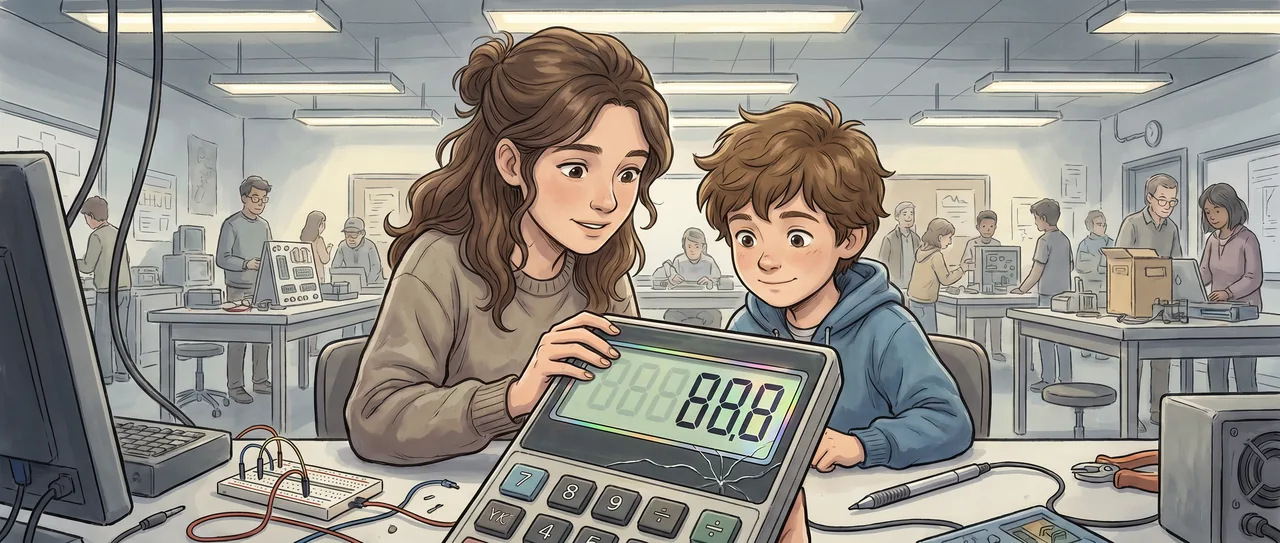
She had found the old calculator in the recycling bin at the maker fair, its solar cell cracked, its LCD face showing nothing. Soren had found a working battery pack. The plan was simple: wire the battery to the LCD, make the digits light up again, prove they could fix something nobody else had bothered to fix.
The battery was connected. The voltage was right. And nothing happened.
"It should work," Soren said. He checked his wiring a third time, tracing each connection with his fingertip. "Power is getting through. The contacts are clean."
Maya tilted the dead screen back and forth under the fluorescent lab lights. "Something moved."
"What do you mean, moved?"
"In the glass. When I tilted it. Like oil."
Soren took it from her and tilted it himself. He couldn't see anything. He tilted it again, slower. Then he saw it. Between the two thin layers of glass, there was a faint shimmer. Not a reflection. Something shifting inside.
"There's liquid in there," he said.
"In a calculator screen?"
They both looked at it. This was supposed to be electronics. Circuits and chips. There was no reason for liquid to be sealed between two pieces of glass in a calculator.
Ms. Wen was three tables away, helping someone solder a circuit board, and she was clearly losing patience with that someone. Maya walked over anyway.
"There's liquid in this LCD screen," Maya said.
"There's liquid crystal in it, yes," Ms. Wen said without looking up. "Hold this wire. No, the other one. LCD. Liquid crystal display. The name tells you."
Ms. Wen blew on the solder joint and waved Maya away.
Maya walked back to their table. "Liquid crystal," she told Soren.
"That doesn't make sense. Liquid and crystal are opposites."
"I know."
"A crystal has structure. Everything locked in place. A liquid flows. You can't be both."
"She said it's in the name. LCD. Liquid crystal display."
Soren wrote it down, then stared at what he had written. He underlined crystal and then underlined liquid and drew a line between them with a question mark over it.
Maya pressed her thumbnail against the glass of the dead screen. Right where she pressed, a dark smudge appeared, then slowly faded when she released it.
"Soren. Push on the glass."
He pressed. The dark spot bloomed under his thumb.
"That's the liquid crystal responding to pressure," Maya said. "It changes how light goes through it when you push on it."
"So it does have structure. If it were just liquid, pushing on it wouldn't change anything optical. You can't change how light passes through water by squishing it."
"But it flows. We saw it shimmer."
They sat with that for ten seconds.
"What if it's actually both," Soren said. "Not liquid or crystal. Both. At the same time."
"A thing that flows but has order."
"Like, the molecules can slide past each other, so it moves like a liquid. But they all point the same direction, so it has structure like a crystal."
Maya picked up two pencils and held them parallel, then slid one past the other while keeping them aimed the same way. "Flowing but aligned."
"So when the screen works, the electric field changes which direction they all point," Soren said. He was talking faster now. "And because they're all pointing together, they control whether light gets through or gets blocked."
Maya looked at the dead screen again. "Then why isn't ours working?"
Soren rechecked the battery. Full charge. He rechecked the wires. Solid. He pressed the glass again and watched the dark bloom appear and vanish. The molecules were in there, responsive, aligned.
"The molecules are fine," he said. "They react to pressure. So the problem isn't the liquid crystal."
"It's the electric field," Maya said. "The field isn't reaching them."
She flipped the panel over. On the back of the glass, so faint she had to hold it at an angle to the light, she could see a pattern of thin transparent lines. Some kind of coating on the inner surface of the glass.
"Those are the electrodes," she said. "Transparent conductors. They create the electric field in specific shapes. That's how you get numbers. The field only switches the crystals in the segments it needs."
Soren looked at the lines. One of them, along the bottom edge, had a visible scratch through it. A hairline break.
"There," he said.
"One broken trace and the whole segment loses its field."
"And without the field, the crystals just sit there. They don't know what shape to make."
Maya went back to Ms. Wen's table and came back with a conductive pen, the kind used to repair circuit boards. She drew a single thin line across the scratch, bridging the break. It was not a clean line. It was a slightly wobbly silver mark on the glass.
Soren connected the battery.
The screen flickered. Then the segments filled in, dark and sharp. Eight eights. Every segment active, every digit complete.
"It works," Soren said.
But Maya was still looking at the screen, tilting it again under the light. Now that it was working, she could see something she hadn't before. Each segment was not simply dark or light. At the edges of each number, where the electric field was slightly weaker, the darkness was not quite complete. There was a gradient. A slow fade from clear to opaque.
"The molecules at the edges are only partly rotated," she said. "They're between states."
"Between aligned and realigned."
"Between two kinds of order."
Soren set the screen on the table. He looked at the shimmer at the edge of each dark segment, the place where the molecules were neither fully switched nor fully unswitched but somewhere in the flowing, structured, impossible middle.
"We always learn there are three states of matter," he said. "Solid, liquid, gas. But this is something else. This is a state that's between two states. And it's not confused. It's not broken. It's a real thing with its own rules."
"Makes you wonder what other betweens there are," Maya said.
Soren opened his mouth, closed it, then picked up the calculator and tilted it so the light caught those shimmering edges, the places where the molecules were neither one thing nor the other but something the periodic table never warned him about.
Maya reached over and tilted it one more degree, and the gradient caught the fluorescent light and scattered it into a faint, unexpected rainbow that neither of them had asked for.
Read the interactive version, listen to the narration, and earn a gold star →
A science-verified short story for curious kids · Curiosity Land