The Star That Refused to Die
The star was wrong.
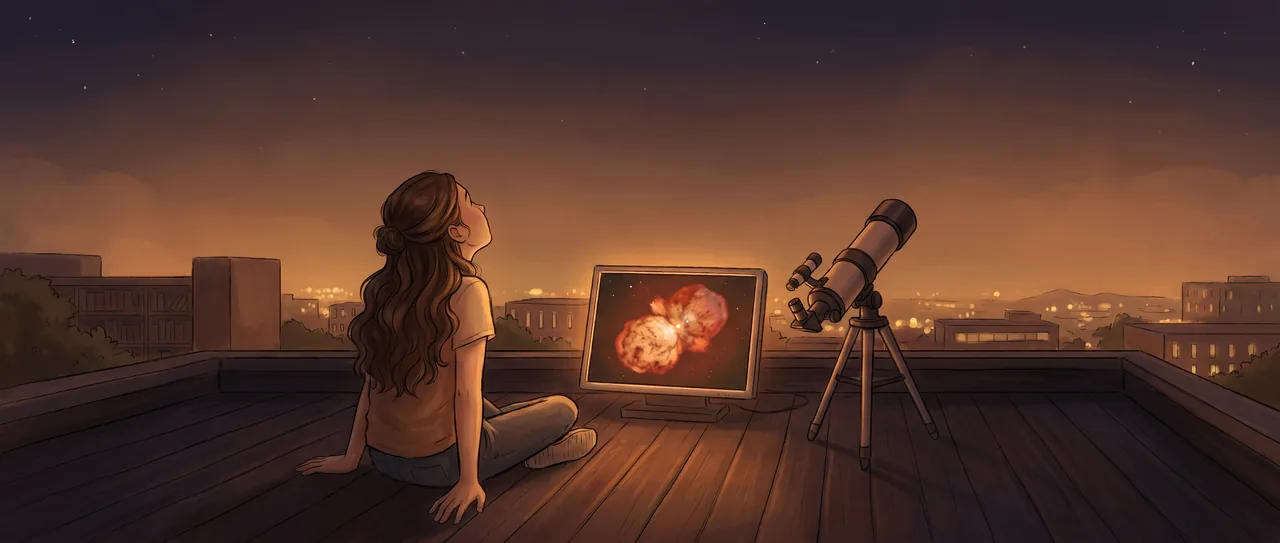
Maya had been staring at the library's rooftop screen for six minutes, waiting for the imaging software to finish stacking exposures of the Carina Nebula. Everyone else in the summer program had already gone inside for pizza. She could hear them through the stairwell door, laughing about something. But the preview frame had loaded, and something in it bothered her.
She didn't know what yet. She just knew the feeling. Like a word on the tip of her tongue, except it was a shape, or the absence of one.
The nebula itself was extraordinary. Two vast lobes of gas, like a dumbbell made of light, billowing outward from a central point. The Homunculus Nebula, the label said. And at the center, the dot that was Eta Carinae.
Mr. Bowen had talked about it during the orientation session that afternoon. He'd called it a ticking time bomb, which made two of the younger kids nervous, and then he'd spent five minutes reassuring them it was seven thousand five hundred light years away and couldn't hurt anyone. He'd moved on to Jupiter.
Maya had not moved on to Jupiter.
She pulled up the archive Mr. Bowen had shown them, the one with historical brightness records going back centuries. She found Eta Carinae and scrolled.
In eighteen forty three, the star had erupted. Not exploded. Erupted. It had thrown off somewhere around ten times the mass of the sun in a single event, and for a brief time it became the second brightest star in the entire night sky, outshone only by Sirius. Sailors in the southern hemisphere had navigated by it. Then it faded.
But it didn't die.
That was the part that had snagged in Maya's mind during the orientation, while Mr. Bowen was already pulling up slides of the Great Red Spot. A star that massive, that unstable, had partially exploded, had flung a nebula's worth of itself into space, and then just kept burning.
She looked at the twin lobes on the screen again. Those were the debris. That hourglass shape was what the eruption had left behind, still expanding outward at over a million miles per hour, even now, almost two hundred years later.
And the star sat in the middle of its own wreckage, still alive.
Maya zoomed in. The dot at the center was not one star but two, she remembered. A binary system. The larger star was roughly a hundred times the mass of the sun. Maybe more. Stars that size weren't supposed to exist for very long. They burned so furiously that they tore themselves apart. And this one had already started.
She opened a second tab and searched for the spectral data Mr. Bowen had mentioned. X-ray observations showed the two stars' stellar winds colliding, superheating gas to tens of millions of degrees. The system was a furnace inside a furnace.
The stairwell door opened. Mr. Bowen leaned out, a paper plate in his hand. "Maya. Pizza's getting cold."
"Mr. Bowen, the eighteen forty three eruption. That wasn't really an explosion, was it?"
He paused, plate halfway to his mouth. "No. Not technically. We still don't fully understand what it was. Some models say it was a merger event, that there used to be three stars and two of them combined. Other models say the outer layers just became too unstable to hold together. Honestly, the mechanism is one of the open questions."
"But it's still there."
"It's still there."
"And it's going to actually explode. For real."
"Almost certainly. As a supernova or possibly a hypernova. Could be tomorrow, could be a hundred thousand years from now. When it does, it'll be visible in broad daylight from Earth." He took a bite. "You coming in?"
"One minute."
He shrugged and let the door close.
Maya sat with it. She wasn't trying to figure anything out. There was no puzzle to solve. There was just this fact, sitting in her chest like a stone that was also somehow weightless.
Somewhere in the southern sky right now, though she couldn't see it from Tucson, a star a hundred times more massive than the sun was in the process of failing to hold itself together. It had been failing for at least two hundred years. Possibly much longer. The light reaching Earth tonight had left the star seven thousand five hundred years ago, when humans were just inventing pottery, which meant the star might have already exploded and the light just hadn't arrived yet.
The explosion might already be on its way.
A shell of light, expanding at the speed of light, crossing the galaxy right now, and nobody on Earth could know. Not with any telescope, not with any instrument. It was the kind of thing that was either happening or not happening and there was absolutely no way to tell.
She thought about the sailors in eighteen forty three. They hadn't known what they were looking at. They'd just seen a new bright star appear in the sky and used it to find south. They couldn't have known they were watching a star shed ten suns' worth of material in a tantrum that still hadn't stopped expanding.
And here was the thing that made Maya's scalp tingle, the thing she'd been circling since orientation without quite reaching it.
The eruption in eighteen forty three had made Eta Carinae the second brightest star in the sky. And that was just the partial explosion. The dress rehearsal. When the real one came, the hypernova, it would be visible in daylight. People would walk outside at noon and there would be a new star in the sky, bright enough to cast faint shadows at night, burning for weeks.
Every person alive would see it.
Every single person on the planet, no matter where they lived or what language they spoke or whether they had ever looked up at the sky before, would walk outside one ordinary morning and the sky would have changed.
Maya tried to imagine it. A world where everyone, all at once, looked up.
She couldn't quite get there. But she could feel the edge of it, the way you can feel the edge of a cliff through your shoes before you see it.
She closed the archive browser. She closed the imaging software. The screen went dark and the city lights of Tucson glowed orange against the desert air.
She tilted her head back. The sky above was washed out, pale, only the brightest stars punching through the light pollution. Somewhere beyond what she could see, beyond what anyone could see, the light was or was not already traveling.
She kept looking.
Read the interactive version, listen to the narration, and earn a gold star →
A science-verified short story for curious kids · Curiosity Land