The Spoon That Wouldn't Melt
The car had failed inspection three times.
Soren's uncle Dmitri was underneath it again, swearing in two languages, and Soren was sitting on an overturned bucket holding the flashlight at exactly the wrong angle. He knew it was the wrong angle because Dmitri kept saying so.
"Little bit left. No. Other left. Soren, are you aiming at the moon?"
"Sorry." Soren adjusted. "What's actually wrong with it?"
"Catalytic converter is shot. Emissions are through the roof. Carbon monoxide, nitrogen oxides, all the ugly stuff. The engine makes it, the converter is supposed to clean it, and this one has given up on life." Dmitri slid out on the creeper, grease on his forehead, grease on his shirt, grease in places grease should not be. "New one costs eight hundred dollars. Mrs. Padilla does not have eight hundred dollars."
Soren wrote that down. Not the price. The other part. Engine makes poison. Converter cleans it. He underlined cleans.
"How does it clean it?" he asked.
Dmitri was already back under the car. "Platinum. Palladium. Fancy metals. They do chemistry things. Hand me the fourteen millimeter."
Soren handed him the wrench and sat back down on his bucket. Chemistry things was not an answer. He pulled out his phone and looked it up, then put the phone down and opened his notebook instead because the screen was too small for the diagram he wanted to draw.
The converter was basically a honeycomb. Thousands of tiny channels coated with a thin wash of platinum and palladium. Exhaust gas flowed through the channels, touched the metal surfaces, and something happened. Carbon monoxide met oxygen and became carbon dioxide. Nitrogen oxides broke apart into plain nitrogen and oxygen. Unburned hydrocarbons combined with oxygen and became water and carbon dioxide.
Three different toxic gases. Three different reactions. All of them happening on the same surface.
And the surface was not consumed.
That was the part that made Soren put his pen down. He read it again. The platinum and palladium were not fuel. They were not ingredients. They did not get used up. They just made the reactions happen faster. Enormously faster. Reactions that would barely occur at exhaust temperatures happened almost instantly on those metal surfaces.
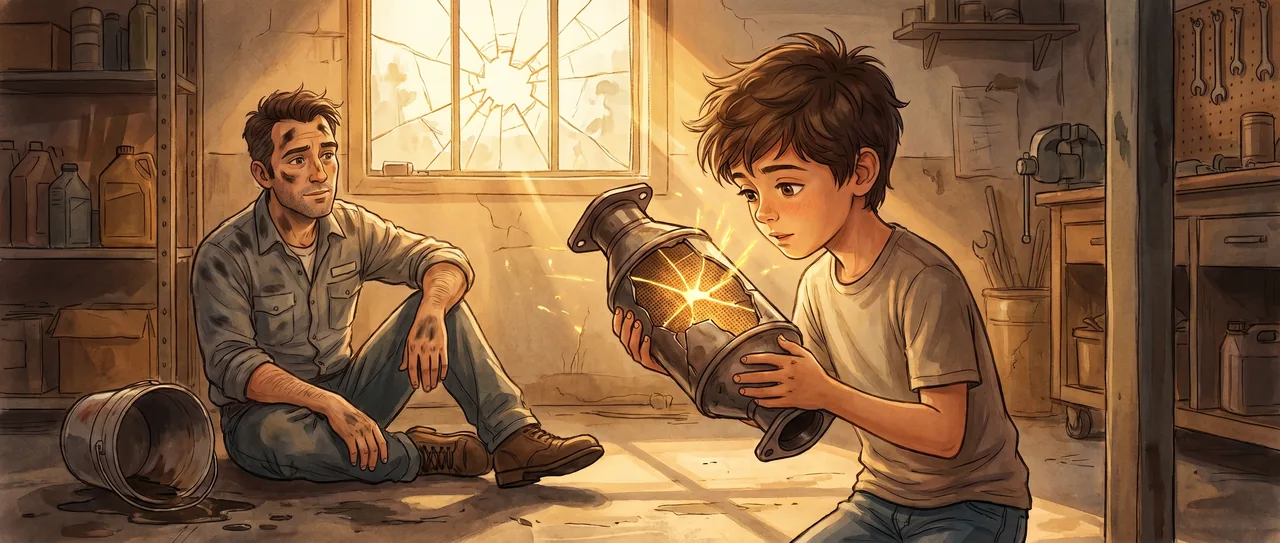
He looked at the old converter Dmitri had pulled out last week, sitting on the workbench like a piece of scrap. He picked it up. It was heavier than it looked. He shook it and something rattled inside, loose and broken.
"Uncle Dmitri, how much platinum is in one of these?"
"Three to seven grams, depending." Dmitri's voice was muffled. "That is why people steal them. The metals are worth money."
Soren stared at the converter. Three to seven grams. He tried to picture it. Less than a tablespoon of metal, spread across that honeycomb, and it was enough to transform the entire exhaust output of an engine. Thousands and thousands of hours of driving. Thousands of liters of poison turned into mostly harmless gas.
And the platinum was still there at the end. Still platinum. Still ready.
He turned the converter over in his hands. The rattling was louder. The honeycomb inside had cracked and collapsed. That was why it failed. Not because the platinum was gone, but because the structure that spread it out had broken apart. The surface area had collapsed.
"It's the shape," Soren said.
"What?" Dmitri rolled out again.
"The platinum still works. It didn't stop being a catalyst. The honeycomb broke, so the gas can't reach it anymore. It's a surface area problem, not a chemistry problem."
Dmitri wiped his hands on a rag. "Yes, that is usually what happens. The catalyst itself lasts practically forever. The substrate cracks from heat cycling, vibration. The guts fall apart."
"So if someone could rebuild the honeycomb and reuse the same platinum..."
"People try. Recycling companies extract the metals. Very difficult to re-coat evenly, though. You need the catalyst spread in a layer a few atoms thick. That is the trick. Thinner than you can see. Thinner than you can imagine."
A few atoms thick. Soren sat with that. A layer of platinum so thin it was essentially invisible, and it could force toxic molecules to rearrange themselves billions of times without losing a single atom of itself. It was like a teacher who never got tired, never lost their voice, never needed a substitute. Except it wasn't even doing the work. It was just providing a surface where the work became easy.
He opened his notebook again and tried to draw it. A molecule of carbon monoxide drifting into a channel. Landing on the platinum surface. The surface holding it in just the right position to meet an oxygen atom. The two combining. Releasing. Floating away as carbon dioxide. And the platinum sitting there, unchanged, waiting for the next one.
The same tiny patch of metal, doing this millions of times per second.
"Uncle Dmitri, does the platinum know what it's doing?"
Dmitri laughed. "It is a metal, Soren. It does not know anything."
"I mean, it doesn't choose which reaction to help. It helps all three. CO oxidation, NOx reduction, hydrocarbon oxidation. Three completely different reactions on the same surface. Why?"
Dmitri stopped laughing. He looked at Soren for a moment with an expression Soren had seen before but never on his uncle's face. It was the look people got when a question was better than they expected.
"The surface energy," Dmitri said slowly. "The electron configuration. The spacing of the atoms in the crystal lattice happens to be right for many different molecules to land and react. It is not designed. It is just... right. It is like asking why a particular rock makes a perfect skipping stone. The shape fits the water."
"But it fits three different waters," Soren said.
Dmitri opened his mouth, closed it, and sat down on the concrete floor next to Soren's bucket. "Yes. That is actually a very good way to not understand it."
They sat there for a minute, the broken converter between them.
Soren thought about the tablespoon of metal that wasn't consumed. He thought about how it worked not by burning or breaking or giving anything of itself, but by being the right shape at the right scale. A surface so thin it was almost nothing, and yet without it, every car on the road would be choking the air.
Something that did all the work by simply being present.
He picked up the old converter and held it up to the garage window, where the afternoon light came through the cracked honeycomb in broken golden lines, each fragment still faintly shining.
Read the interactive version, listen to the narration, and earn a gold star →
A science-verified short story for curious kids · Curiosity Land