The Song That Kept Playing
The rubber hand was sitting on the table between a bowl of plastic fruit and a model of a spinal column, and Soren knew immediately that something about it was wrong.
Not wrong like broken. Wrong like interesting.
"It's too clean," he said.
Maya was already past him, moving toward the row of screens showing brain scans in neon green and orange. The university's neuroscience open house was supposed to be for high schoolers, but Maya's aunt worked in the department and had let them in with lanyards that said GUEST in enormous letters, as though they might forget.
"Soren. Come look at this."
He didn't come look. He was reading the card next to the rubber hand. It described the rubber hand illusion, how your brain could be tricked into feeling sensation in a fake hand if you watched it being touched while your real hand was hidden. The card said the brain builds its map of the body from evidence, not from truth.
From evidence, not from truth. He wrote that down.
"Soren."
He went to look.
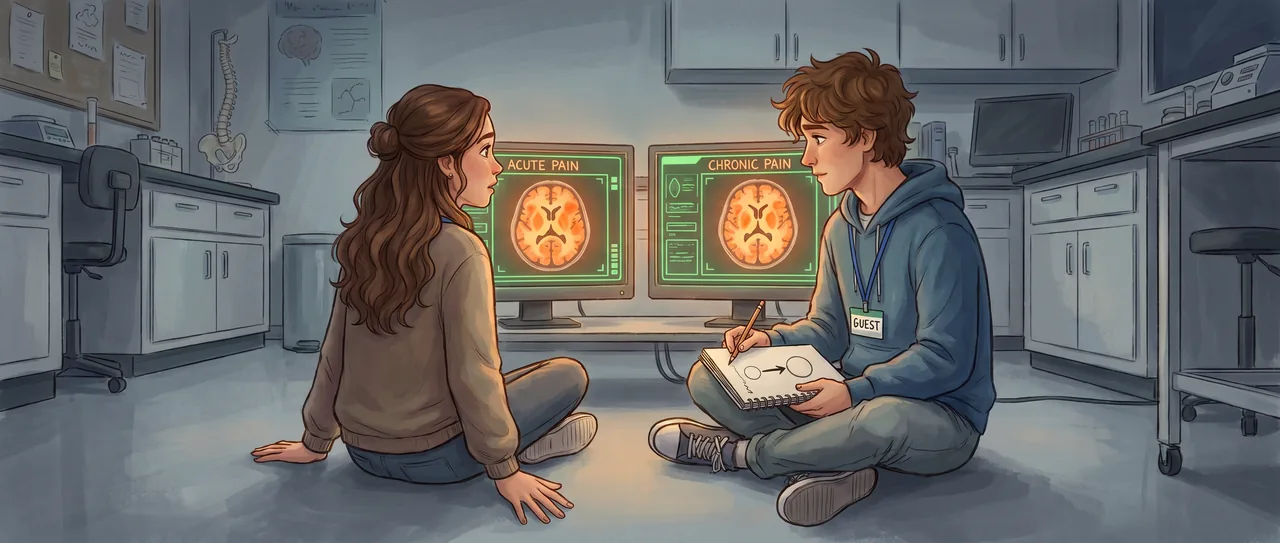
The screens showed two brain scans side by side. One was labeled ACUTE PAIN and the other CHRONIC PAIN, six months after injury healed. Both scans lit up in nearly identical patterns. Orange blooming in the same regions. The same neural signatures firing.
Maya was standing very still, which meant she had found something that did not fit.
"The injury healed," she said.
"Yeah."
"Six months ago."
"That's what it says."
"So why does the brain look the same?"
A graduate student named Tomás was supervising the display. He had dark circles under his eyes and a cold cup of coffee and the look of someone who had explained things to visitors all morning and was running on fumes. "Good question," he said, in the voice of someone who said good question to everything.
"No, but actually," Maya said. "The tissue healed. The scan is from after. Why is the pain circuit still active?"
Tomás blinked. He set down his coffee. "Okay. So. You know how if you practice piano, the piece gets easier?"
"I don't play piano," Maya said.
"Right. Okay. Anything you practice. The more you do it, the more automatic it gets. Your brain physically changes. The connections between the neurons doing that task get stronger, faster, more efficient. That's learning."
"The brain learned pain," Soren said.
Tomás pointed at him. "That. Exactly that. The pain signals ran through those circuits so many times during the actual injury that the pathway got reinforced. Strengthened. It became really, really good at producing pain. And then the injury healed, but the circuit didn't care. It had been trained."
Maya's eyes had gone narrow. "So the pain is real."
"Completely real. It's not imagined. The neurons are genuinely firing. The person genuinely hurts. It's just that the cause isn't in the body anymore. It's in the pattern."
Tomás got pulled away by a high schooler asking about the plastic fruit, which turned out to be part of a different demonstration entirely.
Maya sat down on the floor, right there in the middle of the lab. Soren sat next to her because that was what you did.
"My mom," Maya said.
Soren waited.
"She hurt her back three years ago. Lifting boxes when we moved. The doctor said it healed. The MRI said it healed. She still hurts every single day. And people keep saying." Maya stopped. "They keep saying maybe it's stress. Maybe she should relax more. Like she's making it up."
"She's not making it up."
"I know she's not making it up. I always knew. But I didn't know why I knew." Maya pressed her palms flat against the cold lab floor. "It's because the pain is doing exactly what trained neural pathways do. It's doing what practice does. Her brain got so good at the pain signal that it doesn't need the injury anymore."
Soren opened his notebook. He drew two circles and connected them with a line, then drew the line thicker, then thicker again. "Every time the signal fires, the connection gets stronger. Every time the connection is stronger, it fires more easily. Every time it fires more easily..."
"It fires more."
"It's a feedback loop."
Maya looked at him. "But feedback loops can be interrupted."
Soren looked back at the screens. The chronic pain scan. All that orange light, all those pathways burning bright with a signal they had learned too well. He thought about how learning works in both directions. How you could get rusty at a skill you stopped practicing. How pathways that stop firing together gradually weaken.
"If the brain can learn pain," he said slowly, "then the brain can learn something else instead. Over the same wires."
"Not wires."
"You know what I mean."
Maya stood up. She crossed the lab to where Tomás was explaining phantom limb sensation to a group of high schoolers and she interrupted him without hesitating.
"Is anyone studying how to retrain chronic pain circuits? Not blocking the pain. Retraining the pathway. Teaching the neurons a different pattern."
Tomás stared at her for a moment. Then he smiled, and it was the first real expression Soren had seen on his face all day.
"Graded motor imagery," he said. "Mirror therapy. There's a lab in San Diego doing work on reconceptualizing the pain signal through repeated, graduated exposure to safe movement. They're basically teaching the brain that the pathway doesn't have to fire the way it learned to. It's slow. It's hard. But the same plasticity that created the problem is the thing that can solve it."
"The same plasticity," Maya repeated.
"The brain that learned it can unlearn it. Not by pretending it isn't real. By using the same mechanism."
Maya turned to Soren. He knew that look. It was the look she got when the list of things that didn't make sense yet had just gotten one entry shorter and three entries longer.
"I need you to write down everything he just said."
"Already did."
"My mom needs to see it. Not someone telling her to relax. An actual brain scan showing her that the pain is real, and an actual explanation of why it kept going, and an actual direction that isn't just live with it."
Tomás was already pulling up a website on his phone. "Here. This research group publishes patient-facing materials. They're good. They take it seriously."
Maya took the phone and held it so Soren could see too. He copied the URL carefully into his notebook, letter by letter, then tore out the page and handed it to her.
She folded it once and put it in her pocket, pressing flat the crease with her thumbnail.
Read the interactive version, listen to the narration, and earn a gold star →
A science-verified short story for curious kids · Curiosity Land