The Slow Ones
The puck was too slow.
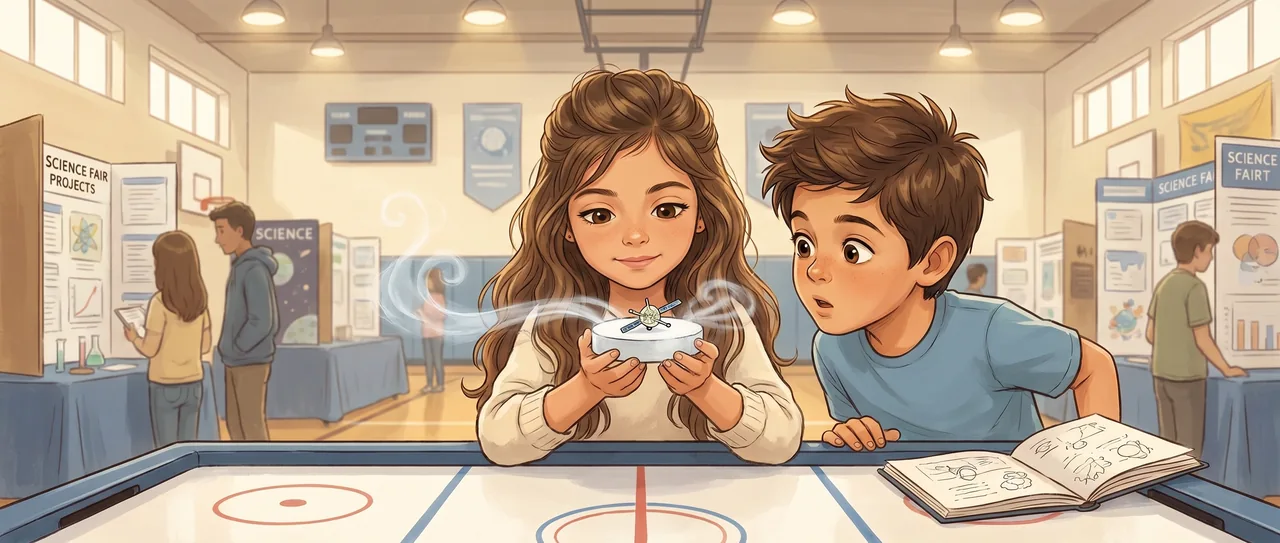
Maya ran it again. She set the flat disc of dry ice on the air hockey table, gave it a precise push toward the far end, and watched it glide across the cushion of air. Soren stood at the other end with his phone's stopwatch running.
"Two point four seconds," he said. "Same as last time."
"It should be two point one." Maya picked up the puck with her gloved hand. It was still smoking, cold vapor curling off it like a tiny ghost. "I measured the friction. I measured the push force. Two point one."
Around them, the gymnasium hummed with other science fair projects. A volcano that actually erupted with real sulfur compounds. A terrarium sealed for two hundred days. A kid who had trained a neural network to identify birdsong. All of them polished. All of them ready.
Maya and Soren's project was supposed to demonstrate frictionless motion. The air hockey table eliminated most friction. The dry ice puck, flat-bottomed and smooth, eliminated more. You pushed the puck, you timed the puck, and you showed that without friction, objects just keep going. Newton's first law, made visible.
Except the puck kept arriving late.
"Something's slowing it down," Maya said.
"That's what we're supposed to be eliminating," Soren said. He wrote the number down. Two point four. He had a full page of two point fours. "Maybe our friction estimate is wrong."
"I accounted for air resistance. I accounted for the table not being perfectly level. I even accounted for the blower vents pushing slightly sideways." Maya set the puck down and stared at it. The dry ice sublimated gently, vapor sliding off the edges. "I'm telling you, something else is happening."
Mr. Tranh, who was supervising their section, walked past with a clipboard. "Looking good, you two. Judges start at four. Make sure your title card is straight." He moved on to the birdsong project without waiting for a response.
"Let me try something," Soren said. He took the puck and turned it over. The bottom was flat and smooth. The top was not. Maya had glued a small plastic spacecraft model to it, a little Pioneer probe, because their display was about space motion. The spacecraft sat on one side of the puck, slightly off-center, because that was where it had looked best.
"What if we run it without the model on top," he said.
Maya blinked. "It weighs almost nothing."
"I know. But it's the only thing that's different from our friction calculations."
So they pried the little plastic Pioneer off. Maya pushed the bare puck. Soren timed it.
"Two point two," he said.
They looked at each other.
"Closer," Maya said. "But still not two point one."
"But closer. So the model was doing something." Soren picked up the tiny spacecraft. It weighed almost nothing. He held it between his fingers. "How does something this light slow down a puck that heavy?"
Maya took the puck back. She held it close to her face and watched the vapor. Dry ice sublimates, she knew. It goes straight from solid to gas. The gas was streaming off all sides, a continuous tiny exhaust of carbon dioxide.
But not all sides equally.
She put the plastic model back on. Glued it slightly off-center, just like before. Then she held the puck at eye level and watched.
"Look," she said.
Soren leaned in.
On the side where the plastic model sat, the vapor couldn't escape as freely. The model blocked it, deflected it, channeled it. On the opposite side, the vapor streamed away unobstructed. There was more gas pushing one way than the other.
"It's making its own thrust," Soren said slowly.
"Tiny thrust. In the wrong direction. Well, not wrong. Just, we didn't expect it." Maya's voice had gone quiet the way it did when her brain was running faster than her mouth. "The puck is pushing itself. Just a little. Against its own direction of travel."
Soren sat down on the gym floor, which he did sometimes when things were getting interesting. He opened his notebook. "So the asymmetry of the vapor, the fact that more gas escapes on one side than the other, that creates an actual force."
"A force we didn't account for. A force that is real, but so small we couldn't see it. We could only see what it did. Which was make the puck arrive late."
Soren wrote for a moment. Then he stopped. "Maya."
"Yeah."
"The Pioneer probes."
She was already nodding.
Because they had both read about it, months ago, when they chose the Pioneer spacecraft for their display model. Both Pioneer ten and Pioneer eleven, launched in the nineteen seventies, had drifted slightly slower than they should have. For decades, physicists could not figure out why. Both probes, billions of miles from Earth, decelerating by the tiniest amount. Some people thought it was new physics. Some people thought it was a gravitational effect no one had discovered. The anomaly had a name. The Pioneer anomaly.
And then, years later, a team of researchers had figured it out. The spacecraft generated heat from their onboard power sources. That heat radiated away as infrared photons. And because the spacecraft were not perfectly symmetrical, more heat radiated in one direction than the other. That tiny, tiny push, the recoil from asymmetric thermal radiation, was exactly enough to account for the anomaly.
Not new physics. Not unknown gravity. Heat, leaking unevenly, pushing back.
"Our puck is a Pioneer," Soren said.
"Our puck is a Pioneer," Maya said.
They sat there on the gym floor next to their air hockey table, surrounded by volcanoes and terrariums and birdsong, and the gymnasium seemed to expand around them because this was the thing, the real thing: that the universe does not have leftover mysteries. It has forces too small to see, hiding inside the ordinary, and they push back. They always push back. You just have to notice the discrepancy and refuse to let it go.
"We have to redo the whole project," Soren said. He did not sound unhappy about this.
"We have forty minutes before the judges come."
"Then we should start."
Maya was already peeling off their old title card. Soren opened to a fresh page and began writing the new explanation. Around them, every other project stood finished and gleaming.
Soren uncapped a marker and wrote the new title in large block letters while Maya repositioned the puck, the plastic Pioneer glued deliberately, beautifully off-center, vapor trailing from its edges like a signal no one had thought to read.
He held up the title card: THE FORCE YOU FORGOT TO COUNT.
Read the interactive version, listen to the narration, and earn a gold star →
A science-verified short story for curious kids · Curiosity Land