The Quiet Ones
The screen showed a cat.
Not a photograph of a cat. A reconstruction of what a brain thought a cat looked like, built from the firing patterns of neurons in a mouse's visual cortex. It was blurry and wrong and unmistakably a cat.
"That's horrible," Soren said.
"That's incredible," Maya said at the same time.
Dr. Liang didn't look up from her own monitor across the lab. She was running a grant deadline calculation that seemed to involve a lot of quiet swearing. "The reconstruction algorithm is on slide fourteen. You two are supposed to be labeling the response data, not poking around in the demo files."
"We finished labeling," Maya said. This was true. They had spent two hours clicking through images and tagging which neuron clusters activated for each one. Edges. Textures. Orientations. It had been repetitive and wonderful.
Soren leaned closer to the screen. The demo let you toggle individual neurons on and off and watch the reconstruction change. He turned one off. The cat lost the curve of its back. He turned on a different one. A stripe appeared that hadn't been there.
"How many neurons made this?" he asked.
"Check the activation count," Maya said, already reading it. "Twenty-three."
Soren scrolled. The mouse had thousands of neurons being recorded in this patch of visual cortex. Thousands. And only twenty-three had fired for this image.
"That seems broken," he said.
Maya shook her head slowly. "Do another image."
He loaded the next one. A set of vertical bars. The activation count read nineteen. He loaded a forest photograph. Thirty-one, which was higher, but out of thousands it was still almost nothing.
"They're all like this," Maya said. "Almost everything is silent."
Soren pulled out his notebook. He wrote: thousands of neurons, only tens active. He underlined it. Then he loaded the cat again and started turning off the twenty-three active neurons one at a time, writing down what each one contributed. Neuron four hundred and twelve added a diagonal edge in the upper left. Neuron seven hundred and nine contributed a specific texture, like short fur. Neuron one thousand and thirty-one handled a boundary between light and dark.
Each neuron had a job. A small, specific, strange job.
"Dr. Liang," Maya said. "Is it supposed to be this few?"
Dr. Liang was still focused on her grant but answered automatically. "Sparse coding. The visual cortex uses maybe one to four percent of available neurons for any given scene. It's been known since the nineties. Slide twenty-two has the Olshausen and Field paper."
Then she went back to swearing at her budget.
Maya was quiet for a moment. Soren knew that kind of quiet.
"One to four percent," she said. "So right now, while I'm looking at you, ninety-six percent of my visual neurons are doing nothing."
"Apparently."
"But I can see you perfectly."
Soren looked at his list of what each neuron did. Each one encoded a tiny feature. An angle. A frequency of light-dark pattern. A specific kind of edge. By themselves, they were almost meaningless. Twenty-three of them together, out of thousands, and you got a cat.
"It's like letters," he said.
"What do you mean?"
"Twenty-six letters. Thousands and thousands of words. But each word only uses a few of them." He stared at his notebook. "If every neuron fired for every image, you'd need a different neuron for every possible thing you could ever see. But this way, you just need combinations. A few at a time."
Maya grabbed the mouse. She loaded the demo's other feature, the one Dr. Liang definitely hadn't told them to open. It was a simulated neural network. Not a real brain. An artificial one, trained on thousands of natural images. The interface let you set a constraint: how sparse the network had to be. How few of its units could activate for any given image.
"Watch this," Maya said. She set the sparsity low, meaning lots of units could fire at once. The network trained. When it finished, its learned features were a mess. Blotchy. Random-looking. No structure.
Then she cranked the sparsity up. Forced the network to use only a few units at a time, the way the real visual cortex did.
The network trained again.
Soren watched the features appear. His hand stopped over his notebook.
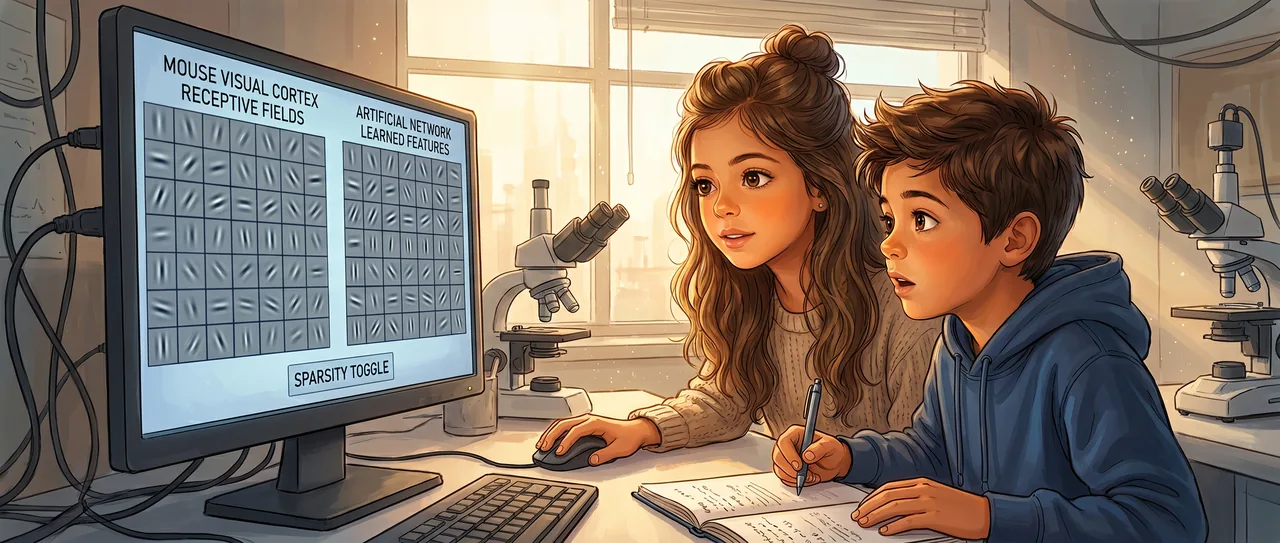
The artificial neurons had organized themselves into edge detectors. Oriented lines. Small gabor-like patterns at every angle. They looked exactly like the receptive fields from the mouse data they had been labeling all morning.
"Nobody told it to do that," Maya said.
"Nobody told it to do that," Soren repeated, and the repetition was not agreement. It was the sound of something landing.
The only instruction was: be quiet. Use as few neurons as possible. And from that single constraint, the network had invented the same solution that evolution had found in actual living brains. Not a similar solution. The same shapes. The same angles. The same features.
"Dr. Liang," Soren said. "Did the network know anything about biology?"
"Nothing. It just minimized an efficiency function with a sparsity penalty. No biological data at all." She looked up from her screen for the first time in twenty minutes. "That's the remarkable part, by the way. Not the reconstruction. The convergence. Two completely different systems, one biological, one mathematical, arrive at the same answer when you force them to be efficient with a sparse code."
Then her email pinged and she turned away again.
Maya and Soren sat with it.
"There might only be one way to do it," Maya said. "One way to efficiently see. And anything that has to see efficiently, whether it grew or was built, finds that way."
Soren looked at the two sets of features side by side on the screen. Mouse brain on the left. Artificial network on the right. The same oriented edges. The same spatial frequencies. Discovered three and a half billion years apart, the biological one by evolution, the mathematical one by a laptop in a university lab.
"If someone on another planet evolved eyes," he said, and stopped.
"Their visual cortex would look like this too," Maya finished.
The lab was quiet. Dr. Liang's keyboard clicked. The building's heating system hummed. On the screen, two sets of features that had never met stared out at them like reflections in a mirror that connected things that should not have been connected.
Soren picked up his pen. Then he put it down. The inside of his head did not feel too small right now. It felt the right size, just barely, for the first time all day.
Maya reached over and toggled the sparsity constraint off.
The features dissolved into noise.
She toggled it back on, and the edges returned, angled and sharp and inevitable, like something the universe had always been trying to say.
Read the interactive version, listen to the narration, and earn a gold star →
A science-verified short story for curious kids · Curiosity Land