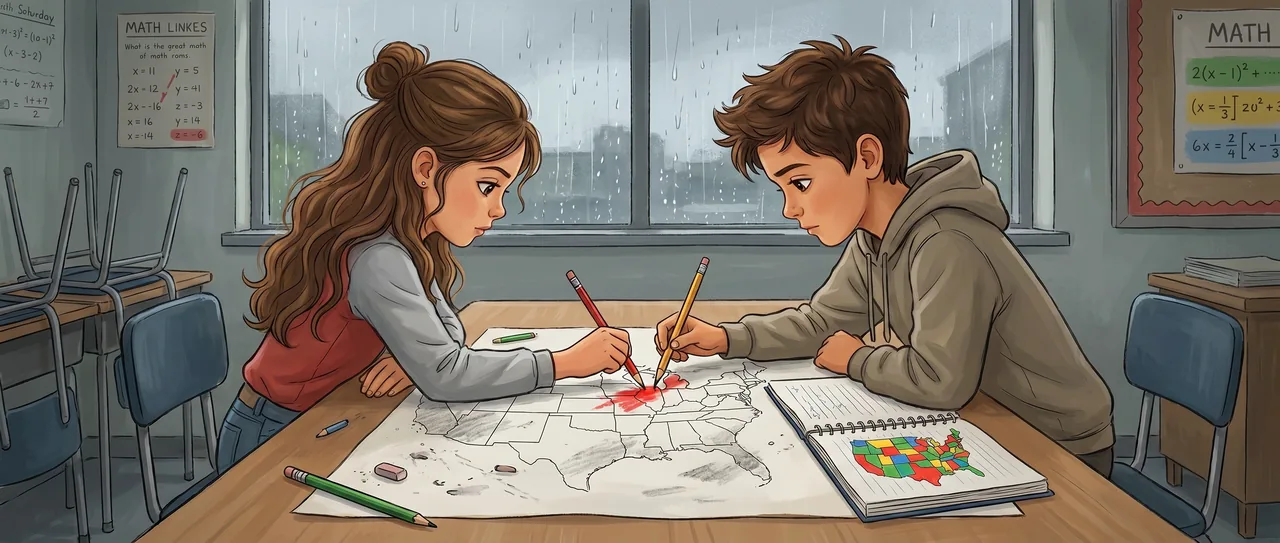
The Map That Couldn't Be Wrong
The proctor slid the final challenge across the table and Maya felt her stomach drop. Not because it was hard. Because it was wrong.
The sheet showed a map. Not a real one. A made-up tangle of regions, maybe forty of them, all interlocking in ways that looked almost biological, like cells under a microscope. The instructions read: Color this map using the fewest colors possible so that no two regions sharing a border have the same color. State the minimum number required.
Every other team in the room was already reaching for colored pencils. Maya could hear them clicking open their cases. She could hear Priya's team arguing about whether to start with five or six.
Soren was staring at the map.
"Four," Maya said.
"Four," Soren said at the same time.
They looked at each other.
"It's always four," Maya said. "For any map. It's been proven."
"So the question isn't really a question," Soren said. He picked up a blue pencil, then set it down again. "The answer is four. But we still have to actually do it."
That was the problem. Knowing the answer was four and actually finding a way to color forty tangled regions with only four colors were two completely different things. Maya grabbed red and started on the outer ring. Soren took green and started on the dense cluster in the center.
Three minutes in, they collided. Maya's red region touched Soren's red region.
"Back up," Soren said. He erased his center section. "If I make this one blue instead, then the three around it can be red, green, yellow. But then this one over here is stuck because it touches all four."
"It can't touch all four. That's the whole point. Four is always enough."
"I know four is always enough. But I can't find it."
Maya sat back. The map stared up at them, half-colored, half-erased, smudged with pencil dust. Around the room she could hear teams calling out numbers. Five. Six. One team said seven.
"They're all wrong," she muttered.
"They're getting answers that work," Soren said carefully. "Seven colors will definitely work. Six will too. They're just not minimum."
"Four is minimum. We know that."
"We know that because a computer checked every possible type of map in nineteen seventy-seven. One thousand nine hundred and thirty-six configurations. No human checked them all by hand."
Maya looked at him. "You looked this up."
"I looked it up last month when Mr. Haddad mentioned it. The thing is, Maya, two mathematicians named Appel and Haken wrote a program that checked all the cases. And then they said it was proven. And a lot of other mathematicians said that doesn't count."
"Doesn't count how? If every case checks out, it checks out."
"Because no human being can read the proof. Not all of it. The computer did thousands of hours of calculations. You'd have to trust the machine."
Maya picked up the yellow pencil and turned it in her fingers. "We trust calculators."
"We trust calculators because we can check any single calculation by hand if we want to. This proof, you can't. Not in a lifetime. It would take too long."
The proctor announced five minutes remaining.
Maya looked at their smudged, half-broken map. She looked at the teams around them confidently shading with six, seven colors. Wrong answers that worked. Then she looked at their right answer that they couldn't make work.
"We know it's four," she said slowly. "We can't prove it's four. Not on this map, not in five minutes, not by hand."
"Right."
"And the mathematicians knew it was four. And they couldn't prove it either. Not without the computer."
Soren nodded.
"So we're in the same position they were in. Except we don't have a computer."
Soren opened his notebook, which he always brought even to competitions where nobody needed one. He had already sketched a smaller version of the map, about fifteen regions. He had colored it perfectly in four colors.
"I can do small sections," he said. "I just can't hold all forty regions in my head at once. When I fix one area, I break another."
"That's why they needed the computer. Not because the math was hard. Because there was too much of it."
The room hummed with pencils. Two minutes.
Maya made a decision. She wrote on their answer sheet: The minimum is four colors (by the four color theorem, proven 1976). We were unable to construct the coloring by hand in the time given.
Soren read it. Then he added, in his careful handwriting: The original proof also could not be done by hand. It required a computer checking 1,936 configurations.
The proctor collected the sheets. When he reached their table, he paused, reading. He was a college student, maybe nineteen, with a faded math olympiad pin on his lanyard.
"You know the other teams actually colored their maps," he said.
"With too many colors," Maya said.
"You're claiming four but you didn't demonstrate four."
"Neither did Appel and Haken," Soren said. "Not by hand."
The proctor's mouth opened, then closed. He looked at their answer sheet again. He looked at Soren's notebook, open to the small map perfectly colored in four. He collected the sheet without another word.
They did not win the competition. The team that used six colors on a clean, confident map took first place. The judges said a complete solution was required. Maya and Soren got an honorable mention and a note from one of the judges, a professor, that read: Your answer was correct. The question was flawed. Come see me if you want to talk about it.
On the bus home, Soren was quiet for a long time. Rain streaked the windows.
"The thing that gets me," he finally said, "is that the proof exists. It's real. It's verified. But no single human being has ever understood all of it at once. The computer understood it, if a computer can understand anything. But no person has ever held the whole proof in their head."
"So there's a true thing," Maya said, "that we know is true, that nobody has ever fully thought."
"Not a person. Not all at once. Not yet."
The bus turned onto the highway. Rain kept falling. Maya pressed her forehead against the cold window and watched the headlights of other cars blur into streaks of white and red, four colors splitting the dark.
Read the interactive version, listen to the narration, and earn a gold star →
A science-verified short story for curious kids · Curiosity Land