The Seventy-Second Decimal
Soren typed the number in wrong.
That was the whole problem, and also, eventually, the whole point.
The university weather lab had been opened for Family Science Weekend, and most of the other kids had already migrated to the robotics room down the hall, where you could drive a little tank over an obstacle course. Soren had stayed. The sign on the door said PREDICT THE FUTURE, and underneath, in smaller letters, How Hard Can It Be?
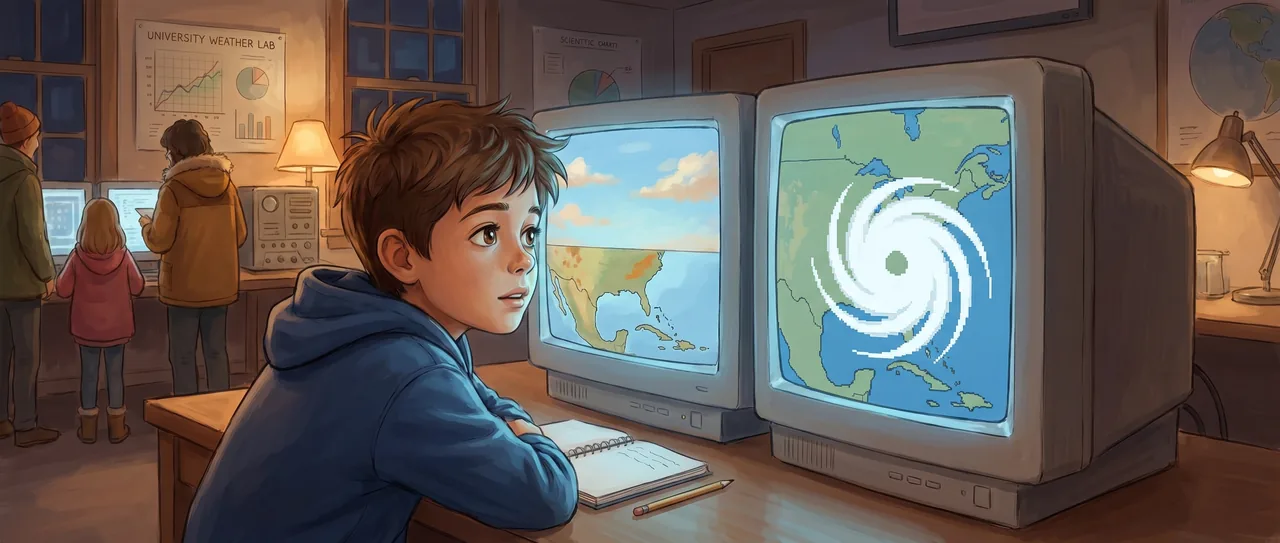
Professor Marsh had set up two computers side by side, both running the same atmospheric simulation. Same code. Same equations. Same starting conditions. Two identical Earths, she called them. She had explained the basics to the group before they scattered, speaking quickly, clearly annoyed that most of the kids were already eyeing the door. Wind speed, pressure, temperature, humidity, all fed into the same set of equations, run forward in time. The simulation wasn't real weather, she said. It was a toy. But the equations were the real ones.
Then she'd been pulled away by a phone call and hadn't come back.
Soren sat in front of the two screens. Both showed the same swirl of blue and white, a fake continent with fake oceans, clouds forming and dissolving. They looked identical. They were supposed to be identical. He pressed the RUN button on both at the same time, and they marched forward together, day by simulated day, perfectly in sync.
He stopped them. Reset them. Ran them again. Still identical. Of course they were. Same inputs, same math, same outputs. He wrote in his notebook: Two identical runs. Same result. Obviously.
Then he noticed the input field.
The starting temperature for grid point one was set to 14.850000000000000 degrees, out to fifteen decimal places. He could edit it. There was a cursor blinking in the field.
On the left computer, he left it alone. On the right computer, he tried to retype the same number and missed. His finger hit a six instead of a five at the very end. So the right computer read 14.850000000000006 degrees.
Six millionths of a millionths of a millionths of a degree. He almost fixed it.
But he wanted to see.
He pressed RUN on both.
For the first thirty simulated days, the two Earths were twins. Same clouds. Same pressure systems drifting east. Soren leaned close to the screens, looking for any difference at all, and there was nothing. He wrote: Day thirty. Still identical. Maybe the difference is too small to matter.
Day forty. He saw it. A tiny curl of cloud on the right screen, just south of the fake continent, that wasn't on the left screen. He sat up straighter.
Day fifty. The curl had become a storm. On the left screen, that patch of ocean was calm.
Day sixty. The storm on the right screen was enormous, a swirling white disc that looked like it wanted to eat the continent. On the left screen, nothing. Clear skies. Two different worlds.
Soren stopped both simulations. He stared.
He reset them. Changed the last digit to a five instead of a six. Ran them. Identical again, all the way out. He changed the last digit to a seven. By day fifty-five, a blizzard appeared in the northern hemisphere of the right screen that didn't exist on the left one.
He went smaller. He found he could type more decimal places than the field displayed. He added a one at the seventy-second decimal place. A difference so small it didn't have a name he knew. He ran both simulations.
By day ninety, the left Earth had a mild autumn over its continent. The right Earth had a hurricane.
Soren put his pencil down and didn't write anything for a while.
Professor Marsh came back, coffee in hand, looking distracted. She glanced at his screens.
"Playing with the initial conditions?"
"I changed one number," Soren said. "At the seventy-second decimal place."
"And?"
"And everything is different." He pointed at the two screens. "Is the simulation broken?"
Professor Marsh set her coffee down and actually looked. She pulled over a chair and sat. "No. It's doing exactly what it should do. The equations are nonlinear. Small differences don't stay small. They grow exponentially."
"But seventy-two decimal places," Soren said. "That's nothing. That's less than nothing."
"It's not nothing. It's a very, very small something. And that very small something, in this system, eventually becomes everything."
Soren looked at the left screen's mild autumn. The right screen's hurricane. "So to predict the weather perfectly, you'd need to know the starting conditions perfectly. Every decimal place."
"Every single one. Infinitely many of them. Which means?"
"You can't," Soren said. "You'd need infinite information."
Professor Marsh didn't say anything. She just watched him.
"It's not that we're bad at predicting," he said slowly. "It's not that we need better computers or better measurements. It's that it's actually impossible. The math itself says so."
"Edward Lorenz found this in 1961," she said. "He rounded a number from six decimal places to three, reran his weather model, and got a completely different result. He spent the rest of his life figuring out what that meant."
"What did it mean?"
"Exactly what you just said. There are systems where long-term prediction is fundamentally impossible. Not difficult. Impossible. And the weather is one of them. And most of the interesting things in the universe are, too."
Soren looked at the two screens again. Somewhere between the seventy-first and seventy-second decimal place, a hurricane was hiding. Not because anyone put it there. Because the equations said that no measurement could ever be precise enough to find it in advance.
He thought about the real atmosphere outside, the actual air pressing against the windows of the lab. Every cubic centimeter of it full of molecules bouncing in ways that could never be measured to infinite precision. Every gust of wind carrying the seeds of weather that no one would ever predict.
Not because the science wasn't good enough. Because the universe was built this way. Unpredictable at its root, not from ignorance, but from mathematics.
He didn't know if that was wonderful or terrifying. He thought maybe it was both.
Professor Marsh had already turned back to her own work. Soren reached over to the right-hand computer and deleted the one from the seventy-second decimal place.
He watched the hurricane vanish, and the calm autumn spread across the screen like it had always been there.
Read the interactive version, listen to the narration, and earn a gold star →
A science-verified short story for curious kids · Curiosity Land