The Reason You Don't Fall Through the Floor
Soren's sister Krista had been practicing the demonstration all week. She had index cards. She had a laser pointer. She had a bowl of marbles and a muffin tin, which she said would make everything clear.
The community college lab smelled like dry-erase markers and old coffee. About fifteen people sat in folding chairs, mostly parents of Krista's classmates, a few younger siblings drawing on their phones. Soren sat in the back row with his notebook open, not because anyone asked him to, but because he'd learned that if he didn't write things down when they were fresh, the interesting parts dissolved.
Krista clicked to her first slide. Atoms, she said, are mostly empty space.
Soren wrote that down. He'd heard it before. The nucleus was tiny compared to the electron cloud, like a fly in a cathedral, or a marble in a football stadium, depending on which book you read. He had always accepted it.
But today, for the first time, sitting in a folding chair that was absolutely holding him up, he felt the problem.
If atoms were mostly empty space, and he was made of atoms, and the chair was made of atoms, then he was mostly nothing sitting on mostly nothing. He pressed his hand flat against the seat. Solid. Completely solid. He pressed harder. Nothing gave.
Why not?
Krista was already past that part. She was talking about electron shells now, dropping marbles into the muffin tin. One marble per cup, she said, then you start the next row. She was explaining the periodic table. Hydrogen had one electron. Helium had two and that filled the first shell. Lithium started a new one.
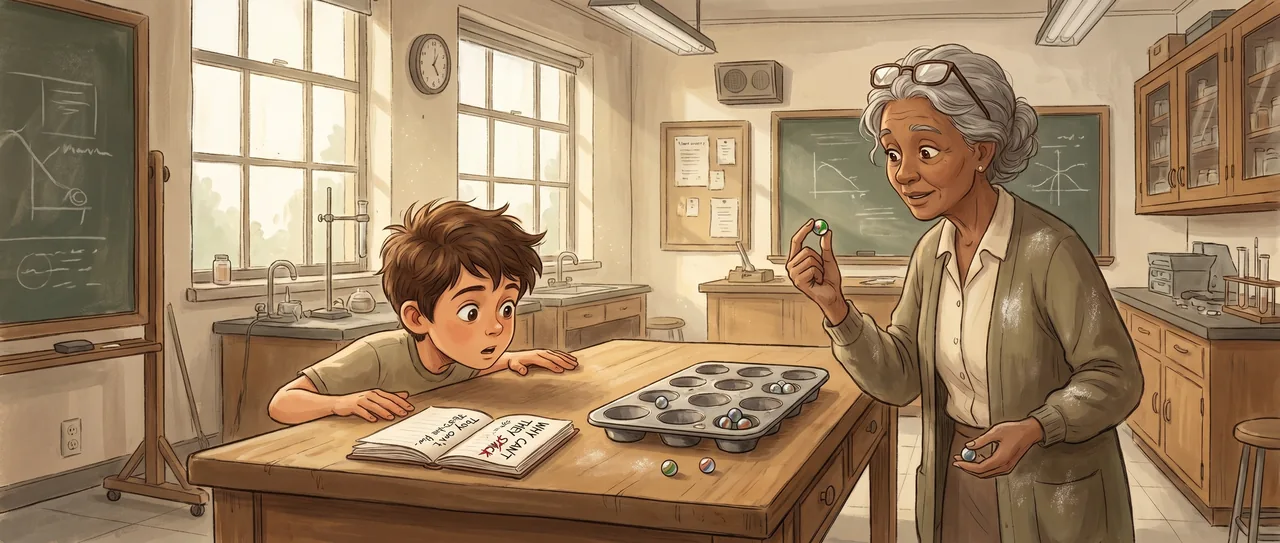
Soren stared at the muffin tin. One marble per cup. But why? Marbles were round. You could stack marbles. You could put six in one cup if you were patient. Why couldn't electrons do that?
He wrote in his notebook: WHY CAN'T THEY STACK?
Krista didn't say. She moved on to something about noble gases being stable because their shells were full, and Soren was stuck three slides back, pressing his hand against the chair.
Afterward, while Krista was talking to her professor, Soren walked up to the muffin tin on the demonstration table. He picked up two marbles and put them in the same cup. They fit fine. He put in a third. Also fine.
The model was wrong. Or rather, the model was leaving out the most important part. The reason it was one-per-cup wasn't because of shape or size. It was a rule. Something was stopping them.
Krista's professor was a short woman with reading glasses pushed up on her head and chalk dust on her sleeve from a different class. She was already packing up. Soren waited until Krista paused for breath, then asked.
Why can't two electrons be in the same state?
The professor looked at him. Not in the way adults look at children asking questions, like they're deciding how much to simplify. More like she was deciding whether to say something she found painful.
Because they can't, she said. It's not a consequence of something else. It's not caused by a force. It's a property of the kind of particle they are. Fermions. Electrons, protons, neutrons. The math simply does not allow two of them to have the same quantum numbers in the same system. If you try to write the equation for two identical fermions in the same state, the answer is zero. The probability vanishes. It doesn't happen.
Soren waited for the rest of the explanation.
There isn't a deeper why, she said. At least not one we have. That's the bottom of that particular hole.
She said it the way you'd describe a cliff you'd once walked to the edge of.
Soren looked at the marbles again. So the muffin tin is wrong, he said. It's not that the cups are too small. It's that reality won't allow it.
The professor almost smiled. The muffin tin is a terrible analogy, she said. Don't tell your sister I said that.
Krista, who had been listening, said, I can hear you, Dr. Achebe.
Dr. Achebe picked up one of the marbles and held it between her thumb and finger. This, she said. This marble is sitting on this table. Your shoes are sitting on this floor. You think that's because solid things stop other solid things. But the atoms in this marble and the atoms in this table are not actually touching. They can't. What's happening is that the electrons in the table refuse to be in the same state as the electrons in the marble. They push back. Not because of electric charge, or not only that. Because the universe does not permit identical fermions to overlap. That resistance is what you feel when you feel solid.
Soren pressed his palm flat on the table. The table pushed back.
Not because of anything mechanical. Not because of tiny balls packed tight. Because of a rule written so deep into the structure of reality that even the equations returned zero rather than break it.
He thought about white dwarf stars, which he'd read about once. Collapsed stars that should keep collapsing but didn't. He'd never understood what stopped them. He asked.
Same thing, Dr. Achebe said. Electron degeneracy pressure. The electrons refuse to be pushed into the same quantum state. So the star holds. Against gravity. Against the weight of its own death. She paused. Until it can't, she added, and then something else happens. But that's a different Saturday.
She picked up her bag. Soren stood at the table.
The periodic table wasn't an invention. It was a consequence. Shells filling one state at a time, electrons forbidden from doubling up, every element's chemistry determined by this single refusal at the bottom of physics. Hydrogen. Carbon. Iron. Oxygen. Every atom in his body obeying a rule that had no why beneath it.
He opened his notebook. He crossed out WHY CAN'T THEY STACK and underneath wrote: They can't. That's the floor. The actual floor.
Then he closed the notebook, because that wasn't where the thought ended. It was where it started.
He pressed both hands against the table one more time, feeling the thing that was not a force and not a wall and not a surface, the thing that was a prohibition, the universe's own refusal, holding him up from the nothing beneath.
Read the interactive version, listen to the narration, and earn a gold star →
A science-verified short story for curious kids · Curiosity Land