The Ninety-Nine Percent
The kidney did not look like a kidney.
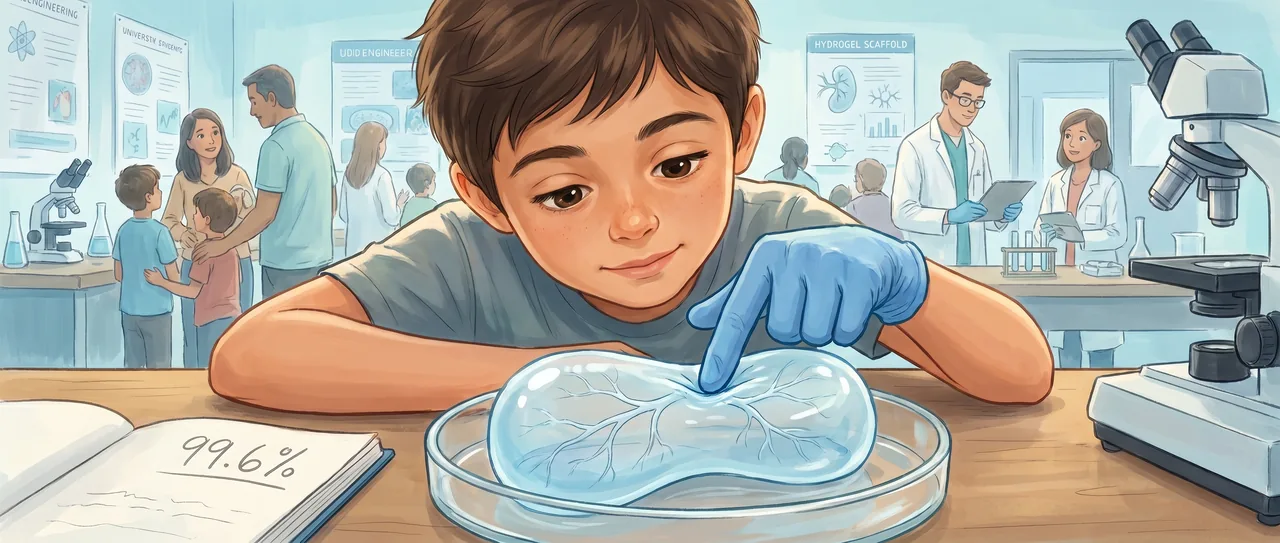
Soren stood in front of it for a long time while other visitors drifted past toward the table with the robotic hand. The thing in the glass dish was translucent, slightly bluish, about the size of his fist. It wobbled when someone walked too close and vibrated the table. A printed card beside it read: HYDROGEL SCAFFOLD, KIDNEY MODEL, DR. VASQUEZ LAB.
It looked like a jellyfish that had decided to be an organ.
He leaned closer. Inside the wobbling shape he could see structures, channels, a faint branching pattern like winter trees. Someone had built an architecture in there. Not solid architecture. More like a suggestion of architecture.
"It is mostly water," said the graduate student behind the table, not looking up from her phone. Her name tag said PRIYA. "Ninety-nine point six percent water."
Soren opened his notebook. He wrote that number down and then stared at it. Then he wrote: How is that a thing? How does something that is 99.6% water hold a shape?
"You can touch it," Priya said. "Use the gloves."
He pulled on a nitrile glove and pressed one finger gently against the surface. It gave. It was cool and slippery and it yielded like, well, like water would yield if water could push back. He pressed harder. The hydrogel compressed, then slowly recovered when he pulled his finger away.
"What is the other point four percent?" he asked.
Priya locked her phone and looked at him for the first time. "Polymer chains. Long molecules cross-linked into a network. Think of it like a net made of thread, and the holes in the net are filled with water."
"But a net with holes that big would collapse."
"That is actually a really good point." Priya pulled over a stool and sat down. "It does not collapse because the polymer chains are hydrophilic. They want to hold onto water. Every chain grabs water molecules and swells, and the cross-links between chains keep the whole thing from dissolving. So the water is trapped, but the water is also what gives it structure. Take the water out, you get a crumbly little flake of nothing. Put the water back in, it swells right back up."
Soren wrote: The water is not just filling space. The water IS the material.
He touched the scaffold again. Ninety-nine point six percent. He tried to think about what that meant. If this thing weighed a hundred grams, less than half a gram was not water. Everything else, all that wobbling solid shape, was water molecules held in place by the thinnest possible web of polymer.
It was like building a skyscraper out of air and four bricks.
"So when you grow an organ," he said slowly, "the cells go where?"
"Onto and into the scaffold. The cells attach to the polymer network and multiply. The hydrogel gives them the right shape to grow into. Eventually, if everything works, the cells replace the scaffold with real tissue. Real extracellular matrix. Real organ."
"The scaffold disappears?"
"It is designed to. Slowly. The polymer degrades as the cells take over. The water just becomes part of the body because, I mean, we are mostly water too."
Soren stopped writing. He looked at the kidney-shaped thing in the dish, and then at his own hand, and something shifted.
Because he already knew the fact that human bodies were mostly water. Sixty percent, roughly. Everyone knew that. It was the kind of fact that sat flat in your brain and did nothing.
But now he was looking at a shape that was ninety-nine point six percent water and holding itself together through nothing but the geometry of long molecules reaching for each other across tiny gaps. And his own hand was sixty percent water, held together by its own scaffolds of collagen and mineral and protein, and those scaffolds were themselves mostly water too, all the way down, every cell a water balloon with a purpose.
He was not that different from the thing in the dish. He was just further along.
"Has it ever worked?" he asked. "Has anyone actually grown a whole organ?"
Priya tilted her hand back and forth. "Bladders, yes. Skin, yes. Tracheas. Simple structures. A kidney is harder because kidneys filter blood, and that means you need working vasculature, millions of nephrons, a whole plumbing system. We can print the scaffold with the channels in the right places. We are not yet sure the cells will organize themselves correctly once they start growing."
"Why not?"
"Because cells make their own decisions. You give them a scaffold and nutrients and signals, and mostly they do what they are supposed to do, but sometimes they don't. Sometimes they grow in the wrong direction or they don't form connections or they just stop. We do not fully understand why."
She said it without apology. She said it like someone who found the not-knowing interesting rather than embarrassing.
Soren looked at his notebook. He had written two pages and none of it was for school. He looked at the scaffold again. The channels inside it branched and branched, a whole river delta waiting for blood that did not exist yet, for cells that had not been born, for a person who might be sick right now and waiting for a kidney that could come from water and geometry and patience.
"Can I ask a weird question?" he said.
"Those are the best kind."
"If the scaffold is ninety-nine point six percent water, and the body it goes into is sixty percent water, then at what point does the scaffold stop being a separate thing? When does it become the person?"
Priya was quiet for a moment.
"I do not think anyone has figured out how to draw that line," she said. "I am not sure there is one."
The robotic hand table erupted in applause behind them. Someone had gotten it to wave. Soren barely heard it. He was still looking at the scaffold, at the architecture of almost nothing, at the blueprint drawn in water for something that did not exist yet but could.
He pressed his palm flat against the outside of the glass dish and held it there, feeling the coolness, until his own warmth started to transfer through.
Read the interactive version, listen to the narration, and earn a gold star →
A science-verified short story for curious kids · Curiosity Land