The Map That Moved
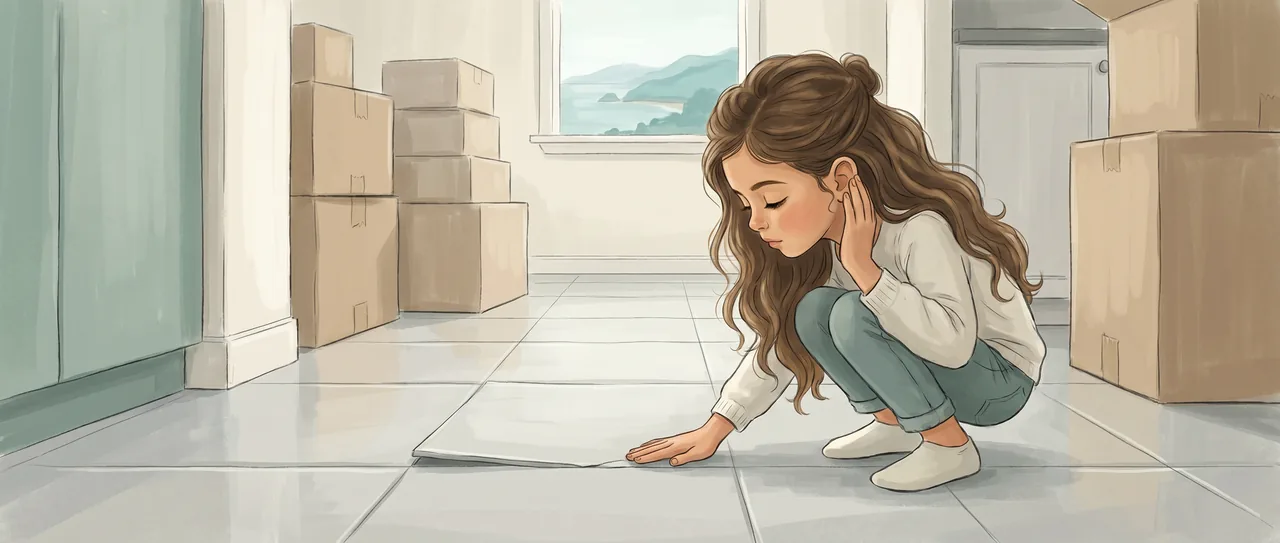
The moving boxes were still stacked in the hallway when Maya found the crack in the kitchen floor.
It was thin, barely a pencil line, running from under the refrigerator to the back wall. She put her finger on it. Traced it. The tile on one side sat maybe a millimeter higher than the tile on the other side.
Her mother was on a video call in the living room, voice bright and professional, pretending they hadn't just driven two thousand miles from Ohio. Maya ate her cereal standing up, looking at the crack, and then she looked at the clock and left for her first day at her new school.
Mr. Bowen taught earth science with the enthusiasm of someone who had been teaching earth science for thirty years and still thought it was incredible. He had pulled down the big wall map, the one showing the ocean floor in blues and greens, and was pointing at a long curved line off the coast of Washington and Oregon.
"The Juan de Fuca plate," he said, almost reverently. "Right there. It's diving under us. Right now. As we sit here."
A boy in the front row asked how fast.
"About four centimeters a year. Roughly the speed your fingernails grow."
The class made the sounds a class makes when something is interesting but not interesting enough to overcome a Monday morning. Maya stared at the map. The ocean floor was not flat. That was the first thing. It had a ridge out in the middle of the Pacific where new rock was being born, hot and fresh, spreading outward, and then, at the edges, it was being swallowed. Pulled under. The blue got darker near the coast where the trenches were, like drains in a bathtub.
She raised her hand. "Where does it go?"
Mr. Bowen looked at her. "Good question. New student, right? Maya?"
"Where does the floor go after it dives under?"
"Down into the mantle. Hundreds of kilometers. It gets heated, compressed, eventually recycled."
"So the ocean floor we're sitting above right now is different from the ocean floor that was here before."
"Entirely different. The oldest ocean floor on Earth is only about two hundred million years old. The continents are billions of years old. The oceans keep being remade."
Maya's hand was still up, but she wasn't waiting for permission anymore. "So the rock under the Pacific right now, near Hawaii or whatever, it hasn't arrived here yet."
"Not yet." Mr. Bowen smiled at her. Not the patient smile. The surprised one. "It's on its way, though."
"How long?"
"Depends on where it is. Could be a hundred million years before it reaches the trench. Then it takes the dive."
The boy in the front row whispered something to his neighbor. Maya didn't notice.
After school she walked home along the coastal road. The Olympic Mountains were out to the west, which still felt wrong. Mountains were supposed to be to the east. In Ohio, everything tilted gently toward the Mississippi and you could feel the center of the continent pulling at you like a slow drain. Here the edge of the continent was right there. She could almost see it.
She couldn't, of course. The actual edge, the place where the Juan de Fuca plate was grinding under the North American plate, was offshore, hidden beneath the Pacific. But the mountains in front of her existed because of it. The volcanoes behind her, Mount Rainier and its siblings, existed because of it. The whole landscape was a consequence of one plate eating another.
She stopped walking.
The crack in the kitchen floor.
She turned it over in her head. A crack in a floor could be anything. The house settling. Bad construction. Freeze-thaw cycles. But the tile on one side was higher than the tile on the other side, and she lived on a continental plate that was being compressed from the west by an ocean plate that was trying to get underneath it, and the last time the whole locked section of that boundary had slipped, it produced one of the most powerful earthquakes in North American history, a magnitude nine, in January of seventeen hundred. She'd read that on the drive out. Three hundred and twenty-four years ago.
A crack in the floor was almost certainly just a crack in the floor.
But the ground here was not the same as the ground in Ohio. The ground here was locked in a slow wrestling match with the bottom of the ocean, and it had been losing for millions of years in the most productive way possible, because every time the ocean floor dove under, it dragged water and minerals down with it, and the heat and pressure melted parts of it, and that melt rose, and volcanoes were born, and new land was built from the corpse of old ocean.
The ocean floor was not permanent. It was a conveyor belt. It was born at the ridges, it traveled, it arrived at the trenches, and it went down. Everything she had ever seen on a map of the ocean was temporary. The continents floated on top like passengers on an escalator that kept rebuilding itself.
She thought about the rock at the mid-ocean ridge right now, still glowing, just barely solid, beginning its long trip toward the coast. It wouldn't arrive for a hundred million years. When it got here, it would be cold and dense and heavy enough to sink. And it would take the dive, joining all the old ocean floors that had gone before it, melting back into the deep earth, becoming something else.
The ground under her feet had been ocean floor once. Before that, it had been mantle. Before that, who knew. It had been recycled so many times that the original ingredients were unrecognizable, like a story retold so many times it becomes a new story.
She got home and went straight to the kitchen. She crouched down and put her whole palm flat on the tile, on the crack, and just felt the floor.
It was still. Of course it was still. Four centimeters a year is nothing a hand can feel.
But somewhere west of here, under dark water, in cold and pressure she couldn't imagine, the ocean floor was bending. Tipping. Starting its long fall into the interior of the planet. And the continent was riding up over it like a wave that took a million years to break.
Her mother came in. "Maya? You okay?"
"The floor's cracked."
Her mother looked at it. "I'll call the landlord."
"Yeah," Maya said.
She kept her hand on the tile for a long time after her mother left the room, feeling for something too slow and too vast and too patient to ever be felt, pressing her fingers against the place where one world slid beneath another.
Read the interactive version, listen to the narration, and earn a gold star →
A science-verified short story for curious kids · Curiosity Land