The Lock That Makes Itself
The screen was three meters wide, and on it, something was shimmering.
Maya stopped walking. Her sneakers squeaked on the lab floor. Soren, two steps ahead, kept going until he realized she wasn't beside him anymore.
"What?" he asked.
"That," Maya said. "What is that."
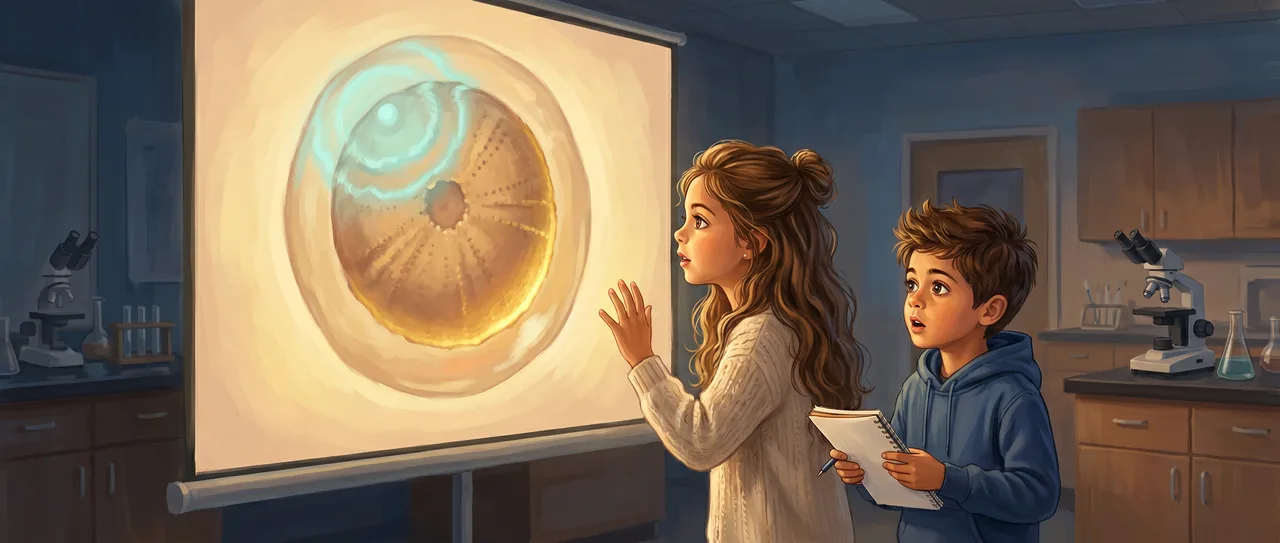
On the enormous projection screen, a sphere floated in pale fluid. It was surrounded by a halo, a thick glowing border that looked almost like a force field in a movie, except it wasn't smooth. It was textured, complicated, alive.
"That's a sea urchin egg," said the graduate student standing near the projector. She was eating a granola bar and talking to another grad student about parking permits. She glanced at them. "We use sea urchin eggs because they're big and they do the same thing human eggs do. The demonstration starts in ten minutes if you want to wait."
She went back to her conversation about parking.
Maya didn't wait. She was already at the screen, close enough that the projected light made her face glow. "Soren. That coating. What is it?"
Soren had his notebook out. He'd read the program pamphlet on the way in, twice. "The zona pellucida. In mammals, anyway. Sea urchins have something similar. It's like a shell around the egg, but made of proteins."
"It's thick," Maya said. She traced the halo with her finger, not touching the screen. "It's really thick compared to the egg."
"Yeah." He checked the pamphlet again. "It says here the demonstration shows fertilization and the block to polyspermy."
"The block to what?"
"Polyspermy. Poly, many. Spermy, well. Many sperm trying to get in."
Maya turned from the screen. "So the egg has to pick one."
"Not exactly pick," Soren said. He was reading ahead. "It says the egg changes itself. The instant the first sperm gets through, the coating transforms so nothing else can follow."
Maya frowned. Not a confused frown. A calculating one. "How fast?"
"It says seconds."
The grad student, whose name tag read Priya, had apparently been half listening. She wandered over, granola bar finished. "You want to see it happen? We're about to add sperm to the dish."
"Yes," Maya and Soren said together.
Priya sat down at the microscope station. The projection shifted as she adjusted the focus. Now they could see the sea urchin egg even more clearly, its thick jelly coat surrounding the inner membrane, the whole thing quietly drifting.
Priya used a pipette to add a tiny drop to the dish. "Watch the coating," she said. Then her phone buzzed and she stepped back to check it, one eye still on the screen.
For a moment, nothing. The egg sat there. Maya held her breath.
Then the edge of the coating rippled.
Something had touched it. Something too small to see at this magnification had reached the outer layer, and now there was motion at one point on the surface, a disturbance, a tiny breach.
And then the egg did something extraordinary.
A wave moved across its surface. Starting from the point of contact, spreading outward in every direction like a ripple in a pond, except this ripple was chemical, structural. The coating visibly shifted. Where it had been soft and permeable, it tightened. The texture changed. The glow on the screen seemed to intensify as the membrane lifted away slightly, and the whole protective layer became something new.
"There," Soren whispered. "Did you see it?"
"It went around the whole thing," Maya said. "Like a signal."
"Cortical reaction," Priya said from behind them, phone put away now. "The egg releases enzymes from tiny packets just under its surface. They pour into the zona, into the coating, and they change its structure. Harden it. The proteins that let sperm bind get clipped apart. In a human egg, the zona pellucida goes from being a door to being a wall. Same thing here."
"In seconds," Soren said.
"In seconds."
Maya was staring at the screen. The egg looked different now. The same egg, the same shape, but the coating around it had transformed. One moment it had been an invitation. The next, a fortress.
"Play it again," Maya said.
"It's not a recording," Priya said, almost smiling. "That was a living egg. That just happened once, right now, and it's done."
The weight of that settled on both of them.
"Every person," Soren said slowly. He was writing, but his pen had stopped. "Every person who has ever been born. That happened. That wave went around an egg, and that's why they're one person instead of, instead of something that couldn't survive."
Priya nodded. "Polyspermy is fatal. If two sperm fertilize the same egg, the embryo gets too many chromosomes. It can't develop. So the egg has this system, millions of years old, that fires in the first seconds. One chance. One wave. One wall."
Maya was quiet in the way she got quiet when her list of things that didn't make sense yet was getting longer.
"It's not a choice," she finally said. "The egg doesn't decide. It's a reaction. Like a mousetrap."
"More like a lock that makes itself," Soren said.
Maya looked at him. "A lock that didn't exist until someone turned the key."
"Yes. Exactly."
They stood there, two eleven-year-olds in a university lab on a Saturday afternoon, looking at a sea urchin egg that had just done the same thing that had happened, precisely once, for each of them. For every person they had ever known. For every person.
Priya was already setting up the next egg for the families arriving behind them. She had six more demonstrations to do today.
Maya pulled Soren toward the door, but she stopped at the threshold. She turned back to look at the screen one more time, where a new egg sat in its soft bright halo, still open, still waiting.
"It doesn't know what's coming," she said.
"Neither did ours," Soren said.
They walked out into the hallway where sunlight fell through tall windows, and Maya pressed both hands flat against the warm glass, looking out at a campus full of people who had all, every single one of them, begun with that same invisible wave.
Read the interactive version, listen to the narration, and earn a gold star →
A science-verified short story for curious kids · Curiosity Land