The Liquid That Remembers How to Leave
The sign on the door said CRYOGENICS LAB — AUTHORIZED PERSONNEL ONLY, but someone had taped a smaller sign underneath that said OPEN HOUSE VISITORS WELCOME and drawn a smiley face with frozen eyebrows.
Maya went in. Soren followed, because the door was already open and that made it technically not trespassing.
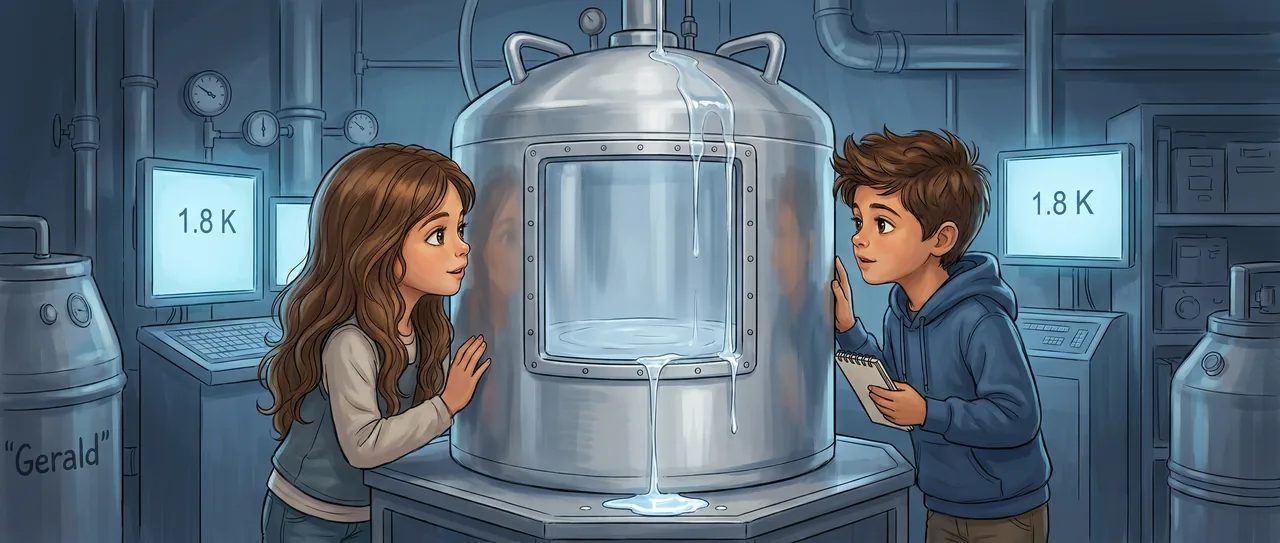
The lab was cold in the way that labs always are, but not cold enough to explain what they were about to see. Mostly it was tables covered in equipment, vacuum lines, and computer monitors showing temperature readings in numbers so small they looked like typos. One monitor read 1.8 K.
"That's one point eight degrees above absolute zero," Soren said, reading the placard next to it.
"I know what Kelvin is," Maya said. She was already past him, looking at something on the far bench.
It was a small glass container, like a beaker but more precise, sitting inside a much larger apparatus of silvered walls and vacuum seals. Through a viewing window, they could see the liquid inside. It looked like water. Perfectly clear, perfectly still.
Except it was climbing the walls.
Maya pressed her face to the window. "Soren."
He came over. Inside the container, a thin film of the liquid was creeping up the inner surface of the glass, past the level of the liquid below, going up and over the rim. On the outside of the container, the film crept down, collecting in a tiny puddle on the platform beneath.
"It's getting out," Maya said.
"That's not possible." Soren watched it for ten full seconds. It kept going. The liquid inside the container was visibly, slowly dropping. The puddle underneath was growing. "That's not possible," he said again, but quieter this time, because it was clearly happening.
A graduate student came around the corner holding a sandwich. She had dark circles under her eyes and the look of someone who had forgotten the open house was today. Her name tag said PRIYA.
"Oh," Priya said. "You found Gerald."
"You named it Gerald?" Maya asked.
"The dewar. The container." Priya took a bite of her sandwich. "Don't touch the vacuum housing, it'll burn you. Cold burn. Listen, I need to go recalibrate the magnetometer, are you two fine here?"
"Why is it climbing out?" Soren asked.
"Because it's a superfluid. Helium-four below the lambda point. Two point one seven Kelvin. It has zero viscosity. Actually zero. Not almost zero. Zero." Priya said this the way someone might say the bus comes at three fifteen. "It's in my thesis. I'll be back in twenty minutes. Don't open anything."
She left.
Soren stared at the liquid climbing the glass. "Zero viscosity. That means zero friction. No resistance to flow at all."
"So it just goes wherever it wants," Maya said.
"No. It goes wherever it can. That's different." Soren pulled out his notebook. Not to write yet. Just to hold. "Think about it. Water has viscosity, right? That's what stops it from flowing through tiny cracks, from creeping up walls. It's like water has a cost to moving. Every move takes effort. This stuff has no cost. Moving is free."
"So it moves everywhere it's allowed to move."
"Everywhere physics allows. The film crawling up the wall, that's not the liquid deciding to escape. It's that there's no reason for it not to. Gravity pulls it down, but the attraction between the helium atoms and the glass surface pulls it up, and normally viscosity means the surface attraction loses. Here, there's nothing to lose to."
Maya was quiet. She watched the film, thinner than paper, sliding over the rim. "It finds every way out."
"Every way out that exists."
"How small a hole can it get through?"
Soren flipped open his notebook and found the placard text he'd been reading near the entrance. "It says here it can flow through gaps that even helium gas can't pass through. Channels a few atoms wide."
Maya pulled back from the window. Something in her face had changed. Not surprise. Recognition.
"A few atoms wide," she repeated. "So if there's a crack in the container. Any crack. Even one you can't see, can't measure, barely exists."
"It gets through."
"It gets through." Maya looked at the dewar, the puddle growing underneath, the liquid level slowly dropping inside. "Soren. If you put this in a sealed container, a perfect sealed container, and there was one flaw, one gap a few atoms wide, somewhere in the seal."
"It would find it."
"It would find it. Not because it's looking. Because there's nothing stopping it." She turned to him. "That's the strangest thing I've ever heard."
Soren wrote something in his notebook. Then he stopped, pen hovering. "There's something else. The placard at the front said if you set it spinning, it doesn't stop."
"Doesn't stop?"
"It rotates forever. No friction to slow it down. Not slowly stops. Not eventually stops. Never stops."
They both looked at the still, clear liquid. Somewhere in that fluid, they knew, quantum vortices could spin without end. Not because of some magical energy source. Because there was nothing to take the energy away.
Maya said, "So it's not that it does something special. It's that something is missing. The friction that stops everything else, the resistance, it's just gone. And without it, all these impossible things are just what naturally happens."
"The impossible things were always what would happen. Friction was just in the way."
The lab was quiet. The vacuum pumps hummed. The film kept climbing, patient and thin, finding the rim, spilling over, one atom-thin layer at a time. The liquid had no intention. It had no cleverness. It simply had nothing holding it back, and so it went everywhere it was possible to go.
Soren closed his notebook. He opened it again. He looked at Maya.
"If you removed friction from water," he said, "would every river on Earth climb out of its banks?"
Neither of them answered. Through the viewing window, the puddle beneath Gerald grew by another slow, bright drop.
Read the interactive version, listen to the narration, and earn a gold star →
A science-verified short story for curious kids · Curiosity Land