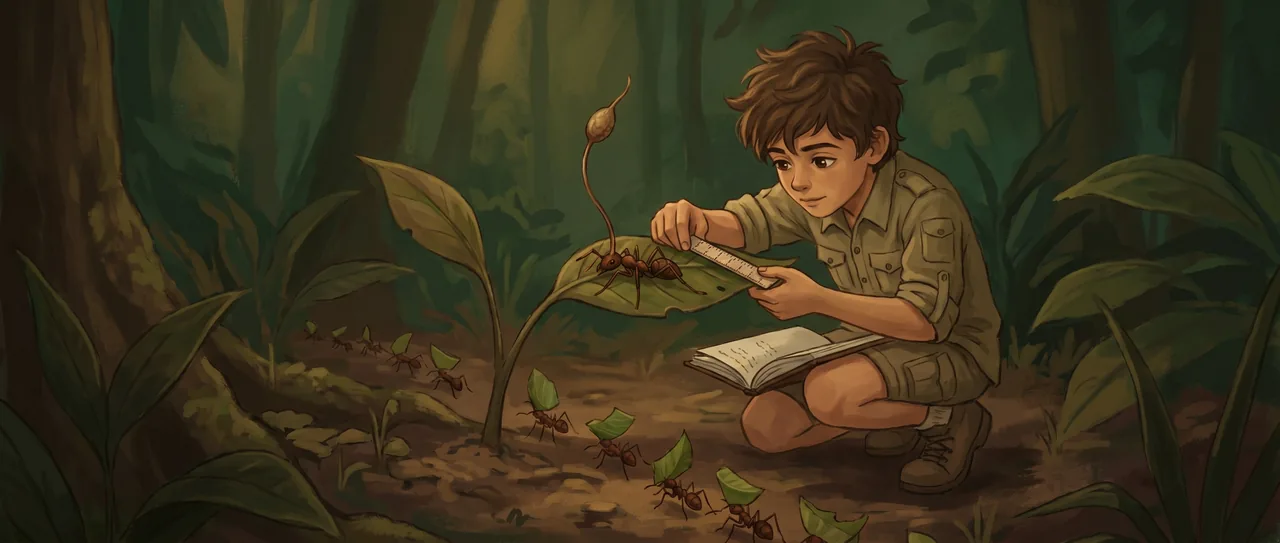
The Height of Things
The first dead ant Soren found was on Tuesday.
It was clamped to the underside of a leaf about twenty-five centimeters off the forest floor, its jaws locked around the central vein so hard that when Soren touched the leaf, the whole ant stayed. Like it had been welded there. A thin brown stalk grew from the back of its head, curving upward, tipped with a swollen pod.
He drew it in his notebook. Mandibles. Vein. Stalk. Pod. He measured the height with the small ruler his mother kept forgetting she'd lent him. Twenty-five centimeters.
He found the second one on Wednesday. Same species of ant. Same kind of leaf. Same stalk from the head. He measured it. Twenty-six centimeters.
The third was on Thursday. Twenty-five centimeters.
Soren did not think this was a coincidence. He thought this was terrifying.
He found seven more over the next three days, fanning out from the main trail behind the research station, crouching low with his ruler and his notebook while his mother argued on the satellite phone about diesel shipments. Every single ant was clamped to a leaf vein on the north side of the plant. Every single one had the stalk. Every single one was between twenty and thirty centimeters off the ground.
Not a meter up. Not on the ground. Not halfway up the tree. Just there. Just that band of air.
He sat on a root and stared at his notebook. Ten measurements. Ten heights. All within the same narrow window.
"Why there?" he said to nobody.
The station's library was one shelf of mildewed paperbacks and three binders of laminated species guides. He found Ophiocordyceps in the fungal section. The description was short. Parasitic. Infects Camponotus ants. Alters behavior. Causes host to leave colony, climb vegetation, bite leaf vein, die. Fruiting body emerges from head.
Alters behavior.
Soren read it again. Alters behavior. Two words covering something enormous. He went back outside.
He already knew the fungus was real. He had ten drawings. What he did not understand was the height.
The ants lived on the ground. Their trails ran along the soil. If the fungus just needed the ant to climb and die, any height would work. A meter up. Two meters. The canopy. But it wasn't any height. It was the same height, over and over, within a space you could cover with your outstretched arms.
Soren measured the temperature at ground level. Then at twenty-five centimeters. Then at fifty. Then at a meter. He used the cooking thermometer from the station kitchen, holding it steady at each height for two full minutes. He wrote the numbers down.
Then he measured humidity. He didn't have a hygrometer, but the station had a can of compressed air for cleaning electronics, and when he sprayed it onto a cold surface and timed how long the condensation lasted at each height, the differences were obvious. Moisture clung longest in the zone between twenty and thirty centimeters. Evaporated fastest above a meter.
He sat back.
The fungus needed humidity to grow. It needed a specific temperature range. And the zone where both conditions overlapped was exactly the zone where every ant had died.
The fungus was not just killing ants. It was steering them. It was driving them to a precise altitude where the air was right for the fungus to fruit and release its spores. The ant climbed to exactly the height the fungus needed, locked its jaws, and became a platform.
Soren put the thermometer down.
He'd been thinking of the ants as the organisms and the fungus as the disease. But looking at it now, the ant was the vehicle. The fungus was the driver. And the driver knew exactly where it was going.
A fungus. No brain. No eyes. No nerves. And it could navigate.
Not just navigate. It could make something else navigate for it.
He opened his notebook to a blank page and tried to write this down. He got as far as "The fungus controls" and stopped, because the word controls was both exactly right and completely insufficient. Control implied a controller. Something deciding. But there was no decision here. There was no brain in the fungus to decide with. There was only chemistry, molecules fitting into other molecules, a key turning a lock in the ant's nervous system, and the lock happened to open a door that led to twenty-five centimeters above the forest floor.
And that was worse than if the fungus were thinking. That was worse because it meant you didn't need a mind to do something that looked exactly like having one.
He heard his mother call from the station, something about dinner. He didn't move yet.
Because the other thing. The thing he hadn't written down.
The ants below the dead ones. The living ants, running their trails on the ground, carrying leaf fragments and food. The spores fell from the pod on the dead ant's head. The spores fell twenty-five centimeters down. They fell right onto the trail.
The height wasn't just about where the fungus grew best. It was about where the fungus could reach the most ants below it. It was a delivery system. The dead ant was positioned like a bomber over a target, and the target was its own colony's highway.
Soren had walked past that trail eleven times this week. He'd thought the dead ants were a sad, strange thing happening at the edge of the path. He had not understood that he was looking at a precision he associated with engineering. With design. With intention.
But there was no intention. There was only selection. Millions of years of fungal spores that landed wrong, that fruited at the wrong height, that missed the trail, that dried out or overheated. Gone. And the ones that got the height right, they were the ones whose spores hit ants, and those ants climbed to the same height, and those spores hit more ants.
No mind. No plan. Just the thing that worked, repeated until it looked like genius.
His mother called again.
Soren closed the notebook. He stood up. He looked at the nearest dead ant, clamped to its leaf in the fading light, the stalk rising from its head like a finger pointing at nothing.
He wanted to say something but there was nothing to say that was equal to it.
He walked back toward the station, and on the ground beneath his feet, a thousand ants carried leaves along their highway, not one of them looking up.
Read the interactive version, listen to the narration, and earn a gold star →
A science-verified short story for curious kids · Curiosity Land