The Garden Nobody Planted
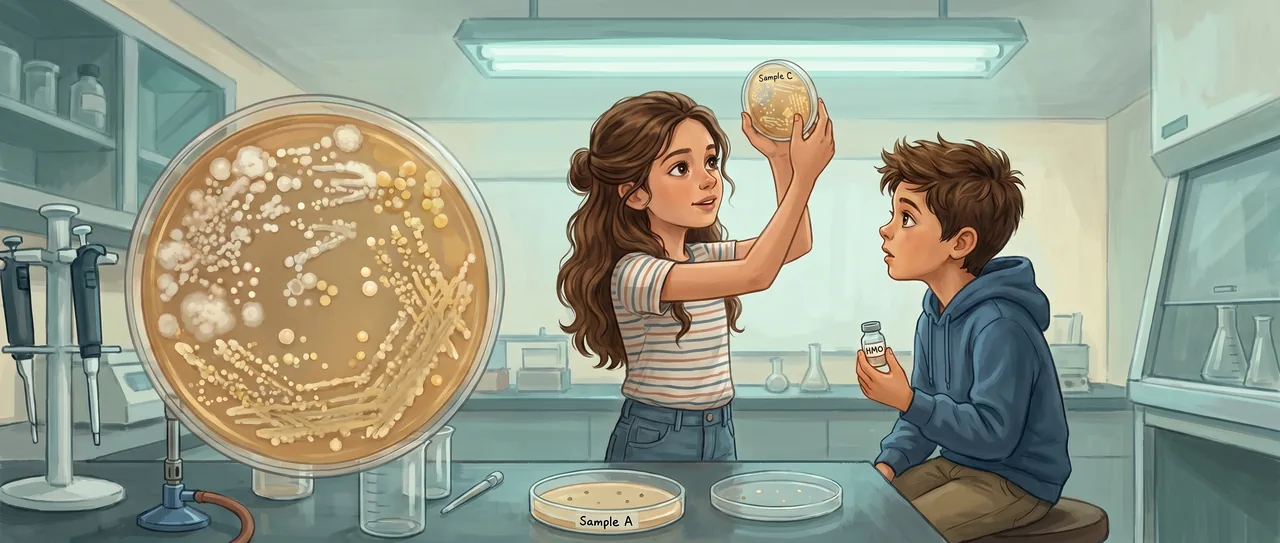
The argument started because of the petri dish labeled Sample C.
"It's contaminated," Soren said. He tilted the dish under the light. The bacterial colonies had spread in thick, cloudy patterns, far more growth than the other samples. "We must have introduced something when we plated it."
Maya looked at her own dish, Sample A, which had sparse colonies scattered across the agar. Then she looked at Soren's Sample C again. "Or it's not contaminated. Maybe it's just getting fed better."
They were in Dr. Kessler's microbiology lab for the Saturday program, and Dr. Kessler herself was three benches away, hunched over her own experiment, muttering about grant deadlines and barely remembering the six eleven-year-olds she was supposed to be supervising. She had given them five petri dishes, each inoculated with the same infant gut bacteria, each fed a different nutrient solution. Then she had gone back to her pipettes.
Sample A got simple sugar water. Sample B got a basic protein solution. Sample C got something from a small unlabeled bottle that Dr. Kessler had set out without explanation. Samples D and E got two different commercial infant formula preparations.
The instructions taped to the bench said: Observe growth patterns. Record differences. Propose explanations.
"The D and E dishes look almost the same as each other," Soren said, writing this down. "Moderate growth. Even spread."
"But C is different from everything." Maya was leaning close to the dish now. "It's not just more bacteria. Look at the pattern. There are at least three different colony types. This fuzzy one here, that smooth one, and these tiny dots along the edge."
Soren looked. She was right. The other dishes had one or two colony types. Sample C had what looked like a whole community.
"What was in that bottle?" he asked.
Maya was already walking toward Dr. Kessler. She came back thirty seconds later.
"She said to read the label more carefully."
"There is no label."
"I told her that. She said there's a code on the cap."
Soren picked up the small bottle. On the cap, in tiny printed letters: HMO fraction, pooled.
"HMO," he said. "Human milk oligosaccharides."
"Oligosaccharides are sugars," Maya said. "Complex sugars. So we basically fed the bacteria in Sample C a sugar from human milk."
"But we fed Sample A plain sugar and it barely grew."
They both looked at the two dishes side by side. Simple sugar, almost nothing. Human milk sugar, an explosion of diverse life.
Soren sat down on his stool. "Okay. That's strange. Why would one sugar do almost nothing and another sugar grow a whole ecosystem?"
"Maybe it's not just a sugar," Maya said. "Maybe it's a specific sugar. Like a key that only certain bacteria can use."
Soren wrote that down, then stopped. "Wait. If these oligosaccharides are in human milk, they're going into a baby. But you said the bacteria are eating them, not the baby."
"Right."
"So the baby drinks something it can't digest."
Maya's face did the thing it did when a pattern clicked. Not a smile exactly. More like her whole expression went still. "The baby drinks something it can't digest. On purpose. Because it was never food for the baby."
"It's food for the bacteria."
"The milk is feeding two things at once. The baby gets the fats and the proteins and the regular sugars. And then there's this whole other layer, over a hundred different oligosaccharides, that pass right through the baby's stomach because the baby literally cannot break them down. They go all the way to the gut. And the bacteria are waiting."
Soren stared at Sample C. At the three or four different species thriving together in their cloudy, complicated pattern. "It's a garden," he said. "The milk is planting a garden inside the baby. Not with seeds. With food for the right plants. The ones that are supposed to be there."
"And if the right bacteria grow," Maya said slowly, "they crowd out the wrong ones. The dangerous ones can't get a foothold."
"The milk is building an immune system. Not directly. Through the bacteria."
They were quiet for a moment. The lab hummed around them. Dr. Kessler's pipette clicked in the background.
"There are over a thousand different components in human milk," Soren said. He had read this somewhere, months ago, and it had seemed like a number. Now it seemed like something else. "Proteins, immune factors, hormones. A thousand different things."
"And some of them aren't for the baby at all."
"They're for organisms the baby doesn't even know are there."
Maya picked up the petri dish labeled A. The simple sugar. The almost-empty one. She held it next to C.
"We always think about feeding a person," she said. "One body. One mouth. One stomach. But it was never just one thing being fed. It was always a whole system. The mother's body is sending instructions to bacteria she will never see, inside a person who doesn't know they're carrying them, and the whole thing works because everyone gets exactly the right message."
Soren looked at the bottle of HMO fraction in his hand. Pooled from donors. Concentrated. A tiny amount of something that had been doing this work for as long as humans had existed, long before anyone understood why.
"How did it know?" he said. "I mean, how did evolution build this? The milk has to make a sugar that the baby can't use but a specific bacterium can, and the bacterium has to already be present in the gut, and the bacterium has to be the kind that protects against infection. All of those things had to line up."
"And they did."
"Thousands and thousands of times. In every mammal that nurses. For millions of years."
Dr. Kessler's voice came from across the lab. "You two going to write up your observations or just hold those dishes all afternoon? I need the bench by four."
Soren set the dish down carefully. Maya didn't. She held it up to the fluorescent light, turning it so the colonies caught the glow, each cluster a slightly different density, a slightly different texture, a whole civilization fed by a message in milk that was older than language.
"There's so much in us that isn't us," she said.
Soren opened his notebook to a fresh page, and then closed it again. He looked at Sample C alongside her, at the thriving, tangled, uncountable lives the light shone through.
Read the interactive version, listen to the narration, and earn a gold star →
A science-verified short story for curious kids · Curiosity Land