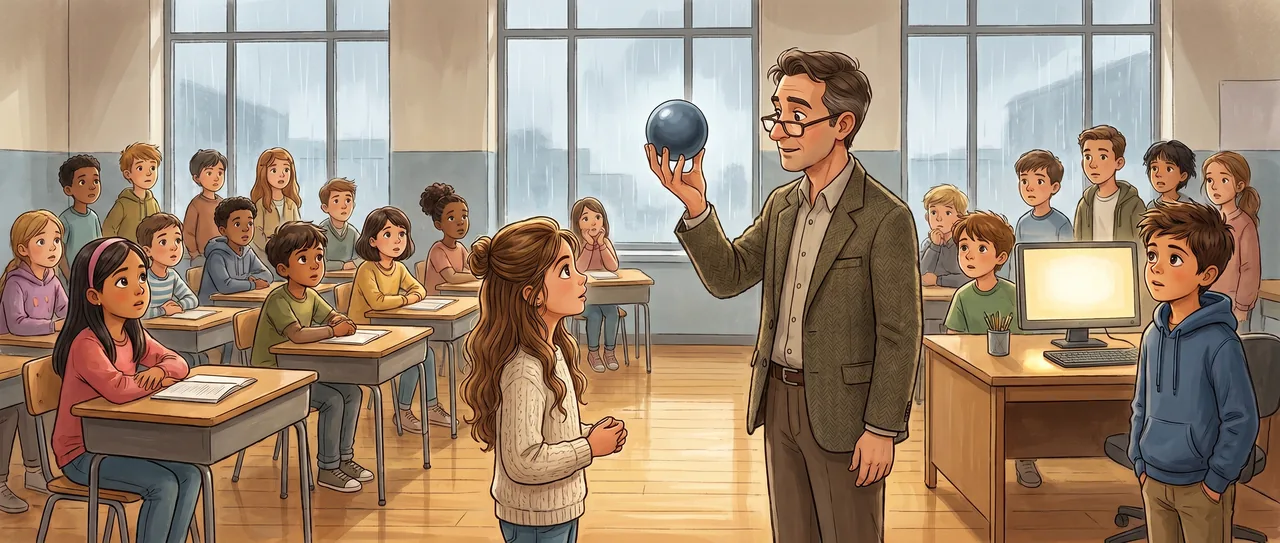
The Ball That Wouldn't Bounce Wrong
The box from the university was supposed to contain three demonstration pendulums, a set of tuning forks, and a pamphlet titled "Energy Loss and You." What it actually contained was packing peanuts, one cracked tuning fork, and a single sphere about the size of a marble, heavier than it looked, dark as a thundercloud.
Mr. Kazarian held it between two fingers and sighed the sigh of a man whose entire Friday lesson plan had just evaporated. "Well," he said. "That's that." He set the sphere on his desk and pulled out a textbook. "Page two hundred and seven. Elastic collisions. Read silently."
Twenty-three heads bent. Two did not.
Maya picked up the sphere when Mr. Kazarian went to argue with the front office about the shipment. It was cold. Not room-temperature cold. Actually cold, like it had been pulling heat out of her fingers.
"It's heavy," she said, and handed it to Soren.
Soren weighed it in his palm. "Too heavy for steel this size. Too light for tungsten." He turned it in the fluorescent light. The surface had no grain to it, no texture at all. It looked like a liquid someone had frozen in place.
"Drop it," Maya said.
"On the desk?"
"On the floor."
Soren dropped it from shoulder height onto the gym's hardwood floor.
The sphere hit and came back up. Not like a rubber ball, which squishes and springs. Not like a steel ball bearing, which clinks and rises partway. This thing returned to almost exactly the height he'd dropped it from. It came up fast and clean, like a video played in reverse.
Maya caught it. "Do that again."
He did it again. Same result. The ball came back like it had decided falling was a temporary inconvenience.
"That's wrong," Soren said. He did not mean the ball was broken. He meant the ball was doing something that the textbook on page two hundred and seven said shouldn't quite happen.
"A steel ball loses, what, thirty percent?" Maya said.
"At least. Rubber loses more. It just hides it because rubber deforms so much." Soren caught the ball on its third bounce and held it still. "This thing is giving almost everything back. Where's the energy going?"
"That's what I'm saying. It isn't going anywhere."
Soren opened his notebook and wrote: dark sphere, unknown metal, near-perfect elastic rebound. Below that he wrote: no visible deformation, no audible ring, surface like frozen liquid.
Maya was already on the classroom computer, typing. Soren knew she would find it faster than he would, so he kept bouncing the sphere, changing the height each time, watching. From ten centimeters, it returned to what looked like nine and a half. From a meter, it returned to something very close to a meter. Each time, he waited for the ball to ring or vibrate or warm up. It did nothing. It just came back.
"Bulk metallic glass," Maya said from across the room.
"It's not glass."
"It is, though. That's the thing." She was reading fast, her finger tracking the screen. "Okay. So. Regular metals are crystalline. Their atoms stack in rows. Neat little lattices. When you hit them, the energy travels along those rows and scatters at the boundaries between crystal grains. That scattering is where the energy goes. Heat. Sound. Vibration. That's what you lose."
Soren looked at the sphere in his hand. "And this doesn't have the rows."
"No rows. No grains. No boundaries. The atoms are jumbled like in a liquid, but it's solid. A glass. They cool certain alloys so fast that the atoms never get a chance to organize. So when the ball hits the floor, the energy goes in and comes right back out because there's nothing in the structure to scatter it."
Soren sat down slowly. He was thinking about all the things he'd ever dropped. Every rubber ball, every basketball, every time something hit the ground and came back a little less than it was. He'd always thought of that as normal. As how the world worked. You put energy in and you get less back. Always less. That was just the rule.
But the rule wasn't the rule. The rule was about crystal boundaries. About atoms in rows. If you took away the rows, you got almost everything back.
The loss wasn't built into the universe. It was built into the structure. Change the structure, change the loss.
"They use it in golf clubs," Maya said. "And surgical tools. And phone cases."
"Because it gives the energy back."
"All of it. Almost all of it."
Soren bounced the sphere one more time. It rose in the air and hung for just a moment at the top of its arc before falling again. This time he let it bounce on its own, and it went six, seven, eight bounces before the tiny losses from the air and the floor's own imperfect crystals finally pulled it to a stop.
Maya was quiet, watching the last few bounces. Then she said, "You know what's strange? The atoms don't know they're disordered. There's no blueprint that says this is better or worse. The disorder just happens to be more efficient for this one thing. The mess gives back more than the order does."
Soren didn't write that down. Not yet. He was holding the sphere up to the light again, looking at that impossible surface, that liquid-that-wasn't. Somewhere in there, billions of atoms were jumbled in positions that no crystal would allow, and because of that chaos, almost nothing was wasted.
Mr. Kazarian came back in, still irritated about the shipment. "Everyone still on page two hundred and seven?"
"Mr. Kazarian," Soren said, "what other things have grain boundaries?"
Mr. Kazarian paused. This was not a page two hundred and seven question. "Everything metallic. Bridges. Airplane wings. Engine parts. Almost every metal object you've ever touched. Why?"
"And every single one of them is losing energy at those boundaries. Every single one."
Mr. Kazarian looked at the sphere in Soren's hand. Then at the computer screen Maya hadn't closed. He pulled his glasses down his nose and read for about fifteen seconds. He looked at the sphere again.
"Where did you drop it from?" he asked.
"Shoulder height," Maya said. "Try it yourself."
Mr. Kazarian held the dark sphere at shoulder height. Twenty-three heads lifted from page two hundred and seven. He let go, and the ball hit the hardwood and rose, clean and fast, almost to his fingertips, like a question returning as itself.
Read the interactive version, listen to the narration, and earn a gold star →
A science-verified short story for curious kids · Curiosity Land