Two Point Four Meters East
The brass survey marker was embedded in concrete at the edge of the parking lot, and it was in the wrong place.
Not obviously wrong. Not wrong in a way that mattered to the woman selling fish across the street, or the bus driver who parked over it every morning. Wrong in the way that only mattered if you were holding a laminated map from two thousand nine and comparing it to a GPS receiver that had been calibrated three weeks ago.
Soren was holding both.
"It's off," he said.
"Off how much?" Maya asked. She was crouching beside the marker, running her finger around its stamped edge.
"Two point three seven meters."
Maya looked up. "East?"
Soren checked. He checked again. "East."
They had come to the Oshika Peninsula station as part of the summer program. The assignment was simple: use GPS coordinates to locate five geodetic survey markers, record their positions, compare them to the published positions on the reference map. The point of the exercise, according to Dr. Hayashi, was to learn that science was about measurement, patience, and getting the same answer twice.
Dr. Hayashi was currently on a phone call about a budget meeting that had been rescheduled four times. She was pacing beside the van, speaking rapid Japanese into her phone, occasionally glancing toward them with the expression of someone who trusted them not to fall off a cliff in the next ten minutes.
Maya stood up. "They're all going to be off."
"We've only measured one," Soren said.
"They're all going to be off, and they're all going to be off to the east."
Soren opened his notebook. He did not argue with Maya when she did this, because she was usually right about the shape of things even when she hadn't worked out why. But he wanted the second marker before he believed it.
"Next one's four hundred meters that way," he said, pointing up a gravel path toward a low hill.
They walked. The air smelled like salt and pine. Below them, the Pacific was flat and silver, impossibly calm, the kind of ocean that made it very difficult to believe it had ever done anything violent.
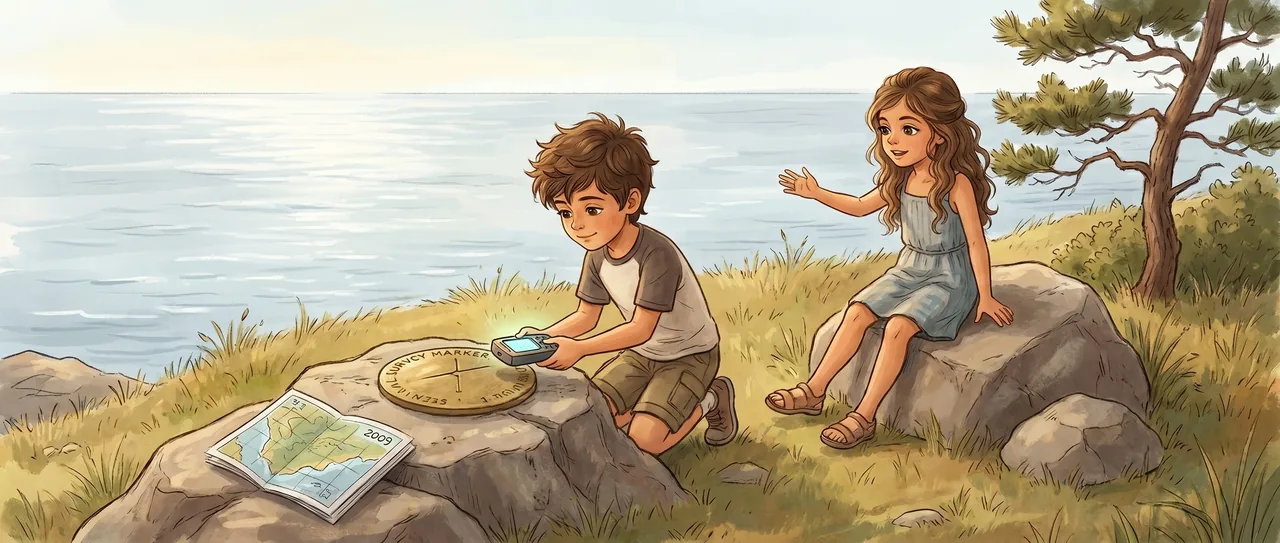
The second marker was set into a rock outcrop overlooking the water. Soren placed the GPS receiver on the marker and waited. Maya sat on a nearby boulder and stared at the ocean.
"Two point four one meters," Soren said. "East."
"The whole thing moved," Maya said quietly.
Soren sat down next to her. He looked at the reference map, at the GPS, at the brass disc in the rock. The disc had been placed in two thousand and four. It recorded a position on the planet that no longer existed. Not because the disc had moved in the way a ball rolls or a car drives, but because the ground itself, the rock, the hill, the gravel path, the parking lot, the fish shop, the bus stop, every single thing they had walked on since arriving, had shifted two and a half meters to the east in about three minutes on March eleventh, two thousand eleven.
"How big is two point four meters?" Maya said. Not really asking. Measuring it in her head.
"About from here to that tree."
They both looked at the scraggly pine she'd been leaning against.
"That's a long way for an island to jump."
"Honshu is not small," Soren said. He was writing. He stopped writing. "Maya. Honshu is the seventh largest island in the world. Two hundred twenty-seven thousand square kilometers. And it moved two point four meters."
The number sat between them.
"What moves an island?" Maya said.
Soren had read about this. The Pacific Plate slides beneath the North American Plate. The edge of the overriding plate gets dragged down, compressed, stuck. Stress builds for decades, centuries. Then the locked section ruptures and the overriding plate snaps upward and outward, releasing all that stored energy at once. A megathrust earthquake. The most powerful kind the Earth produces.
"The plates are always moving," he said. "Eight centimeters a year, roughly. The Pacific Plate going under Japan. But the boundary gets stuck, and the energy stores up, and when it lets go..."
"Everything jumps."
"Everything jumps."
Maya picked up a flat stone and turned it over in her hands. "What else moved?"
Soren flipped back through the notes he'd taken during Dr. Hayashi's lecture on the first day. He found the line he'd written and underlined and then written an exclamation point next to.
"The Earth's axis," he said. "The earthquake shifted the Earth's rotational axis by about ten centimeters."
Maya put the stone down.
"The whole Earth."
"The redistribution of mass. When the plates shifted, it changed how the Earth's mass was balanced, just slightly. Like when you're spinning on a chair and you move your arms."
"And the planet wobbled."
"Ten centimeters. The day got shorter, too. About one point eight microseconds. Because the mass moved closer to the axis, and the spin sped up."
Maya was very quiet. Soren knew this quiet. It was not confusion. It was the quiet of Maya's running list getting a new entry that pushed everything else down.
"We're standing on a thing that moved an island and wobbled the planet," she said, "and you can't even tell. The fish shop is still there. The road is fine. The ocean looks like nothing ever happened."
"The GPS knows."
"The GPS knows." She almost smiled. "That's why the exercise works. Dr. Hayashi didn't send us out here to learn about measurement. She sent us out here to find the gap."
Soren looked at the two numbers. The published position and the measured position. Two point four one meters apart. A gap that recorded the memory of a planet adjusting itself.
"Every survey marker on this peninsula is a fossil of that day," he said.
"Not a fossil. Fossils are finished. This is still happening. The plates are still moving. Right now. Under us."
She was right. Eight centimeters a year. The boundary was already locking again, already storing the next century's energy. The ground they sat on felt solid and permanent, but it was riding on a plate that was being compressed, dragged, loaded like a spring.
"It doesn't stop," Soren said.
"No."
They sat on the hill above the silver Pacific, two eleven-year-olds on a piece of the Earth that had jumped east and hadn't told anyone who wasn't paying very close attention. Below them, the fish shop was open, and the bus was arriving, and everything was exactly where it appeared to be and also two point four meters from where it used to be.
Dr. Hayashi's phone call ended. Her distant voice called them back to the van.
Maya stood and brushed the dust off her knees. Soren closed his notebook. They walked down the gravel path, and beneath their feet, the Pacific Plate slid another fraction of a millimeter under the island that carried them.
Read the interactive version, listen to the narration, and earn a gold star →
A science-verified short story for curious kids · Curiosity Land