Twenty Letters
The bacteria were supposed to glow green.
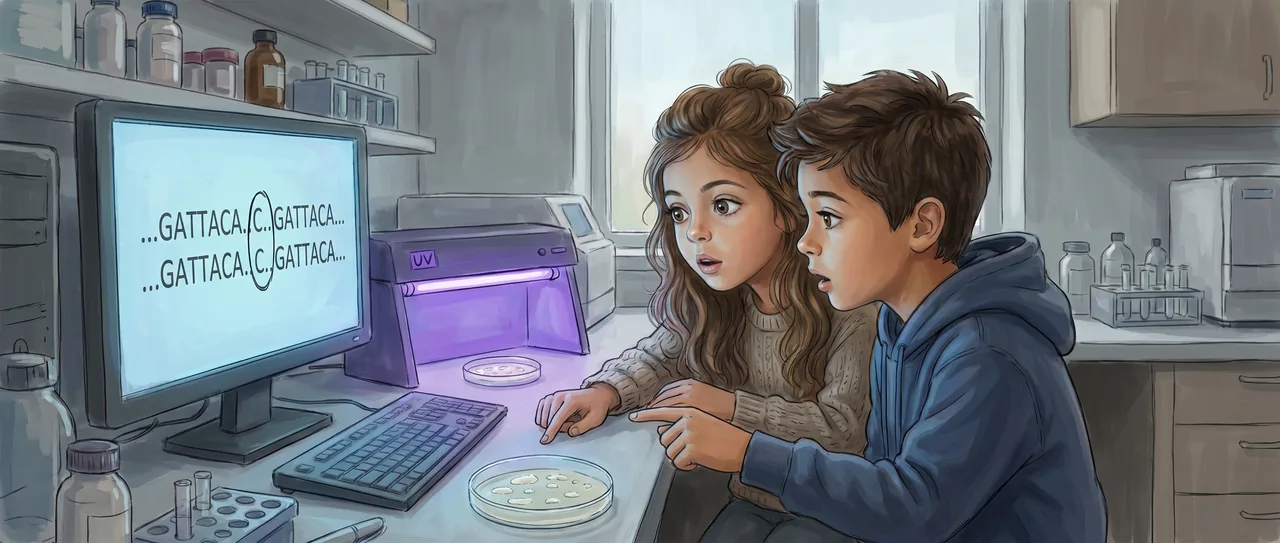
Maya held the petri dish up to the UV lamp for the fourth time, tilting it slowly, as if the angle might make a difference. The colonies sat there, pale and ordinary, like tiny dots of oatmeal.
"Still nothing," she said.
Soren was already at the bench behind her, flipping back three pages in his notebook. "Our cut didn't work. The fluorescence gene didn't get inserted."
"The cut worked," Maya said. She said it before she knew why she was sure, and then she stood there holding the dish, figuring it out. "The cut worked because the bacteria survived. If the Cas9 protein had just chewed up the DNA randomly, the cells would be dead. They're alive. They're fine. They just aren't glowing."
Soren looked up. "So the cut happened in the wrong place."
"The cut happened exactly where we told it to happen. We told it wrong."
Dr. Kapoor was across the lab, hunched over her own experiment, muttering at a gel image on her screen. She had given them the protocol on Wednesday, printed on three pages with her coffee ring on page two. She had said, "Follow it exactly, come find me if something catches fire, otherwise I'll check in at noon." It was nine fifteen.
Soren pulled up their guide sequence on the lab computer. Twenty letters long, displayed on screen in a plain font. AGCTTAGCCTGAATCGGCTA.
"Twenty letters," he said. "Out of the whole bacterial genome. Four point six million letters, and these twenty are supposed to tell the protein exactly where to cut."
Maya leaned over his shoulder. "Like an address."
"More like coordinates. Latitude and longitude, but in a space that's four point six million positions long." He paused. "There's only one place in the whole genome where these exact twenty letters show up in this exact order. That's where the Cas9 goes. That's where it cuts. Both strands. Clean through."
"So if we typed one letter wrong."
"Different address. Different cut."
Maya pulled up the original protocol on the screen beside their sequence. She put her finger under the guide sequence printed on Dr. Kapoor's page. Then she moved her finger to their sequence on the screen.
Letter by letter. Both of them reading.
A-G-C-T-T-A-G-C-C-T-G-A-A-T-C-G-G-C-T-A.
A-G-C-T-T-A-G-C-C-T-G-A-A-T-C-C-G-C-T-A.
Soren saw it on the sixteenth letter. Maya saw it at the same time because she heard him stop breathing.
"G instead of G," Soren started.
"No. Look again. Position sixteen. The protocol says G-G. We have C-G."
One letter. The sixteenth position out of twenty. A C where there should have been a G.
Soren sat back. "We sent the Cas9 to the wrong address. It went there. It cut both strands exactly where we aimed it. Perfectly. Just not where we needed it."
"It did its job," Maya said. "We gave it the wrong job."
They were both quiet for a moment. The lab hummed around them, the freezer cycling, the centrifuge in the next room winding down. Dr. Kapoor said something sharp to her gel image.
Soren was staring at the two sequences side by side. "One letter out of twenty, and the cut lands somewhere completely different in four point six million base pairs of DNA."
"That's the point, though," Maya said. She pulled a stool over and sat down level with the screen. "That's why the guide is twenty letters long and not ten or five. Twenty letters is specific enough to match exactly one spot in the entire genome. If it were shorter, there'd be multiple matches. The Cas9 would cut in a bunch of places. You need twenty to be precise."
"But precise means if you're wrong, you're precisely wrong."
Maya almost smiled. "Yeah."
Soren wrote the two sequences in his notebook, one above the other, and circled position sixteen. Then he did something he didn't expect himself to do. He started calculating.
"Four letters in the alphabet. A, T, G, C. A sequence twenty letters long. The number of possible sequences is four to the twentieth power." He punched it into the calculator on the bench. The number came back: one trillion, ninety-nine billion, five hundred eleven million, six hundred twenty-seven thousand, seven hundred seventy-six.
"Over a trillion possible addresses," he said. "And the genome is only four point six million letters long. So there are way more possible guide sequences than there are positions in the genome. That's why twenty letters is enough. You can find a unique match for basically anywhere you want to cut."
Maya took this in. Then she said something quietly. "You could aim at any gene. Any one. In any living thing."
"If you know its genome. If you find the right twenty letters. Yes."
"Any gene in wheat. Any gene in mosquitoes. Any gene in us."
The lab hummed. Dr. Kapoor's chair creaked as she finally leaned back from her screen.
Soren looked at the petri dish sitting under the UV lamp, its colonies stubbornly not glowing. A failed experiment. A typo. One wrong letter in a twenty-letter address, and the Cas9 protein had sailed right past the gene they wanted and cut open a different sentence in a four-point-six-million-letter book.
"We should fix it," he said. "Order the right guide. Run it again."
"Obviously." Maya was already opening the ordering form on the computer. But her hands paused over the keyboard. "Soren. We sent a molecular machine to a specific spot in a genome, and it went there and cut both strands of the double helix. We were wrong by one letter, and it still went and cut exactly where we told it. Exactly."
"I know."
"We're eleven."
"I know."
She didn't say anything else about it. She typed in the corrected sequence, all twenty letters, checking each one against the protocol twice. Soren checked it a third time. They submitted the order.
Then Maya picked up the petri dish of failed, unglowing bacteria, and held it up to the light one more time. Not because she expected it to be different. Because something had cut open those cells' DNA at a precise location in four point six million letters, and the cells had simply stitched themselves back together and kept living, and that was worth looking at.
Soren pulled his notebook closer and started a new page.
Read the interactive version, listen to the narration, and earn a gold star →
A science-verified short story for curious kids · Curiosity Land