The Thread That Didn't Break
The fiber was supposed to break.
Maya had watched eleven samples snap already that morning. The tensile testing machine pulled from both ends, slow and steady, and the readout climbed until each fiber gave up. Steel wire at six hundred megapascals. Kevlar at three thousand. Spider silk, which surprised everyone, at one thousand. Each one popped or frayed or pinged apart, and Dr. Vasquez marked the numbers on the whiteboard while fifteen kids in safety goggles watched.
But sample twelve would not break.
The readout climbed past four thousand megapascals. Past five thousand. Past eight thousand. The machine hummed louder. Dr. Vasquez stopped writing on the whiteboard and just stared at the screen. She tapped it twice, like it might be frozen.
It was not frozen.
"That's not right," she muttered. She pulled her phone out and started texting someone. "Hold on, everybody. Just. Hold on."
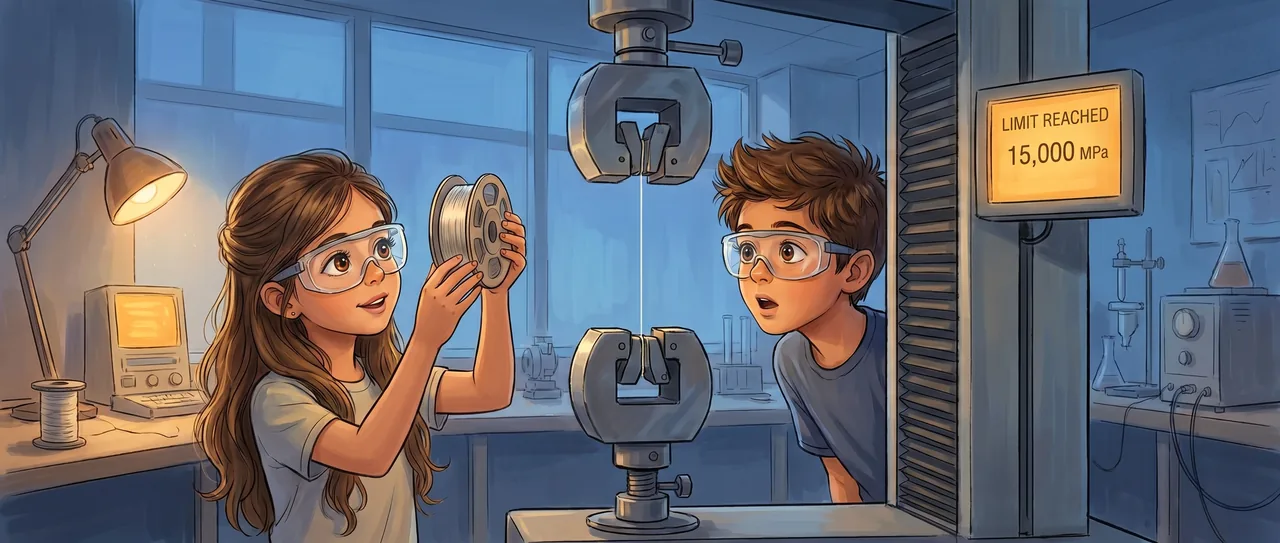
Soren was not watching the screen. He was watching the fiber.
It was thinner than a hair. Barely visible between the two clamps. And it was holding. The machine was pulling with a force that had already snapped steel, and this thread, this nothing, this whisper of a thing, was holding.
"What is it?" he asked.
Dr. Vasquez was still texting. "It's a carbon nanotube yarn. One of my graduate students spun it. I put it in as a demo but I didn't expect." She trailed off. The readout hit twelve thousand.
"It's not even stretching," Maya said.
Soren looked at her. She was right. The other fibers had all elongated before they broke. This one looked exactly the same as when they had clamped it in. He wrote that down.
"Why is it so strong?" one of the other kids asked. Dr. Vasquez was now on a phone call, pacing toward the hallway, saying things like "Jia, come down here, bring your data."
Maya pulled Soren toward the materials table where the sample containers sat in a row. Each one had a label. Sample twelve's label read: MWCNT Fiber, Batch 7, aligned.
"Multi-walled carbon nanotube," Soren said, reading his program booklet. "It says here the carbon atoms are arranged in a cylinder. Like chicken wire rolled into a tube."
"Chicken wire isn't strong."
"Chicken wire isn't one atom thick."
Maya picked up the container. Inside, a spool held a length of dark fiber no thicker than sewing thread. She turned it in the light. "Soren. This weighs nothing."
He took it. She was right again. It felt like holding an empty container.
"That's the thing," he said slowly. "Steel is strong but heavy. This is strong and weighs almost nothing."
Behind them, the machine beeped. They both turned. The readout said LIMIT REACHED. Fifteen thousand megapascals. The machine had maxed out.
The fiber had not broken.
Dr. Vasquez came back in with a young woman in a lab coat who looked like she had been sleeping. "Which batch?" the woman said.
"Seven."
The woman, Jia, pressed her hands against her face and stood very still for several seconds.
"Is it good?" Maya asked.
Jia laughed. It was the kind of laugh that sounds like crying. "I aligned them," she said to Dr. Vasquez, ignoring Maya entirely. "I used the new magnetic field protocol and I think the tubes actually aligned. If the alignment holds at longer lengths."
She kept talking. Technical words. Maya and Soren drifted away from the conversation they were not part of.
They stood at the window. The program booklet had a diagram of a carbon nanotube. Six carbon atoms in a hexagon, repeated, curved into a seamless cylinder roughly one nanometer wide. One billionth of a meter.
"The theoretical strength," Soren read aloud, "is approximately one hundred times that of steel, at one sixth the weight."
Maya pressed her forehead against the glass. Outside, clouds moved over the campus, and beyond them the sky was that impossible deep blue that happens in late October.
"What would you build," she said, "if you had a rope that was a hundred times stronger than steel and weighed almost nothing?"
Soren did not answer right away. He was thinking about the number. One hundred times stronger. One sixth the weight. He multiplied those in his head. Strength to weight. Six hundred times better than steel, roughly.
"You could build something really tall," he said.
"How tall?"
"I mean. The problem with building tall things is the material has to support its own weight. Steel cables can't even hold themselves up past a certain length. They break under their own heaviness."
"But this wouldn't."
"This might not."
Maya turned from the window. "A cable from the ground to orbit."
Soren stared at her. Then he stared at the spool of dark fiber on the table. Then he stared at the sky.
"A space elevator," he said.
"A space elevator."
They were both quiet. The idea was too large to say more about. You would not need rockets. You would not need fuel. You would climb. You would just climb, on a thread, all the way up.
"That's why she was crying," Maya said.
"She was laughing."
"Same thing. She knows what it means if the alignment holds at longer lengths."
Soren looked back at the machine. The fiber was still clamped in, still intact, still a thread so thin you could barely see it. Jia was on her phone now too. Dr. Vasquez was taking photographs of the readout.
Nobody was running the outreach program anymore. Nobody was paying attention to fifteen kids in safety goggles. Because something had happened in this room that was about a future neither Maya nor Soren would be kids for, and they both knew it, and the knowing was so big it was hard to breathe around.
"It didn't break," Soren said.
"It didn't break," Maya said.
The fiber hung between the clamps, thinner than a hair, barely visible, holding the weight of everything they had asked it to hold, still holding, patient as a road that has not been walked yet.
Maya reached out and touched the spool on the table, running her thumb along the dark thread that weighed almost nothing at all.
Read the interactive version, listen to the narration, and earn a gold star →
A science-verified short story for curious kids · Curiosity Land