The One Percent
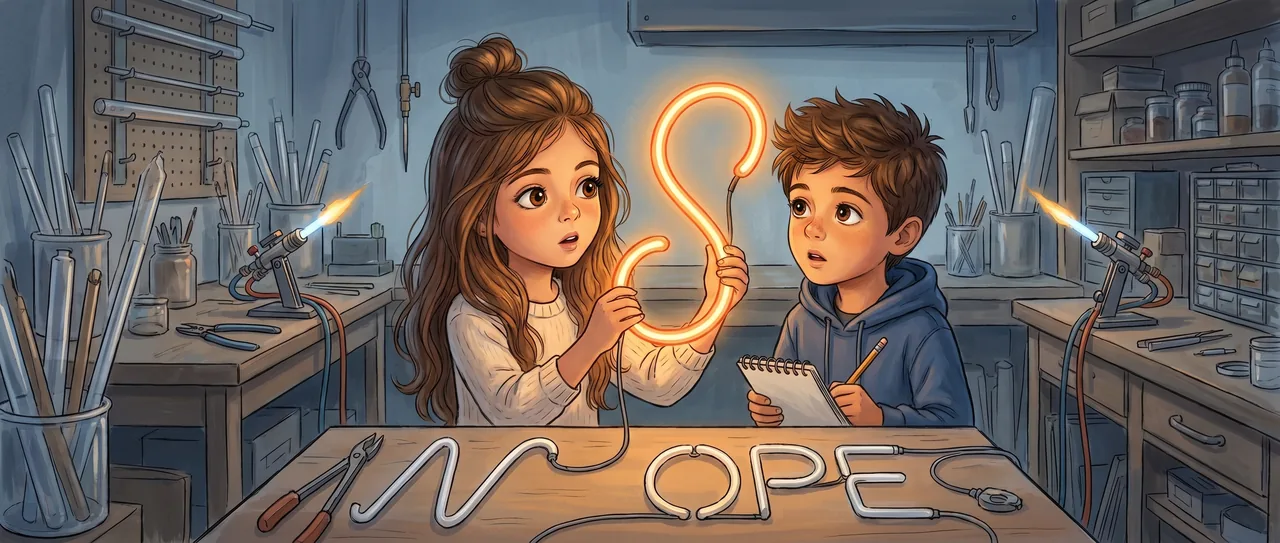
The sign was supposed to say OPEN.
It said OPE.
The N tube sat dark on the workbench, and Mr. Roosa was annoyed about it. He kept tapping the electrode with his thumbnail while the summer camp kids crowded around the other displays. Maya and Soren were the only ones still watching him fail.
"Leak in the seal," Mr. Roosa muttered, more to himself than to them. "Air got in. Kills the whole thing." He set the tube down and picked up a working one, a long glass tube bent into a cursive letter S, glowing the color of a tangerine.
"This is what we're here to see," he announced to the group, holding it up. "Neon gas, sealed inside glass. You run current through it, and the gas does something. Anybody know what?"
Someone said, "It lights up."
"Sure," said Mr. Roosa. "But what actually happens to it?"
Silence.
Maya was staring at the dead N. She picked it up, then put it down.
"It stops being a gas," she said.
Mr. Roosa looked at her. "Go on."
"I don't know the word for what it becomes. But it's not a gas anymore, right? If it were still a gas it wouldn't glow."
Mr. Roosa almost smiled. "Plasma. The gas gets so energized that its atoms start losing electrons. Electrons fly free. The whole thing becomes a soup of charged particles. That's plasma. Fourth state of matter."
He said it like he was checking a box, and moved on to show the group how he bent glass with a ribbon burner. Most of the kids followed him.
Soren didn't. He was writing something down. Then he stopped and looked at Maya.
"He said fourth state of matter."
"Yeah."
"Solid, liquid, gas, and then plasma. So there are four."
"Yeah."
"So why did I only ever learn three?"
Maya picked up the dead N tube again. "Because look around. Where is it? Everything here is solid or liquid or gas. The table. The air. His coffee. There's no plasma anywhere unless he forces it into a tube."
Soren looked at the glowing S on the bench. Inside it, something that was not a solid, not a liquid, and not a gas was burning in a color that had no business being that beautiful.
"But it's a state of matter," he said. "Like, an actual one. Not a weird lab trick. It's supposed to be normal."
"Mr. Roosa," Maya called across the studio.
He was in the middle of heating a glass tube and didn't look up. "Busy."
"Is plasma rare?"
"On Earth? Very. Lightning. The aurora. That's about it for nature."
"What about not on Earth?"
Mr. Roosa pulled the soft glass tube from the flame and began bending it with asbestos gloves. He was concentrating. "Stars are plasma. The sun is plasma. Most of the stuff between stars is plasma." He blew gently into one end of the tube to keep it from collapsing. "Most of the visible universe is plasma, actually. Ninety-nine percent. More than ninety-nine."
He said it like it was just another fact. He went back to bending.
Soren's pencil had stopped moving. Maya's hand was still on the dead tube.
"More than ninety-nine percent," Soren repeated quietly.
"So we live in the one percent," Maya said.
Soren sat down on a stool. He needed a second. Maya could see him doing what he always did, running the numbers forward, testing them against what he already knew to see if the structure held.
"Every star," he said. "Every star we can see."
"Plasma."
"The sun. The thing that makes everything here alive."
"Plasma."
"The nebulas in Soren's phone wallpaper."
Maya grinned. "You refer to yourself in third person now?"
"The nebulas, Maya."
"Plasma."
He stood up. "So the most common state of matter in the entire visible universe is the one we basically never experience. We live on a little cold rock where things are solid and wet and gassy, and that's the weird part. That's the exception. We're the exception."
Maya put the dead N tube back on the bench and picked up the glowing S. It was warm in her hands. Inside the glass, the neon plasma shimmered, charged particles shedding photons as electrons fell back into place and got knocked free again, over and over, a tiny furious cycle.
"This is what normal looks like," she said, holding it up. "Out there. This is what almost everything is."
"And we need a sealed glass tube and an electrical current just to get a little piece of it."
They stood there, two eleven-year-olds holding a letter that didn't spell anything, while across the room Mr. Roosa's ribbon burner hissed and the other kids took selfies with the word OPE.
Soren opened his notebook again. Then he closed it.
"What?" Maya asked.
"I was going to write down that plasma is ninety-nine percent of the visible universe. But that's just the fact. That's not the thing."
"What's the thing?"
He looked at her, and then past her, at the window. Outside, the sun was doing what it always did. Fusing hydrogen into helium, sixteen million degrees at its core, a ball of plasma so enormous that one point three million Earths could fit inside it. It was right there. It had always been right there.
"We grow up thinking solid is normal," he said. "But solid is the fluke. We're the weird ones. Our whole planet is the weird one."
Maya held the glowing tube higher. Its light fell on both their faces, tangerine and strange.
"I like that," she said. "I like being the weird one."
For one held breath, the tube between them was a tiny window into the way the universe actually worked, the real normal, the ninety-nine percent they had never been taught, and the light it cast was the same ancient light as everything burning out there in the dark.
Mr. Roosa called for the group to line up by the door.
Maya set the S tube gently back on the bench, and it went on glowing after her hands left it.
Read the interactive version, listen to the narration, and earn a gold star →
A science-verified short story for curious kids · Curiosity Land