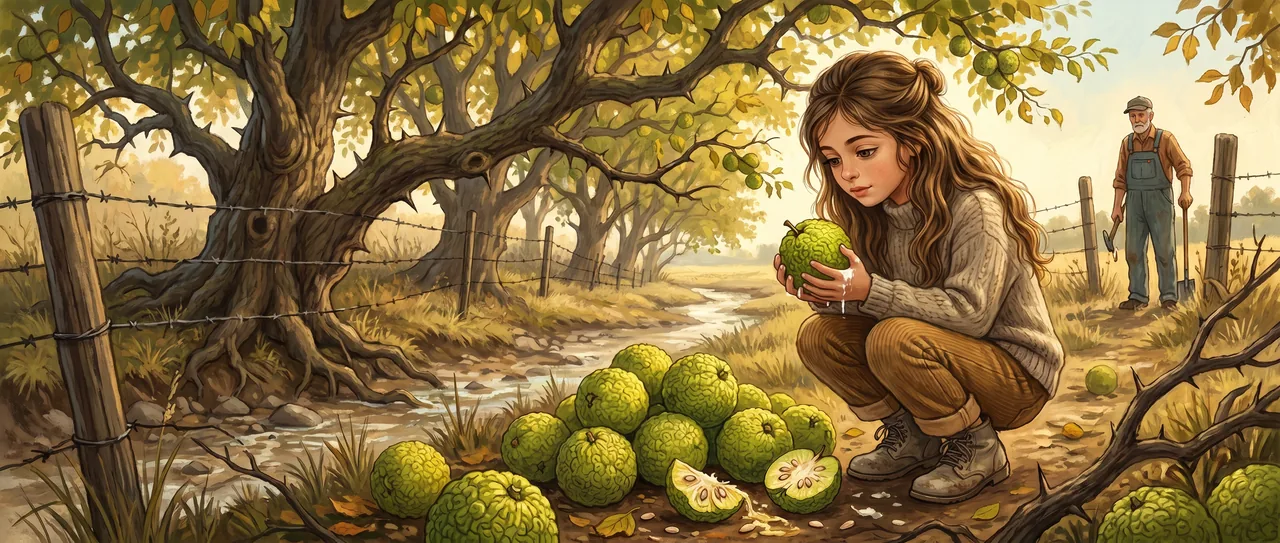
The Fruits Nobody Eats
The first thing Maya noticed was the smell.
Sweet and sharp at the same time, like someone had crushed a hundred limes into wet grass. She was walking the fence line behind her grandmother's property, kicking at the dust because she'd been told to get some air while the adults argued about property taxes inside. The smell rose from the ground, and she followed it to a heap of green globes scattered under a twisted tree.
They were the size of softballs, bumpy and brain-wrinkled, split open where they'd fallen. Seeds spilled out of the pale flesh like loose teeth. Dozens of them on the ground. Maybe hundreds. All just sitting there, rotting.
Her grandmother's neighbor, Mr. Pruitt, was on the other side of the fence replacing a post. He looked up when she crouched near the pile.
"Hedge apples," he said. "Osage orange. Don't eat those."
"I wasn't going to," Maya said. She picked one up. It was heavy, dense, sticky with white sap that clung to her fingers. "What eats them?"
"Nothing," said Mr. Pruitt. He drove the post another inch into the ground. "Squirrels tear into them sometimes for the seeds, but they don't move them anywhere useful. Mostly they just fall and rot. Whole tree's a nuisance, if you ask me. Good fence wood though."
He went back to hammering.
Maya turned the fruit over. The seeds were packed deep inside, wrapped in that tough, fibrous flesh. She tried to pull one out and couldn't, not without really digging. A squirrel could gnaw the seeds free, sure. But the fruit wasn't designed for gnawing. It was designed for swallowing.
Something was supposed to eat this whole.
She looked at the fruit in her hand. Softball-sized. What eats a softball?
Not a deer. Not a coyote. She thought about the animals she knew in Texas. Feral hogs, maybe, but the fruit had been here longer than feral hogs. Way longer. The tree looked ancient, and the fence line ran along a creek bed that had probably been here for centuries.
She set the fruit down and counted the ones she could see. Forty, fifty, more behind the trunk. All within a few meters of the parent tree. Every single seed, every year, landing in the shadow of its own parent, where it would have to compete for the same water, the same light, the same thin soil. No animal carrying them away. No river moving them. Just falling and falling and going nowhere.
Mr. Pruitt straightened up, wiping his forehead. "My granddad used to say they keep spiders away. Put them in your basement. Load of hogwash, but people still buy them at the farmer's market. Dollar a piece."
"Mr. Pruitt," Maya said. "How big would an animal have to be to swallow one of these?"
He looked at her like the question had come from a different conversation. "I don't know. Big."
"Like, elephant big?"
He laughed. "No elephants in Texas, sweetheart."
"Not now," Maya said.
She said it quietly, almost to herself. But she heard it land. Not now. The tree was still making fruit for a mouth that no longer existed.
She knew about mammoths. Everyone knew about mammoths. But she had never once thought about what mammoths ate, or what depended on them eating it. She picked the fruit up again, felt its weight, its ridiculous size. This was not a berry. This was not meant to be carried by wind or stuck to fur. This was a meal. A whole, dense, swallowable meal, wrapped in a package that would survive a digestive tract and come out the other end, kilometers away, buried in a warm pile of fertilizer.
The animal was supposed to eat it, walk for a day, and plant it somewhere new.
The animal had been dead for thirteen thousand years. And the tree was still packing the lunch.
Maya stood up and looked down the fence line. Osage oranges grew in a tight, gnarled row, the way trees grow when they can never get far enough from each other. She could see three, four, five of them, all hunched and competing. If they'd had their disperser, they would have been scattered across the landscape, each one alone in its own wide space. A forest that was supposed to be spread across miles had been compressed into a single fence line, waiting.
Not waiting. Trees don't wait. They just keep doing the thing that worked, over and over, even after the world changes around them. The fruit still ripens. The flesh still wraps around the seeds. The smell still calls out to something.
She pressed her thumb into the bumpy surface, and the sap stuck to her skin like the tree was trying to hold on.
Thirteen thousand years. That was longer than all of recorded human history. Longer than writing, longer than cities. And every autumn, the Osage orange made its fruit and dropped it and nothing came. Nothing big enough. The engineering was perfect. The passenger was gone.
Mr. Pruitt finished his post and gathered his tools. "You want a bag of those? My wife sells them at the market. Like I said, dollar a piece."
"People carry them home," Maya said.
"Sure. Basement, closet, wherever."
"People carry them home. In their cars. Miles away."
Mr. Pruitt gave her a long look. Then he laughed, shook his head, and walked back toward his house.
Maya didn't laugh. She was thinking about how humans built roads along the same paths animals once walked. How the fence lines followed the creeks where megafauna came to drink. How every autumn, people picked up these strange, beautiful, useless fruits because something about them was irresistible, even though no one could say why.
The tree had been waiting for a giant. It got one. A different kind. One with trucks and farmer's markets and basements. One that carried things not in its gut but in grocery bags, not for miles but for dozens of miles, and sometimes threw the seeds out in the yard because they'd started to smell.
She looked at the heap of green globes glowing in the low October sun, sticky and heavy and perfect for a mouth that would never come again.
Then she picked up two of them, one for each hand, and started walking toward the road.
Read the interactive version, listen to the narration, and earn a gold star →
A science-verified short story for curious kids · Curiosity Land