The Bone That Chose
The argument started because of a chicken bone.
Soren held it up under the fluorescent lights of the biomaterials lab, turning it slowly. The university open house was winding down, and most of the other visitors had drifted toward the robotics demo down the hall. But Maya had stopped at this table twenty minutes ago and hadn't moved.
"It's not glued," she said for the third time.
"Everything that sticks to something else is glued," Soren said. "That's what glued means."
"No. Look."
The table was covered with sample displays: a titanium hip joint, a dental implant the size of a pencil eraser, and cross-section photographs of bone fused to metal. The PhD student who was supposed to be running the demonstration had gotten a phone call ten minutes ago and stepped into the hallway, leaving them alone with the microscopes and sample slides.
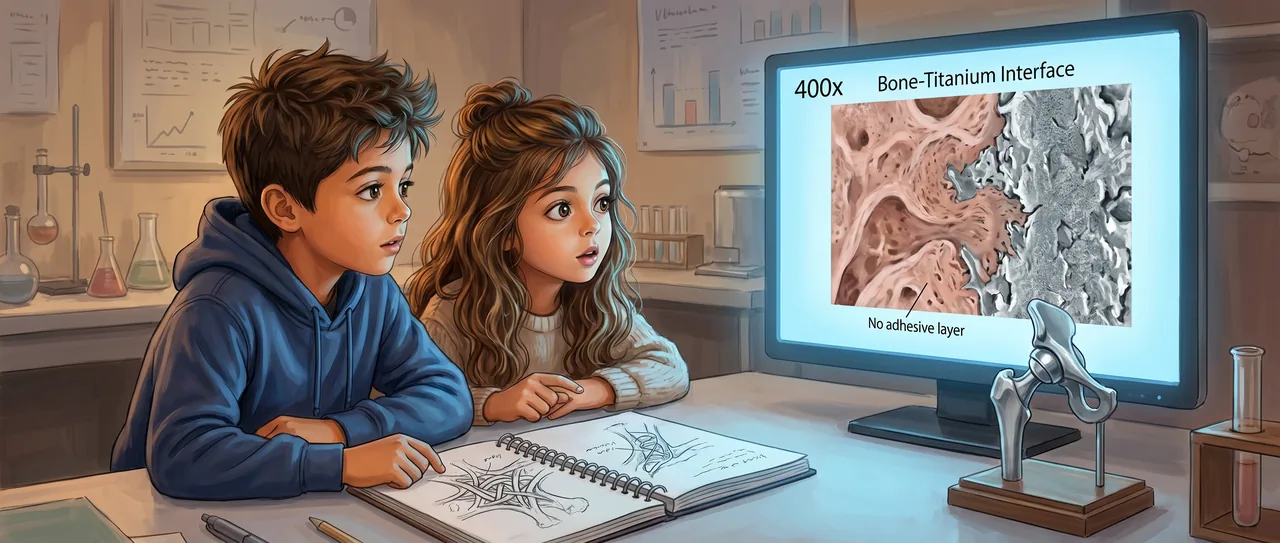
Maya pointed at the projected image on the monitor above the microscope station. It showed a slice of bone tissue meeting a titanium surface, magnified four hundred times. "If it were glued, you'd see the glue. A layer of something between the bone and the metal. Some third thing holding them together."
Soren leaned closer to the monitor. She was right about that. There was no visible layer between the living bone and the implant surface. The bone cells simply arrived at the titanium and continued, as if the metal were a continuation of themselves.
"Maybe the glue is just really thin," he said, but he was already pulling his notebook out because something about the image was bothering him too.
"Draw what you see," Maya said.
"I am drawing what I see."
He sketched the boundary. Bone on one side, titanium on the other. But the boundary wasn't a line. It was a territory. The bone tissue had reached into every microscopic ridge and valley of the metal surface, like roots growing into soil. Except roots push soil aside. This looked different. This looked like the bone had recognized the metal as something it could become part of.
"That's what doesn't make sense," Maya said, reading his sketch upside down. "Your body rejects everything. Splinters. Other people's blood if it's the wrong type. Even surgical thread, eventually. So why would bone cells grow toward titanium instead of away from it?"
Soren flipped to the informational card on the table. He read it aloud: "Titanium spontaneously forms a thin layer of titanium oxide on its surface when exposed to air. This oxide layer is biocompatible, meaning bone cells, called osteoblasts, can attach directly to it and deposit new bone matrix. The process is called osseointegration."
"Spontaneously," Maya repeated. "So the titanium does it on its own. It coats itself."
"In air. Just from touching air."
They both looked at the hip joint sitting on the display stand. It gleamed under the lab lights, silver-gray and smooth. Right now, this very second, its surface was covered in a layer of titanium oxide so thin it was measured in nanometers. The metal had armored itself with a shell that happened, by some accident of chemistry, to be the one thing bone cells recognized as safe.
The PhD student came back in, still distracted, phone in hand. Her name tag said Priya.
"You're still here," she said, surprised.
"Why does bone trust titanium?" Maya asked.
Priya blinked. "Well, the oxide layer has a specific crystalline structure. And it's negatively charged at physiological pH, which attracts the proteins that osteoblasts use to anchor themselves. Basically, the surface chemistry accidentally mimics what bone cells are already looking for."
"Accidentally," Soren said.
"Yeah. Nobody designed it that way. A Swedish orthopedic surgeon named Branemark discovered it in nineteen fifty-two. He put titanium chambers in rabbit legs to study blood flow and then couldn't get them out. The bone had fused to the metal so completely that the titanium had become part of the skeleton."
"He was studying something else entirely," Maya said.
"Blood flow, yeah. Osseointegration was an accident he was paying enough attention to notice." Priya glanced at her phone, then seemed to decide something and put it in her pocket. "The wild part is that the bond is stronger than glue would be. If you try to break an osseointegrated implant free, the bone fractures before the connection does. The living bone fails before the interface does."
Soren stopped writing. He read that sentence back in his head. The bone breaks before the bond does.
"That means it's not attachment," he said slowly. "Attachment can be undone. This is, the bone doesn't think there's a boundary anymore."
"The bone doesn't think anything," Priya said, almost reflexively, then paused. "But yes. At the cellular level, the osteoblasts treat the titanium oxide surface as if it were a continuation of the bone's own mineral structure. They deposit hydroxyapatite directly onto it. The same calcium phosphate mineral that makes bone hard. So the interface becomes bone-mineral-titanium with no gap."
Maya was staring at the cross-section image again. "So the titanium doesn't pretend to be bone. It just has a surface that bone is allowed to claim."
Priya opened her mouth, then closed it. "That's actually a really good way to describe it. Most biomaterials researchers spend their careers trying to make surfaces that the body won't attack. Titanium doesn't trick the immune system. The oxide layer is just, genuinely, something bone can grow on. It's honest compatibility."
Soren looked at Maya. She was doing the thing she did when something connected to something else in her head, her eyes focused on nothing in the room.
"What," he said.
"We had the question wrong. I said your body rejects everything. But it doesn't. It rejects things that don't fit. If something actually fits, actually matches what the cells are searching for, bone doesn't just tolerate it. Bone chooses it. Harder than it chooses itself."
The room was quiet. Priya was watching Maya with an expression Soren recognized because he'd felt it before, the expression of an adult realizing a kid had just rephrased their entire field in one sentence.
"You two should come back on a weekday," Priya said. "I have samples from a twelve-year osseointegration study. The bone remodeled around the implant the same way it remodels around its own structure. It couldn't tell the difference anymore."
Soren wrote that down. Twelve years. He underlined it twice, then looked up at the cross-section image still glowing on the monitor, that borderland where bone became metal became bone, and no cell on either side knew where one ended and the other began.
Read the interactive version, listen to the narration, and earn a gold star →
A science-verified short story for curious kids · Curiosity Land