Fainter Than It Should Be
The supernova was wrong.
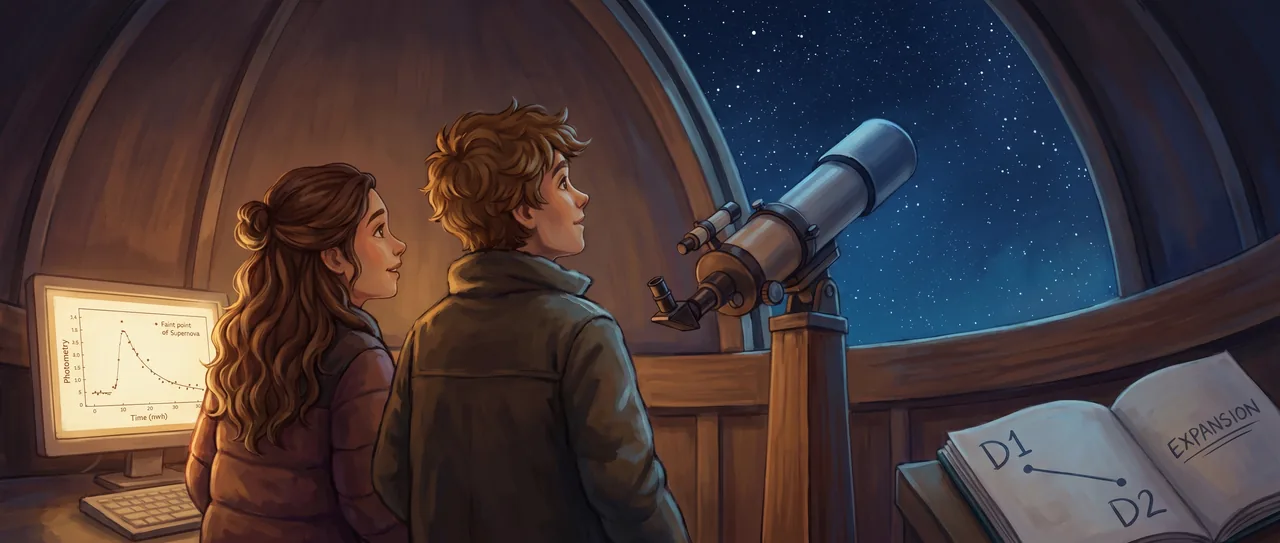
Maya had checked their measurements four times, which was unusual for her. Soren had checked them six times, which was not. They sat side by side at the computer terminal in the rooftop observatory of Garfield High School, and the number on the screen refused to change.
"It's too faint," Maya said.
"I know."
"Like, not a little too faint. Way too faint."
"I know."
They had been working toward this for seven weekends. Mr. Haddad, the physics teacher who had sponsored their access to the twelve-inch telescope, had given them a single task for the student competition: measure the apparent brightness of a Type Ia supernova in a distant galaxy, compare it to its known intrinsic brightness, and calculate how far away it was. Simple. Type Ia supernovae were perfect for this because they all exploded with nearly the same luminosity. Standard candles, the textbooks called them. If you knew how bright something actually was, and you measured how bright it looked, you could figure out the distance. Like seeing a hundred-watt lightbulb and knowing it was far away because it looked dim.
Except their lightbulb was dimmer than it should have been.
Not dimmer than a hundred watts. They had accounted for that. The problem was that the distance they calculated from the dimness was larger than the distance they calculated from the supernova's redshift. Two different methods. Two different answers. And the brightness method said the supernova was farther away.
"So either our photometry is wrong," Soren said, writing both numbers in his notebook and drawing a line between them, "or the redshift measurement is wrong."
"Or neither is wrong," Maya said.
Soren looked at her. "Both can't be right. They give different distances."
"I didn't say both were right. I said maybe neither is wrong."
He waited. This was the part where Maya had gotten somewhere and hadn't told him how yet.
"What if the supernova really is as far as the brightness says," she said slowly. "But it got there faster than the redshift expects."
Soren tapped his pen against the notebook. "That would mean the galaxy moved away faster than we predicted from its redshift. But the redshift literally tells you how fast something is receding. That's what redshift is."
"The redshift tells you how fast it was moving when the light left. Not how fast it's moving now."
The observatory hummed. The tracking motor in the telescope made its small constant sound, keeping pace with the rotation of the Earth. Below them, the school parking lot was empty except for Mr. Haddad's car. He was downstairs grading papers, having told them he trusted them not to break anything expensive.
Soren wrote Maya's sentence down. He read it back to himself. He looked at the two numbers again.
"If something is farther away than its recession speed suggests," he said carefully, "that means it covered more distance than it should have in the time the light was traveling."
"Which means it sped up," Maya said.
"The expansion sped up."
They both went quiet.
Maya stood and walked to the dome slit, where the telescope pointed out at the sky. The supernova was invisible to the naked eye, just one fading point of light in a galaxy so distant it was barely a smudge even through the eyepiece. But the CCD camera had captured it, and the photometry software had measured it, and the number was the number.
"That can't be right, though," Soren said from behind her. "The expansion of the universe is supposed to be slowing down. Gravity pulls everything back. Everything we've read says that."
"Everything we've read was written before someone checked."
Soren came to stand beside her at the dome slit. The night was cold and clear. Stars everywhere. She could feel him thinking.
"If the expansion is accelerating," he said, "something has to be driving it. Gravity pulls things together. For things to fly apart faster and faster, there has to be something pushing. Something stronger than gravity on big scales."
"What would that be?"
"I have no idea. I don't think anyone does."
"Soren."
"What."
"We didn't discover this. Did we."
He almost laughed. "No. No, this was 1998. Two teams. They found exactly what we found. Supernovae too faint. Distances too large. The universe accelerating. They won the Nobel Prize for it."
"Then why didn't Mr. Haddad warn us?"
Soren was quiet for a moment. Then he said, "I think he wanted us to find the wrong answer."
Maya turned to look at him.
"Not wrong. The answer that feels wrong. The one where you check it six times because you think you messed up. I think that was the whole point of the assignment."
She thought about that. About two teams of astronomers in 1998 staring at numbers that made no sense, checking their instruments, suspecting errors, finding none. About the moment when not-making-sense became the answer.
"Seventy percent," Soren said quietly.
"What?"
"I looked it up once. Whatever is causing the acceleration, whatever this pushing force is, it makes up about sixty-eight percent of all the energy in the universe. The majority of everything that exists is something we discovered twenty-seven years ago and still can't explain."
Maya pressed her forehead against the cold metal of the dome frame. Sixty-eight percent. More than half of everything, and it was invisible, unidentified, known only because supernovae were too faint. Known only because someone measured a brightness and got an answer that didn't match, and instead of throwing it away, they kept it.
The tracking motor hummed. The telescope followed its star.
"We should write up our results for the competition," Soren said.
"With the wrong distance?"
"With both distances. And the gap between them. And what the gap means."
Maya nodded. She looked out through the dome slit again, at all those stars pulling away from each other, the spaces between them stretching wider, and the stretching getting faster, and no one knowing why. She thought about all the things that were supposed to slow down and didn't. All the numbers that were supposed to match and didn't. She thought about what it meant that the universe's deepest secret had been found not by someone looking for it, but by someone paying close enough attention to trust a measurement that seemed like a mistake.
Below them a door opened, and Mr. Haddad called up, "You two finding anything interesting?"
Maya looked at Soren. Soren looked at Maya.
"We're not sure yet," Maya called back.
Above them the dome slit framed a narrow rectangle of sky, and inside it, the stars were getting farther apart.
Read the interactive version, listen to the narration, and earn a gold star →
A science-verified short story for curious kids · Curiosity Land