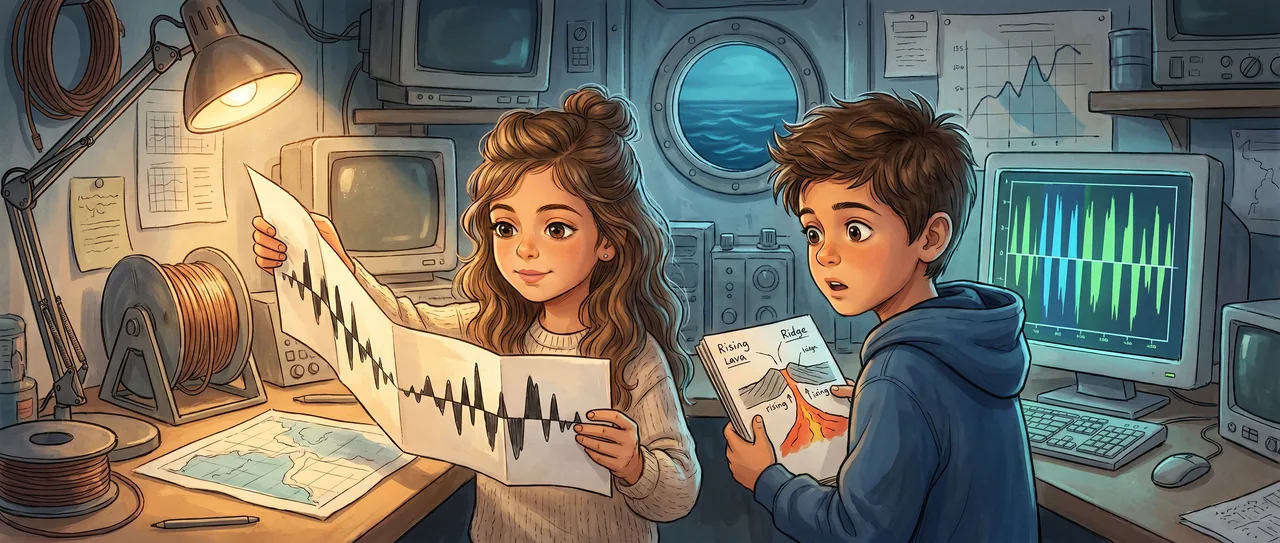
The Tape That Plays Backward
The magnetometer was broken, and Dr. Reiss would not stop talking about lunch.
"Cafeteria closes at one," she said, already halfway out the lab door. "Don't touch the tow cable. I mean it. Back in twenty."
Soren stared at the screen. The magnetometer wasn't broken. He'd been watching it for three hours, and the signal was doing exactly what a signal does. It was just doing it wrong.
"Maya."
She was cross-legged on the deck beside him, sorting through the morning's printouts. Strips of paper covered in tiny numbers, each one representing the magnetic field strength measured by the sensor they were dragging behind the ship.
"Maya, look at this."
"I'm looking at something," she said. But she came over.
The screen showed a graph. As the ship crossed the ridge, the magnetic readings should have been roughly even. The Earth has a magnetic field. Rocks on the ocean floor are magnetized. You drag a sensor over them, you get a reading. Simple.
Except the readings swung. Positive, negative, positive, negative. Not randomly. In bands. Symmetrical bands, mirrored on either side of the ridge.
"Dr. Reiss said the sensor housing might be cracked," Soren said. "Water leaking in, corrupting the data."
"Does corrupted data come in symmetrical stripes?" Maya asked.
Soren pulled up the morning's track on the navigation display. The ship had crossed the ridge at nine forty-seven, heading east. He pointed at the graph. "Here's the ridge. See how the pattern on the left mirrors the pattern on the right? Positive band, negative band, wide positive band, thin negative band. Then the ridge. Then thin negative, wide positive, negative, positive. It's a mirror."
"So the sensor isn't broken."
"The sensor isn't broken."
Maya took one of the printout strips and folded it in half, lining up the ridge point with the crease. She held it to the light. The peaks and valleys on one side aligned almost perfectly with the peaks and valleys on the other.
"Soren, what makes rock magnetic?"
He'd read the orientation packet three times. "When lava cools, iron minerals in it lock in whatever direction the Earth's magnetic field is pointing. Like a compass needle frozen in stone."
"So positive means the rock locked in a field pointing north. Same as now."
"And negative means it locked in a field pointing the other way. South."
Maya set the paper strip down on the table. She smoothed it flat. "The Earth's field has flipped. Multiple times."
"That's in the packet, yeah. Every few hundred thousand years, sometimes longer. North becomes south, south becomes north."
"And the ridge is where new crust forms. Lava comes up, cools, becomes rock, gets pushed to the sides."
Soren felt the thing she was building toward, but he needed to walk there himself. He pulled out his notebook and drew it. A line down the center for the ridge. Lava rising. Cooling. Splitting apart, half going left, half going right. New lava filling the gap. Cooling. Splitting again.
"If the field is normal when a batch cools, both halves carry normal magnetism. One half goes left, one goes right."
"Then the field flips," Maya said.
"Next batch cools with reversed magnetism. Splits. Goes both directions."
"So you'd get stripes," Maya said. "And they'd be mirrored. Because every batch gets torn in half."
Soren looked at his drawing. He looked at the graph on the screen. He looked at Maya's folded printout strip.
"The ocean floor is a recording," he said.
Maya didn't answer immediately. She was running her finger along the printout, touching each band.
"This wide one," she said. "This is a long time when the field didn't flip. Maybe a million years of normal field, just sitting there, while lava kept coming up and cooling."
She moved her finger. "This thin one. Short reversal. The field flipped, stayed flipped for maybe a hundred thousand years, flipped back."
Soren counted the bands. Seven distinct reversals visible in their single east-west crossing. Seven times the whole planet's magnetic field had swapped ends, and each time, the lava had faithfully written it down.
"We're dragging a tape head across the ocean floor," he said. "And the ocean floor is the tape."
"A tape that plays the same backward and forward," Maya said. "Because it records in both directions at once."
The ship hummed beneath them. Two thousand meters below, the Mid-Atlantic Ridge was still doing it. Right now. Lava was rising, cooling, locking in today's field, being pushed aside. The Atlantic Ocean was getting wider. Not fast. About as fast as fingernails grow. But the tape was still recording.
Soren tried to hold the scale of it in his head and couldn't. The oldest stripes at the edges of the Atlantic were a hundred and eighty million years old. The ocean hadn't existed and then it did, written into being one stripe at a time, carrying a record of every reversal the planet had ever made.
"Why does the field flip?" he asked.
Maya shook her head. "Nobody knows. The packet says nobody fully knows."
"But it does."
"It does."
And every time, the rock remembers.
The lab door opened. Dr. Reiss came back holding a sandwich and frowning at her phone. "Okay, I emailed the tech team about the sensor. They said they can't look at it until we're back in port, so we should just flag the anomalous data and move on to the bathymetry."
"Dr. Reiss," Soren said. "The data isn't anomalous."
She looked up.
Maya handed her the folded printout strip. "Fold is at the ridge. Hold it to the light."
Dr. Reiss held it up. She went very quiet. Then she set her sandwich down and pulled a chair up to the screen, leaning in close, scrolling back through the morning's full dataset.
"This is clean," she murmured. "This is really clean."
She reached for the ship's intercom. "Bridge, this is Reiss in the magnetics lab. I need our afternoon track changed. I want five more east-west crossings at ten-kilometer intervals. Yes, today."
She hung up and looked at them. Not like a teacher. Like a colleague who had almost thrown good data away.
"Show me everything you found," she said.
Maya was already pulling up the navigation display. Soren turned to a fresh page in his notebook and started redrawing his diagram, cleaner this time, with the stripe widths labeled.
Beneath them, the ship changed course, and far below, the ridge went on recording.
Read the interactive version, listen to the narration, and earn a gold star →
A science-verified short story for curious kids · Curiosity Land