The Tallest Mountain
The signal was wrong, and Soren knew it before anyone else did.
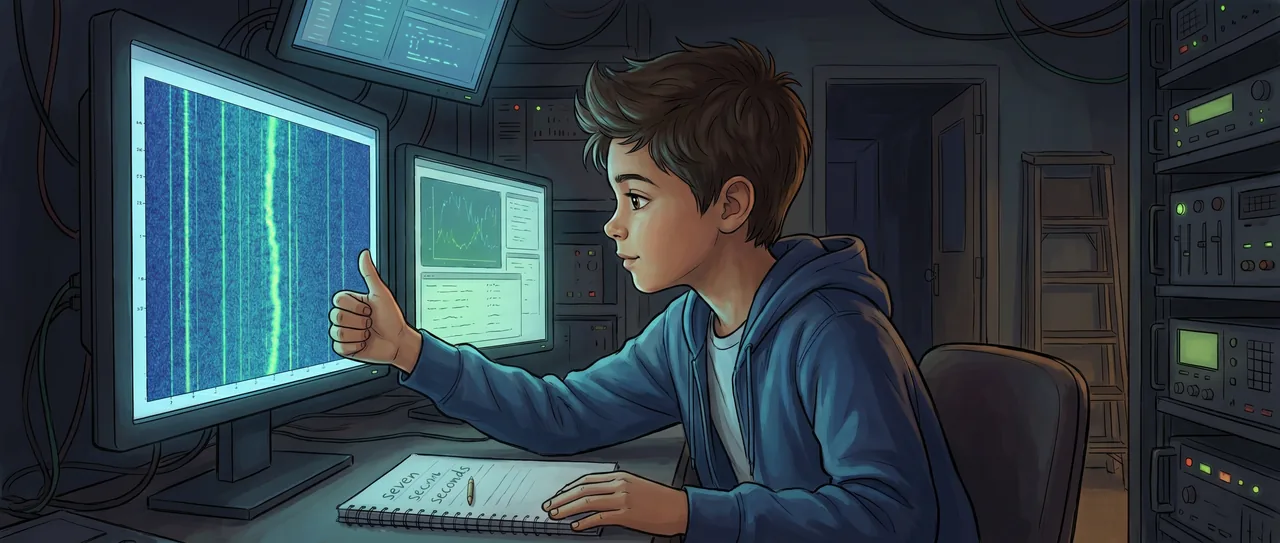
His mother had left him at the monitoring station while she climbed the access ladder to swap a faulty amplifier card on the dish. She did this kind of thing on Saturdays. Soren came along because the university lab had good wifi and a vending machine with those cinnamon pretzels. But today the vending machine was broken, and his phone was dead, and so he was just sitting there, watching the signal waterfall scroll down the screen.
The pulsar they were tracking, PSR J0437, blinked in radio waves one hundred seventy-four times per second. The signal was supposed to be a clean vertical stripe on the waterfall display. Perfectly regular. Perfectly boring.
Except it wobbled.
Soren watched the stripe shiver, then steady, then shiver again. He opened his notebook and started counting the interval between wobbles. Seven seconds. Seven seconds. Seven seconds. Then eight. Then seven.
His mother's voice crackled on the intercom. "Soren, don't touch anything. I'm almost done up here."
"I'm not touching anything," he said. "But the signal's wobbling."
"Probably the new amplifier card settling in. Ignore it."
He wrote down: Mom says ignore it. Then he wrote down: But it was wobbling before she put the new card in.
He pulled up the archive from two hours ago, from before they'd started any maintenance. He scrolled through the waterfall. Clean. Clean. Clean. Then, forty minutes ago, the wobble started. His mother hadn't gone up the ladder until twenty minutes ago.
So the wobble wasn't the equipment.
Soren leaned closer. The wobble had a shape to it. Not random noise. A pattern that repeated, almost but not quite the same each time, like someone humming a tune they kept almost remembering.
He pulled up the reference page for PSR J0437 on the lab computer. A neutron star. The collapsed core of a dead star, about twenty kilometers across. Spinning one hundred seventy-four times every second. He'd known that already. His mother talked about pulsars the way other people's parents talked about weather.
But he'd never really thought about what twenty kilometers meant. He scrolled down.
Mass: one point four times the mass of the sun.
He read that twice. A thing the size of a city, weighing more than the sun.
The gravity section made him put his pretzel money on the table and sit very still.
Surface gravity: approximately two hundred billion times Earth's gravity. A marshmallow dropped from one meter above the surface would strike with the energy of a small nuclear weapon.
Soren looked at the table in front of him. One meter. The distance from his hand to the floor. He imagined holding a marshmallow and letting go. On Earth it would bounce. On that star it would hit like a bomb.
The same distance. The same marshmallow. A completely different universe of consequences.
He kept reading. Under that gravity, the surface of a neutron star was almost perfectly smooth. The strongest material in the universe, a crystalline lattice of neutron-rich nuclei, and even it could not support a bump higher than a centimeter or so. The tallest mountain on a neutron star was shorter than his thumbnail.
Soren held up his thumb and looked at it.
That was the tallest anything could be. Not because nothing pushed upward, but because gravity pulled so hard that the strongest possible matter in the universe could only resist it by one centimeter. That was the absolute maximum that structure could defy collapse. Anywhere. On the hardest surface that physics allowed.
He looked back at the wobble on the screen.
If the surface was that smooth, and the star was spinning that fast, then any tiny irregularity, any mountain even a fraction of a centimeter tall, would change how the star's mass was distributed. It would make the spin wobble. Like a basketball spinning on a fingertip with a grain of sand glued to one side.
Soren grabbed a pencil and started calculating. The wobble period he'd measured was about seven seconds. If the star rotated one hundred seventy-four times per second, then in seven seconds it completed about one thousand two hundred eighteen rotations. He didn't know exactly what that meant yet. But the wobble was real, and it had a period, and it started forty minutes ago.
He called up to his mother on the intercom. "How tall is a centimeter?"
"What?"
"Never mind. Can a neutron star grow a new mountain?"
A long pause. He heard a wrench clang. "A starquake. The crust can crack and resettle. It would change the surface features. Why?"
"I think one happened. Forty minutes ago. The wobble started before you changed the card."
Another pause, longer this time. Then his mother's boots on the ladder, fast, and she was in the room, leaning over his shoulder, scrolling through the archive data he'd already pulled up.
"That's not equipment drift," she said quietly.
"I know."
"Soren, if this is a real glitch event, it needs to be reported to the timing consortium within the hour." She was already reaching for the phone. Then she stopped and looked at him. "You caught this."
"It was wobbling," he said, as if that explained it. To him, it did.
She made three phone calls in nine minutes. On the third call, to someone named Dr. Yoon, she said: "My son noticed a wobble in the timing residuals for J0437, onset approximately sixteen forty-seven UTC. Looks like a possible glitch. Yes. Yes, I know. He's eleven."
Soren wasn't really listening. He was looking at his thumbnail again.
Somewhere, three hundred light-years away, on a star that could crush a marshmallow into a nuclear explosion, something had cracked. The crust had broken and shifted, the way continents shift on Earth, but in a millisecond instead of a million years. And where it settled, the new tallest point on the entire star might be half a centimeter high. Maybe less.
The smallest mountain imaginable. On a world where gravity was so total, so absolute, that even that tiny ridge was a monument to the fact that matter fights back. Always. Even when the universe is crushing it with two hundred billion gravities, matter pushes up. Not much. A centimeter. But it pushes.
His mother was still on the phone, reading off timestamps.
Soren pressed his thumbnail flat against the desk and measured its height against the wood grain.
Read the interactive version, listen to the narration, and earn a gold star →
A science-verified short story for curious kids · Curiosity Land