The Number That Followed Them Home
They got eliminated on the second clue, which was embarrassing.
The scavenger hunt was supposed to last three hours. Maya and Soren's team lasted forty minutes. The university volunteers had set up stations all across Ridgemont Park, and teams of kids moved between them solving problems, and Maya and Soren's team got knocked out at Station Four because their answer was wrong by a lot.
The question was about needles.
"If you drop a needle that's exactly as long as the gap between floorboards, and you drop it over and over, what fraction of the time will it land crossing a line?"
Their team had said one half. It felt right. Fifty-fifty. Crosses or doesn't.
The answer was two divided by pi.
"That can't be right," Maya had said to the volunteer, a college student named Derek who was already waving the next team forward. "There aren't any circles."
"Buffon's needle problem," Derek said, not looking up from his clipboard. "Look it up. It's famous."
So now they were sitting on a bench near the pond, eliminated, watching other teams run between stations, and Maya was furious in the way she got furious, which meant she was very quiet and her eyes were moving fast.
"There were no circles," she said again.
"I know," Soren said.
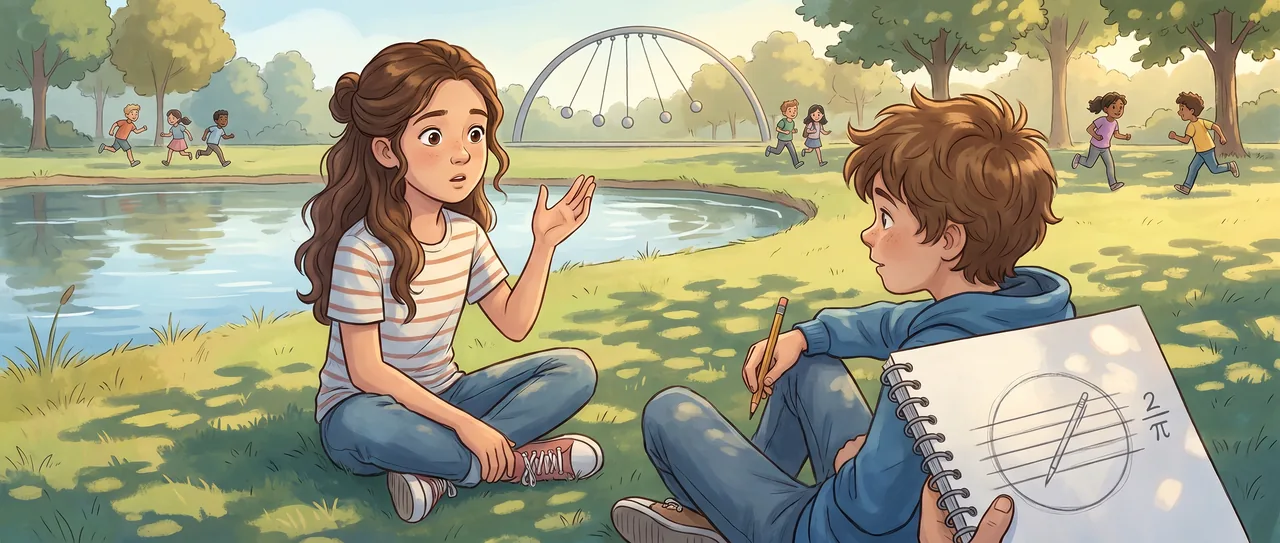
He had his notebook open. He'd written down the answer. Two divided by pi. He'd also drawn a needle and some parallel lines, and he was staring at the drawing like it owed him something.
"The needle rotates when it falls," Maya said suddenly. "It can land at any angle."
"Right."
"Any angle. All the way around."
Soren looked at her. Then he looked at his drawing. Then he slowly traced a circle around the needle with his pencil.
"All the way around is a circle," he said.
"The needle doesn't know about circles. It just falls. But all the angles it could land at, if you collected every possible angle, that's a full rotation. And a full rotation is..."
"Is a circle hiding inside the randomness," Soren finished.
They sat with that for a second.
Maya pulled the scavenger hunt pamphlet from her pocket. It listed all twelve stations and their topics. They couldn't compete anymore, but nobody said they couldn't walk the course.
"Station Seven is about pendulums," she said.
They went to Station Seven. The volunteer there, a woman named Priti who was eating an apple and reading a textbook, barely glanced at them.
"We're eliminated," Maya said. "Can we just read the question?"
Priti shrugged and handed them the card.
The question asked for the period of a pendulum one meter long. The formula was printed on the card: two times pi times the square root of length divided by gravitational acceleration.
"There it is again," Soren said.
"A pendulum swings back and forth," Maya said. "That's not a circle either."
But Soren was already writing. He drew a pendulum. Then he drew the arc it traced. Then, slowly, he extended the arc into a full circle.
"It's part of a circle," he said. "The swing. If it kept going all the way around, it would be circular motion."
"So the pendulum is a piece of a circle pretending to be a straight line."
"Is it pretending? Or is it just what it is, and circles are in there whether it means to or not?"
Priti looked up from her textbook. "You two got eliminated?"
"On Station Four," Maya said.
"Huh." Priti took another bite of her apple. "You don't sound eliminated."
They went to Station Eleven. This one was about probability. The question read: Pick two whole numbers at random. What is the probability that they share no common factors other than one?
The answer was six divided by pi squared.
"Okay," Maya said. "Okay. There is absolutely no circle here. None. Two random numbers. Factors. Division. Where is the circle hiding in that?"
Soren wrote down the answer. Six divided by pi squared. He stared at it. He wrote out pi squared: nine point eight six nine six something. He divided six by it. Zero point six zero seven nine something.
About a sixty-one percent chance.
"I don't see it," he admitted.
Maya sat down in the grass next to the station marker. Soren sat next to her.
"Maybe it's not about circles," she said.
Soren waited. He knew this voice. This was Maya thinking.
"Maybe we have it backwards. Maybe pi isn't a circle thing that keeps sneaking into other things. Maybe pi is something deeper, and circles are just one of the places where it shows up."
Soren felt something shift. Like the ground had tilted two degrees and everything on it was still standing but all the shadows pointed somewhere new.
"The needle problem," Maya continued. "The pendulum. Two random numbers having nothing to do with each other. Pi is in all of them. What if pi is like... not about circles at all? What if pi is about something underneath circles? Something underneath everything?"
"Something about the shape of randomness," Soren said slowly. "Or the shape of how things relate to each other. And circles are just the simplest version of that shape. The one we noticed first."
"Because we had eyes."
"Because we had eyes. We saw circles. We measured them. We found pi. And we thought pi belonged to circles."
"But it belongs to something bigger."
Soren wrote that down. Pi belongs to something bigger than circles. He looked at the sentence and it seemed both obviously true and completely impossible to explain further. He didn't know what the bigger thing was. Neither did Maya. He wasn't sure anyone did.
He thought about all the kids still running between stations, getting answers right, winning. He and Maya were sitting in the grass, eliminated, going backwards through the scavenger hunt, and they had stumbled into a question that might not have a neat answer, a question that was bigger than the game.
That felt right. That felt like exactly where they were supposed to end up.
"We should go to every station," Maya said. "See how many of them have pi in the answer."
"We're not in the game anymore."
"Soren. We were never in the same game."
She was already standing up, pamphlet in hand, pointing toward Station One.
Soren closed his notebook and followed her across the park, where the shadows of the trees made patterns on the grass that were not circles, were not any shape with a name, and held pi in them anyway.
Read the interactive version, listen to the narration, and earn a gold star →
A science-verified short story for curious kids · Curiosity Land