The Gate That Thinks
The model brain was the size of a beach ball, made of clear resin, and it was the only exhibit in the whole open house that nobody was standing around.
Maya noticed that first.
Soren noticed the sign taped to the table: TOUCH ANYTHING YOU WANT. WE MEAN IT.
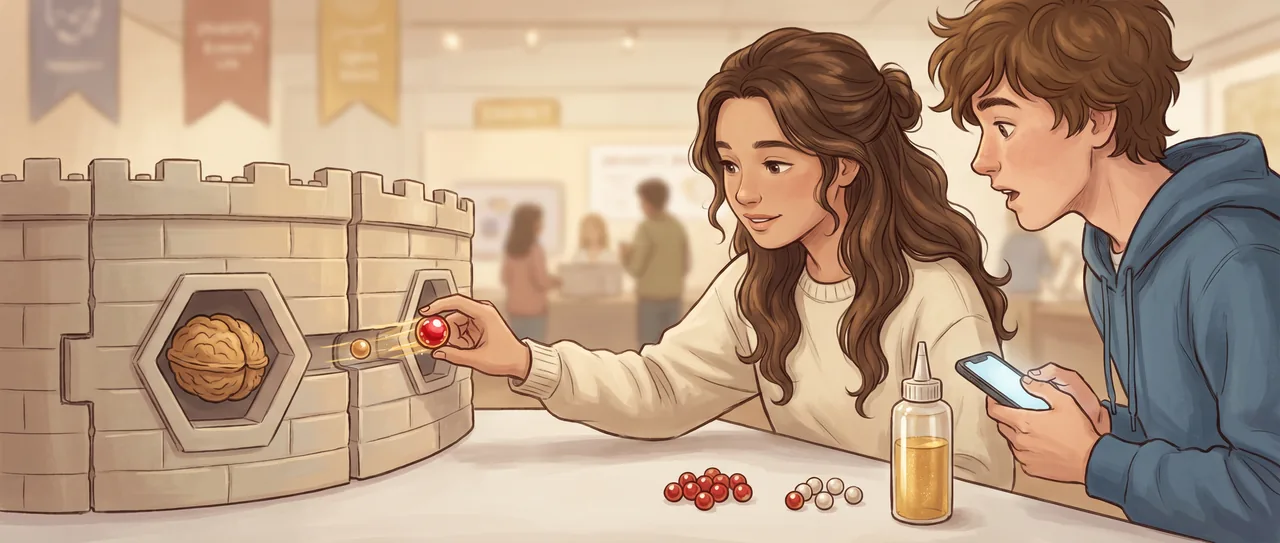
Scattered across the table were dozens of small colored beads, a squeeze bottle of soapy water, and what looked like a miniature castle wall built from interlocking plastic bricks, barely six inches tall, curving in a circle. Inside the circle sat a sponge shaped, very roughly, like a walnut.
"The brain," Soren said, pointing at the sponge.
"Obviously," Maya said, already picking up a red bead. She tried to push it through the wall. It didn't fit between the bricks. She tried three more spots. Nothing.
Soren read the laminated card propped against the squeeze bottle. "It says the wall represents endothelial cells. They line every capillary in the brain, and they're locked together so tightly that almost nothing slips between them."
"Define almost nothing."
He kept reading. "Oxygen gets through. Glucose gets through. Most medicines don't. Ninety-eight percent of small-molecule drugs can't cross. Almost a hundred percent of large-molecule drugs can't."
Maya set down the red bead. She picked up a tiny green one, the smallest on the table. She tried to push it through the wall at every seam. It still didn't fit.
"That's the point," Soren said slowly. "The gaps aren't just small. There basically aren't gaps. The cells are fused together. Tight junctions, it says here."
"Then how does glucose get in?"
Soren flipped the card over. On the back was a diagram showing a tiny door built into one of the bricks, with a specific shape cut out of it, like a puzzle piece. The card read: TRANSPORTER PROTEINS. THE WALL DOESN'T HAVE HOLES. IT HAS CHOICES.
Maya stared at that sentence for a long time.
She picked up a yellow bead. It had a funny shape, not round but slightly hexagonal. She found a brick in the wall that had a hexagonal slot in it. The yellow bead clicked in one side and popped out the other, landing on the sponge brain.
"It let that one through," she said.
"Because it was the right shape," Soren said. "The wall recognized it."
They both stood there, looking at the little castle wall with its hidden doors, each door shaped for one specific molecule and nothing else.
"So the brain isn't locked away," Maya said. "It's more like. It has its own customs office. Checking passports."
"And most drugs don't have passports."
A woman walked past carrying a box of pamphlets, stopped, and doubled back. She had a university lanyard and paint on her sleeve. "Oh good, someone's actually using it. I built that model and then got assigned to the poster session across the hall. Has it been sitting here alone this whole time?"
"Pretty much," Soren said.
"Figures. Everyone wants the VR heart. Listen, I've got to get back, but the squeeze bottle is the best part. Try it." She walked away before either of them could ask what it did.
Maya picked up the squeeze bottle and examined it. The soapy liquid inside shimmered slightly, with a faint gold tint. She squirted a drop onto one of the red beads that hadn't fit through the wall. The soap coated the bead in a thin glistening layer.
She pushed the coated bead against the wall.
It slid through.
Not through a gap. Through one of the shaped doors. The soap coating had changed the bead's surface just enough that the transporter protein slot accepted it.
Soren's mouth opened. "That's a Trojan horse."
"That's the research," Maya said. "That's what they're trying to do. Coat drugs in something the barrier recognizes so the transporters pull them through."
Soren grabbed a blue bead, coated it, tried a different section of wall. It went through a different door. He coated an orange bead. It didn't go through anywhere.
"Not every disguise works," he said, and wrote that down.
Maya was already coating bead after bead, methodically, pressing each one against every door in the wall. Some slid through. Some didn't. She started sorting them into two piles.
"Here's what I don't understand," she said after a minute. "If the barrier keeps out almost everything, how do brain infections happen at all? How does anything bad ever get in?"
Soren looked at the card again. Flipped it. Nothing about infections. He pulled out his phone and searched, and then went very quiet.
"Some pathogens figured out their own version of this," he said. "Millions of years before any scientist tried it. Certain bacteria and parasites evolved surface proteins that trick the transporters into letting them through. They made their own fake passports."
Maya stopped sorting beads.
The lab noise continued around them. Somewhere across the hall, people were laughing inside the VR heart.
"So the barrier has been in an arms race," she said. "For millions of years. Getting more selective, and the invaders getting better at faking their way in, and the barrier getting more selective again."
"And now researchers are basically studying the invaders' strategy," Soren said. "Learning from the things that already cracked the code. To carry medicine instead of infection."
Maya looked at the little castle wall. At the sponge walnut sitting inside it, with its small collection of beads that had earned passage.
The barrier wasn't a wall. It was an argument, millions of years old, between protection and access, between safety and the need to let the right things in. Every transporter door was a decision the body had made, over evolutionary time, about what the brain needed badly enough to risk a door for.
And every disease that couldn't be treated was a medicine that hadn't found its door yet.
"There are people," Maya said quietly, "whose whole job is learning the passwords."
"And the passwords keep changing," Soren said.
The woman with paint on her sleeve came back, slightly out of breath. She looked at Maya's two sorted piles of beads and Soren's phone open to a page about parasitic immune evasion. She looked at the squeeze bottle, nearly empty.
"I need more of that soap stuff," Maya said.
The woman pulled over a stool, sat down across from them, and reached under the table for a second bottle.
Read the interactive version, listen to the narration, and earn a gold star →
A science-verified short story for curious kids · Curiosity Land