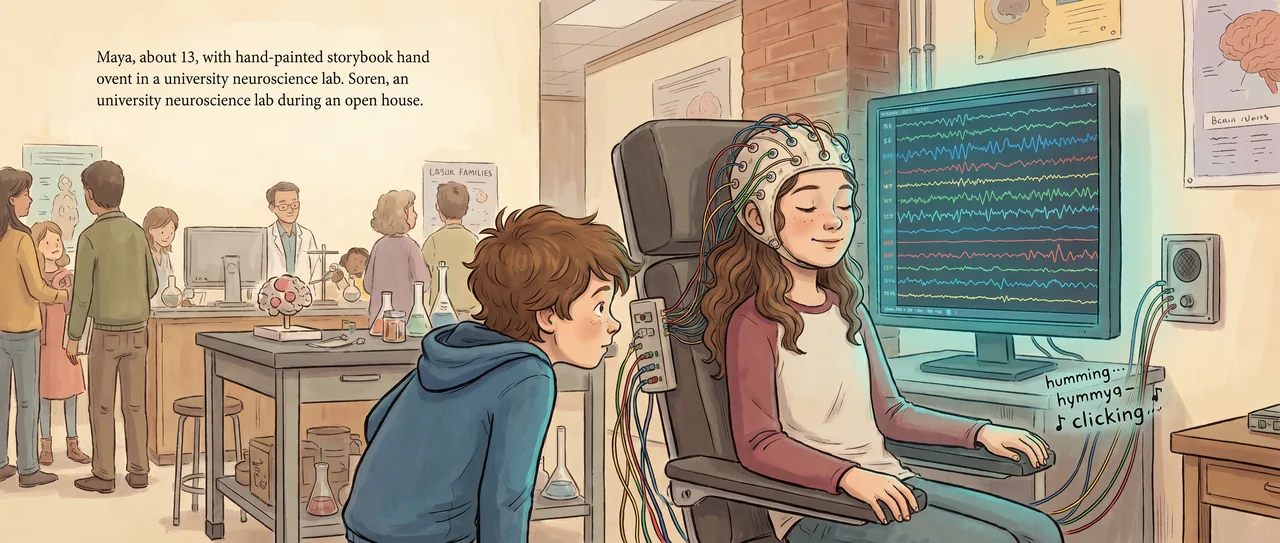
The Frequency of Us
The first thing Maya noticed was the drums.
Not real drums. The sound came from a speaker mounted to the wall of the neuroscience lab, translating brainwave data into audio. A graduate student named Priya had set it up for the university open house, and she was proud of it in a way that made her talk too fast and forget to explain things.
"So this is sonification," Priya said, already turning to adjust a dial. "We take the EEG signal, map the frequencies to tones, and you can actually hear the brain's rhythmic activity. It's mostly for fun. Well, it's for outreach. Well, it's because my advisor said I needed to do something quote-unquote accessible." She pushed her glasses up. "Anyway. Who wants to go first?"
Soren was already sitting in the chair.
He had been reading the poster on the wall behind the EEG setup, the one titled "Cross-Frequency Coupling in Cortical Networks," and he had not understood most of it, but the diagram had caught him. It showed waves of different sizes nested inside each other, small fast ripples riding on top of slow, rolling swells, like tiny waves on the surface of an ocean wave.
"That picture," he said. "Is that real? Waves inside waves?"
Priya looked at the poster, then at Soren, then back at the poster, as if she had forgotten it was there. "Oh. Yes. That's cross-frequency coupling. Your brain doesn't just produce one rhythm at a time. It produces many, at different frequencies, and they nest. Gamma waves, which are fast, forty hertz or so, they tend to lock onto the peaks of theta waves, which are slower, around four to eight hertz. The slow wave organizes the fast wave. Like a conductor keeping different sections of an orchestra together."
"Why?" Maya asked. She was standing behind Soren, arms crossed, staring at the EEG machine.
"Because your brain is huge," Priya said. "Relatively. Neurons in your visual cortex and neurons in your prefrontal cortex are centimeters apart. That's an enormous distance at cellular scale. They need to coordinate. The slow oscillations are like a shared clock. They create windows, specific phases in the wave, where distant regions can talk to each other. If two regions are oscillating in sync, information flows between them. If they're out of sync, it doesn't."
Soren sat very still.
"Put the cap on him," Maya said.
Priya fitted the electrode cap, dabbed gel at the contact points, and connected the leads. The monitor flickered alive. Colored lines began to scroll across the screen, each one representing a different electrode, a different location on Soren's scalp. And from the speaker came a low, layered hum.
"Close your eyes," Priya said.
Soren closed them. The hum shifted. A new tone emerged, stronger and more rhythmic, pulsing at about ten beats per second.
"Alpha waves," Priya said. "That's your occipital cortex. When you close your eyes and you're not processing visual information, the alpha rhythm gets stronger. You're hearing your own brain idling."
"It sounds like breathing," Maya said quietly.
"Open your eyes and do multiplication," Priya said. "Something hard. Like seventeen times thirteen."
Soren opened his eyes. The alpha tone diminished. A faster, thinner sound crept in, busier, almost like static with a buried pulse inside it.
"Gamma," Priya said. "Binding. Your brain is linking distant areas together to solve the problem. Pulling from memory. Sequencing. That sound is coordination."
Soren stared at the waveforms on the screen. Then he said, "Two hundred and twenty-one."
"Was that right?" Priya asked.
"Yes," Maya said, because she had already done it.
Priya went to check something on her laptop, and for a moment Maya and Soren were alone with the scrolling brainwaves.
"Think about something you know really well," Maya said.
Soren frowned. "Like what?"
"Anything. Something you've thought about a lot."
Soren thought about his grandmother's kitchen. The yellow wallpaper. The exact sound of the drawer that stuck. The way the light came through the window above the sink at four in the afternoon in autumn. He didn't say any of this. He just thought it.
The speaker changed. The fast tone and the slow tone seemed to fall into a relationship, the quick gamma sound clustering and repeating in a pattern that rode the slower rhythm beneath it. It was not random anymore. It almost sounded like a sentence.
"There," Maya said. "Hear that? The fast one is locking onto the slow one."
Soren heard it. He could hear his own brain organizing itself.
"That's the coupling from the poster," he said.
"It's not just a diagram," Maya said. "It's you. Right now."
Soren sat with that for a moment. Then he said something unexpected. "Priya said if the oscillations don't sync, information doesn't flow."
"Yeah."
"So what happens if someone's brain can't do this? Can't lock the waves together?"
Maya didn't answer. She had seen the smaller poster, the one half-hidden behind the coat rack, about oscillatory disruption in neurological conditions. She had read the word "schizophrenia" and the word "epilepsy" and the phrase "atypical cross-frequency coupling in autism spectrum conditions." She had not skimmed past any of them.
"It said atypical," Maya said carefully. "Not broken. Atypical coupling."
Soren heard her being careful. "Atypical means different," he said.
"Different synchronization," Maya said. "Different windows opening. Different regions talking to each other, or talking at different times, or talking louder."
They both looked at the screen, where Soren's brain was still producing its layered rhythms.
"So everyone's brain has this," Soren said. "These rhythms. But the exact pattern is different."
"The exact pattern is you," Maya said.
Soren thought about the people he knew who thought differently than he did. Not wrong. Not broken. Tuned to a different coupling. Windows opening at different phases. What would their brainwaves sound like through this speaker? Not the same as his. Not worse. A different sentence.
He thought about how he had always needed more steps than other people, how his brain wanted to check and recheck, how he sometimes felt like he was running at a different speed than the world. And here on the screen was the literal evidence that brains run at different speeds. Many speeds at once. All of them necessary.
"Maya."
"Yeah."
"I want to hear yours."
Priya came back and switched the cap to Maya's head. The gel was cold. The electrodes settled against her scalp. The screen cleared and began drawing new lines, and from the speaker came a sound that was similar to Soren's and also not similar at all. The same frequencies lived there, alpha and gamma and the slow theta beneath, but the relationships between them were shaped differently. The clustering happened at different moments. The pauses fell in different places.
Soren leaned forward.
"Close your eyes," he said.
Maya closed them, and the room filled with the sound of her brain breathing, and it was its own rhythm, its own language, its own particular music, and Soren listened to it the way you listen to something you have always wanted to hear.
Read the interactive version, listen to the narration, and earn a gold star →
A science-verified short story for curious kids · Curiosity Land