The Wrong Way
The demonstration was supposed to be simple. A laser, a glass prism, a screen. Professor Koval had set it up for the weekend open house, and now she was across the room arguing with someone from the dean's office about parking signs, leaving the optics station unattended.
Maya watched the red dot on the screen while Soren read the laminated card taped to the table. Beam enters glass, bends toward the normal line, exits glass, bends away. Snell's Law. A diagram showed the angles.
"It's doing what the card says," Soren confirmed. He moved the prism a few degrees. The dot shifted on the screen exactly the way the diagram predicted.
But behind the prism station, on a second table pushed against the wall like it had been moved out of the way, sat something else. A flat rectangle, dark gray, no bigger than a playing card. It was mounted in a small clamp with a sticky note that read DO NOT DEMO, KOVAL ONLY in capital letters.
"What is that?" Maya said. Not to Soren. Just out loud, the way she sometimes did when something was pulling at her.
"Looks like a sample," Soren said. He leaned in without touching anything. The surface wasn't smooth. Under the overhead lights, he could see a texture, almost like a tiny grid, too regular to be natural. "Some kind of structured material."
Maya was already looking at the laser, then back at the sample.
"We shouldn't," Soren said.
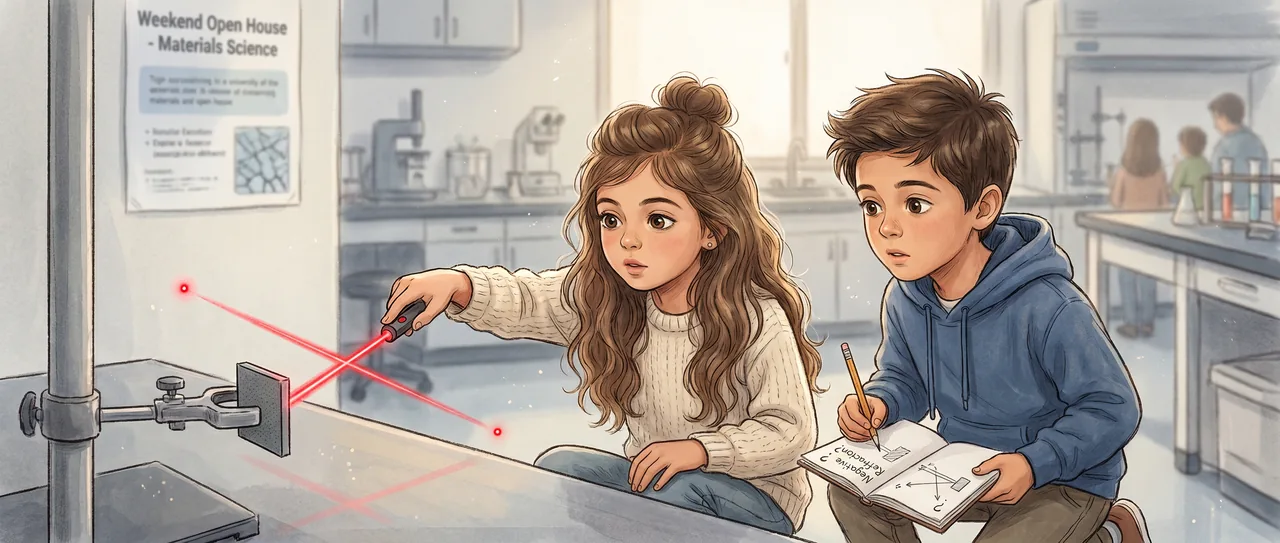
"We're not going to touch it. But what if we just," she picked up the laser pointer from the demo tray, the one meant for visitors to play with, "see what it does."
Soren looked across the room. Professor Koval was now drawing a map to the parking structure on the back of an envelope. He pulled his notebook from his jacket pocket and opened to a blank page.
"Go," he said.
Maya aimed the pointer at the flat gray rectangle.
The dot appeared on the wrong side.
Soren stared. "Do that again."
She turned the pointer off and on. Same result. When the beam hit the sample, the light that came through bent, but it bent the wrong way. In the prism demo, light entering at an angle from the left exited angled further to the left. Here, the light was going right. Like it had crossed over itself inside the material.
"That's backwards," Maya said.
"That's not possible." Soren drew the beam path on his notebook page. He drew it three times, from three different angles, each time having Maya shift the pointer slightly. Every single time, the light bent in the opposite direction from what the Snell's Law card described.
He stared at his drawings.
"Unless," he said slowly, "the material has a negative index. Like, the refractive index is below zero."
"That's a real thing?"
"I don't know. I've never seen it. But mathematically, if you put a negative number into Snell's Law, the angle goes to the other side." He tapped his diagram. "Which is exactly what's happening."
Maya crouched down so her eyes were level with the sample. She moved her head slowly from one side to the other, watching the dot track across the wall behind it.
"Soren. Come here. Get low."
He crouched beside her. From this angle, looking through the sample at a shallow slant, the grid pattern on the wall poster behind it did something his brain refused to accept. The lines of the grid appeared to shift in the wrong direction as he moved his head. With normal glass or water, when you shift your viewpoint, the image behind it slides one way. Through this material, the image slid the other.
"Everything through it is mirrored," he whispered. "Not left to right. The depth is mirrored. It's like the light paths are crossing inside."
Maya was quiet for a moment, which meant she was chasing something.
"If light bends the wrong way," she said, "then you could focus it differently. Right? A normal lens has a limit. It can only focus things down to about the size of the wavelength. But if the light goes the other way, the rules change."
"A perfect lens," Soren said. He said it like it hurt. "You could see things smaller than the wavelength of light should allow."
"And if you could bend light around something instead of through it," Maya continued, and then stopped.
They looked at each other.
"You could make something invisible," Soren finished.
Not science fiction invisible. Not magic invisible. Invisible because the light would flow around the object the way water flows around a river stone, meeting up on the other side as if the stone weren't there. For specific wavelengths. For specific frequencies. The material would have to be engineered for each one.
That's what the tiny grid was. Not random texture. Structure. Smaller than the wavelength of light, designed to interact with electromagnetic waves in a way no natural material did. Someone in this lab had built a material that told light to go the wrong way, and light obeyed.
"Excuse me." Professor Koval was behind them, envelope still in hand. Her eyebrows were up, but she didn't look angry. She looked at the laser pointer in Maya's hand, then at Soren's notebook, then at the angles drawn on the page.
"You figured out the negative index," she said.
"The light goes the wrong way," Maya said.
"The light goes exactly the way the material tells it to," Professor Koval corrected. She looked at them with an expression Soren couldn't quite read. Not impressed, exactly. More like recognized.
"The thing is," the professor said, pulling the sample from its clamp and holding it under the light so the grid caught and vanished and caught again, "we only have this for microwaves so far, mostly. Visible light is harder. The structures need to be nanoscale. We're years away from a real invisibility cloak, decades maybe from a perfect lens." She paused. "But the physics works. The physics is clean and beautiful and it works."
She set the sample on the table between them.
"The thing nobody talks about at open houses," she said, already turning back toward her parking sign argument, "is that we don't know yet what this changes. We know it changes everything. We just don't know how."
She walked away. Maya picked up the laser pointer again. Soren held his notebook open, pencil ready, and nodded.
The red dot appeared on the wrong side of everything they knew.
Read the interactive version, listen to the narration, and earn a gold star →
A science-verified short story for curious kids · Curiosity Land