The Two Towers of Babel
The obstacle course changed every round. That was the whole point.
Maya and Soren had built their robot in Soren's garage over six weekends. It was not beautiful. It had a crooked wheel and a sensor that sometimes pointed slightly left of where it should. They had named it Clementine, because Soren said that was the kind of name you gave something you loved despite its flaws.
Now they stood in the engineering building at State, watching fourteen other teams set up along the starting grid, and Maya was worried about the wrong thing.
She was not worried about Clementine. She was worried about the team at Station Twelve.
Their robot was called LOGOS. It was beautiful. It was also, based on the code she had glimpsed on their screen, running on pure hand-written rules. If wall on left, turn right. If gap wider than eighteen centimeters, proceed. If ramp angle exceeds fifteen degrees, slow motors by forty percent. Hundreds of rules, nested inside each other, covering every situation the programmers could imagine.
"They wrote rules for everything," Maya said.
"Everything they could think of," Soren said. He was writing in his notebook. He had been sketching the course layout from Round One, which they had already completed. Clementine had finished ninth out of fifteen. Not great. Not eliminated.
"It's going to work," Maya said. "In Round One it finished first."
"In Round One."
She looked at him. "You think it won't work in Round Two?"
Soren turned his notebook around. He had drawn the Round One course from memory and circled every obstacle. Ramp. Gap. Wall. Corridor. "Every single obstacle is a thing you could describe in a rule. What if Round Two has something you can't describe in a rule?"
"Like what?"
"I don't know. That's the point."
Round Two's course was revealed at noon. The organizers pulled back a curtain and the room went quiet.
The floor surface changed. Not once but continuously, a gradient from smooth tile to gravel to sand to rubber mat, all flowing into each other with no clean boundary. There were no walls, just curves of foam that leaned at angles that kept shifting because fans underneath were blowing them. The ramp was not a ramp. It was a hill that someone had shaped by hand, uneven, lumpy, different on every side.
Maya watched the Station Twelve team. Their lead programmer, a tall girl with braids and a university sweatshirt, was scrolling through her rules with something close to panic. You could not write a rule for a surface that was tile and gravel and sand simultaneously. You could not write an if-then statement about a wall that was always moving.
"She's trying to add more rules," Soren said.
"It won't be enough."
It was not enough. In Round Two, LOGOS froze eleven seconds in. It encountered the gravel-to-sand transition and its rules disagreed with each other. The floor was not tile and not gravel and not sand. It was between categories. LOGOS sat there, motors humming, trying to find a rule that matched a world that refused to be described in rules.
Clementine did better. Not because Clementine was smarter, but because Clementine was dumber in a useful way. They had trained Clementine's little neural network on hundreds of hours of navigating Soren's garage, the backyard, a gravel parking lot, the uneven floor of Maya's basement. Clementine had never been told what a ramp was. Clementine had rolled over enough surfaces that it had learned something about surfaces in general, something Maya and Soren could not have written down as a rule even if they wanted to.
Clementine finished fifth. The crooked wheel actually helped on the lumpy hill, finding grip where balanced robots slipped.
Afterward, the girl from Station Twelve found them.
"Your robot doesn't have any rules," she said. It was not a question.
"Neural net," Soren said. "Trained on data. No rules at all."
"It can't explain why it does anything."
"No," Maya admitted.
"Mine can explain every decision. It just can't make the right ones when the world gets weird." The girl sat down on the floor next to them. Her name tag said Priya, Volunteer Mentor. She was maybe seventeen. "You know what your problem is going to be in Round Three, right?"
Maya did not know.
"Round Three always has a logic puzzle. Last year it was a color sequence on the floor. The robot had to recognize the pattern and choose the correct door. Your neural net is going to look at that sequence and do something. It just won't be the right something. It will guess based on what it's seen before, and it has never seen a logic puzzle before."
Soren looked at Maya. Maya looked at Clementine.
"So rules are good at logic but bad at mess," Soren said slowly, "and learning is good at mess but bad at logic."
"And Round Three is going to have both," Priya said. She stood up, brushed off her jeans, and walked back to Station Twelve without offering a solution.
They had ninety minutes before Round Three.
Soren opened his notebook to a blank page and drew a line down the middle. On the left he wrote RULES. On the right he wrote LEARNING. Under RULES he wrote: logic, sequences, if-then, categories, explainable. Under LEARNING he wrote: surfaces, mess, gradients, adaptation, unexplainable.
"What if we use both," Maya said.
"We don't have a rule engine."
"Priya does."
They found Priya resoldering a motor connection. Maya did not waste time. "What if LOGOS handles the logic gates and Clementine handles the terrain? What if we connect them?"
Priya stared. "The rules are on a completely different system. Different language. Different architecture. You can't just plug them together."
"We don't plug them together," Soren said. He was already drawing. "Clementine navigates. When she hits something that looks like a pattern, a repeating sequence, a choice point, she stops. LOGOS reads the pattern. LOGOS makes the decision. Clementine moves."
"Two robots," Priya said. "One body, one brain. Meeting in the middle."
"Is there a rule against two robots?"
Priya checked the competition handbook. There was not.
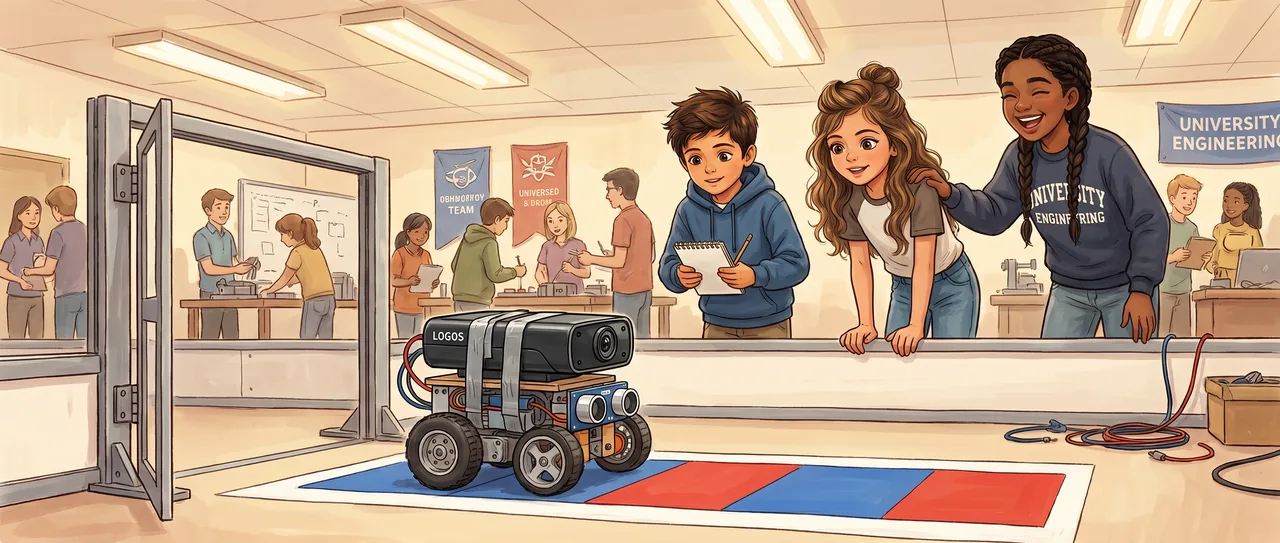
They worked for eighty-seven minutes. Priya wrote a simple handshake protocol. Soren tested the signal between the two systems fourteen times. Maya repositioned LOGOS on top of Clementine, held in place with zip ties and electrical tape, its camera pointing forward where Clementine's sensor pointed slightly left.
It was the ugliest robot in the building.
Round Three had a sand hill, a foam maze that shifted in the wind, and a three-color logic sequence that opened one of two gates.
Clementine rolled through the sand. She wobbled over the foam. She reached the three-color panel and stopped.
LOGOS read the sequence. Blue, blue, red, blue, blue, red. LOGOS knew what came next.
The left gate opened.
Clementine rolled through.
They finished second. Priya was laughing. Soren was writing something down so fast his pencil tore the page. And Maya was already thinking about what else could meet in the middle, what other opposites could be zip-tied together, because the world was full of problems that were both messy and logical at the same time, and she was just beginning to count them.
Clementine sat on the finish platform, crooked wheel spinning slowly in the air, LOGOS strapped to her back like a second brain she had grown on purpose.
Read the interactive version, listen to the narration, and earn a gold star →
A science-verified short story for curious kids · Curiosity Land