The Shape of Ten Thousand Pennies
The problem started because Soren dropped the jar.
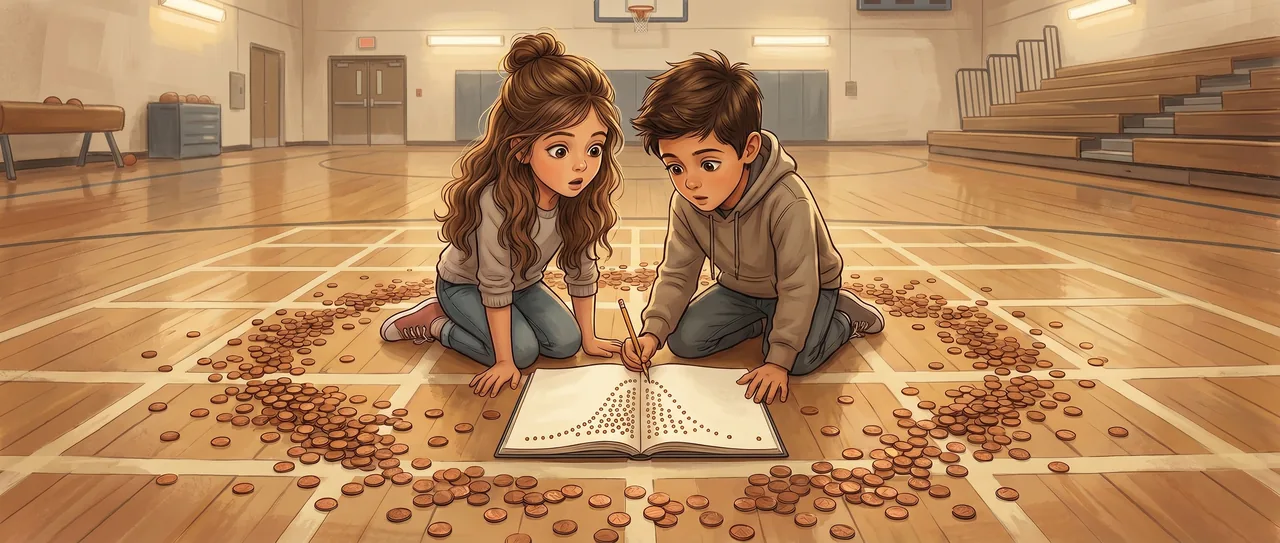
It was a big jar, the kind that holds pickles at a deli, and it had been full of pennies for the carnival's guess-the-number game. It hit the gymnasium floor and exploded. Pennies everywhere. Hundreds and hundreds of them, spinning and ringing and rolling under the bleachers.
Ms. Davenport, who was hanging streamers from the basketball hoop and not really paying attention, said, "Just pick them up and count them back in. I need to finish this before the helium runs out."
So Maya and Soren got on their hands and knees.
"There's no way we're finding all of these," Maya said.
"We don't have to find them all. We just need to know the number for the guessing game."
"We don't know the number. That's the whole point. Nobody counted them going in."
Soren sat back on his heels. A penny was stuck to his knee. "So we need to figure out how many there were."
Maya looked at the scatter pattern across the gym floor. Pennies had spread in a rough circle from the point of impact, thicker near the center, thinner at the edges. She was already doing something in her head that she couldn't quite name yet.
"What if we don't count all of them," she said.
Soren waited.
"What if we count some of them. Like, really carefully, in small sections. And then use that to figure out the whole jar."
Soren pulled out his notebook. "Okay. How?"
They used masking tape from the streamer supplies to mark out a grid on the gym floor. Each square was roughly one meter by one meter. The penny explosion covered maybe forty squares total. They didn't have time to count every square. So they picked ten squares at random, Maya pointing with her eyes closed, Soren writing down whichever square her finger landed nearest.
They counted.
Square one: thirty-one pennies. Square two: six. Square three: forty-four. Square four: nineteen.
The numbers jumped around wildly.
"This isn't working," Soren said. "Six and forty-four? Those aren't even close to each other."
"Keep going," Maya said. She was watching the numbers in his notebook with that expression she got when a pattern was arriving but hadn't landed yet.
Square five: twenty-two. Square six: fifteen. Square seven: thirty-eight. Square eight: twenty-nine. Square nine: twelve. Square ten: twenty-seven.
Soren added them up. Two hundred forty-three pennies across ten squares. Average: twenty-four point three per square.
"So if there are forty squares, that's about nine hundred seventy-two pennies," Soren said. "But I don't trust it. The individual squares are all over the place."
"Do more," Maya said.
They counted ten more squares. Then ten more. Soren kept a running table in his notebook. Every time they added more squares to the sample, he recalculated the average.
After ten squares: twenty-four point three. After twenty: twenty-two point one. After thirty: twenty-three point six.
"It's tightening," Soren said, surprised. "The average is jumping around less each time."
"Even though the individual squares are still wild."
"Yeah." He looked at the column of individual counts. They ranged from two to fifty-one. Totally scattered. But the average was settling, like a spinning top finding its center. "That's weird, Maya. Each square is basically random. But the more of them I average together, the more the average stays put."
"It's not weird," Maya said, but she said it the way she said things when she meant it was actually very weird and she was thinking hard. She started pulling pennies from under the bleachers, not to count them, just to have something to do with her hands. "It's like the randomness cancels itself out. A high one and a low one, they balance."
"But not perfectly. There's still some wobble in the average."
Maya stopped. She had seven pennies in her left hand. "How much wobble?"
Soren looked at his notebook. He had recorded the running average after each batch of ten. He wrote down how far each batch's average was from the overall average.
Most batches were close. A few were farther off. One was way off.
"Huh," he said.
"What?"
"Most of the batches are a little off from the big average. A couple are more off. And one batch is really off. But it's like, symmetrical. The ones that are too high and the ones that are too low, there's the same number of each."
Maya crouched next to him and looked at the numbers. "Draw it," she said.
Soren made a rough chart on the next page. He marked each batch's deviation from the average as a dot on a number line. A cluster of dots in the middle, near zero. A few dots farther out. One dot way out on the right.
They both stared at it.
"That's a shape," Maya said.
"It's a hill," Soren said. "Tall in the middle, sloping on the sides."
"We didn't put that there."
"No."
"The pennies fell randomly. We picked squares randomly. Everything about this is random. So where did the hill come from?"
Soren wrote the word shape and underlined it twice. Not because he had an answer. Because the question felt like the kind that needed to be held down on the page before it got away.
Ms. Davenport walked past with an armload of streamers. "Did you two get a count?"
"About nine hundred and fifty," Maya said.
"Great. Write it on the slip and put it in the envelope."
She moved on. She hadn't asked how they knew. She didn't need to.
But Maya and Soren stayed on the gym floor, knees on the hardwood, looking at Soren's chart.
"The randomness isn't shapeless," Soren said slowly. "Each penny, each square, it's chaos. There's no pattern at all. But when you pull back and look at all of them, the chaos has a shape."
"A bell," Maya said. "Tall middle, thin edges."
"And we didn't put it there," Soren said again, because it mattered.
"Nobody put it there. It just happens. Whenever random things pile up, they make that shape."
Soren looked out across the gymnasium floor, pennies still glinting under the fluorescent lights, each one landed in its own unpredictable spot, each one contributing to a curve that neither of them had drawn but both of them could see.
"What else makes that shape?" Maya asked. Not to him exactly. To the room. To the pennies. To whatever was listening.
Soren turned to a fresh page.
Read the interactive version, listen to the narration, and earn a gold star →
A science-verified short story for curious kids · Curiosity Land