The Line You Cannot Feel
The argument started three days before the planetarium visit, and it hadn't stopped.
"You'd feel it," Maya said. "You'd have to."
"Why would you have to?" Soren asked.
"Because it's the point of no return. Because after that, nothing gets out. Not even light. Something that important can't just feel like nothing."
Soren had looked it up. He'd read four different sources and written the key sentence in his notebook in capital letters: AN OBSERVER CROSSING THE EVENT HORIZON OF A SUFFICIENTLY MASSIVE BLACK HOLE WOULD NOTICE NOTHING UNUSUAL AT THE MOMENT OF CROSSING. He believed it because the physics said so. But he also understood why Maya didn't believe it, because it felt wrong.
Now they stood in the planetarium's simulation room, and Dr. Alvarado was already distracted. She had spent ten minutes explaining the new immersion system, then gotten a phone call about a budget meeting and wandered into the hallway saying, "Just don't touch the calibration panel. The scenario's already loaded. I'll be right back."
They looked at each other. The dome was dark. Stars everywhere.
"She said it's loaded," Maya said, and pressed start.
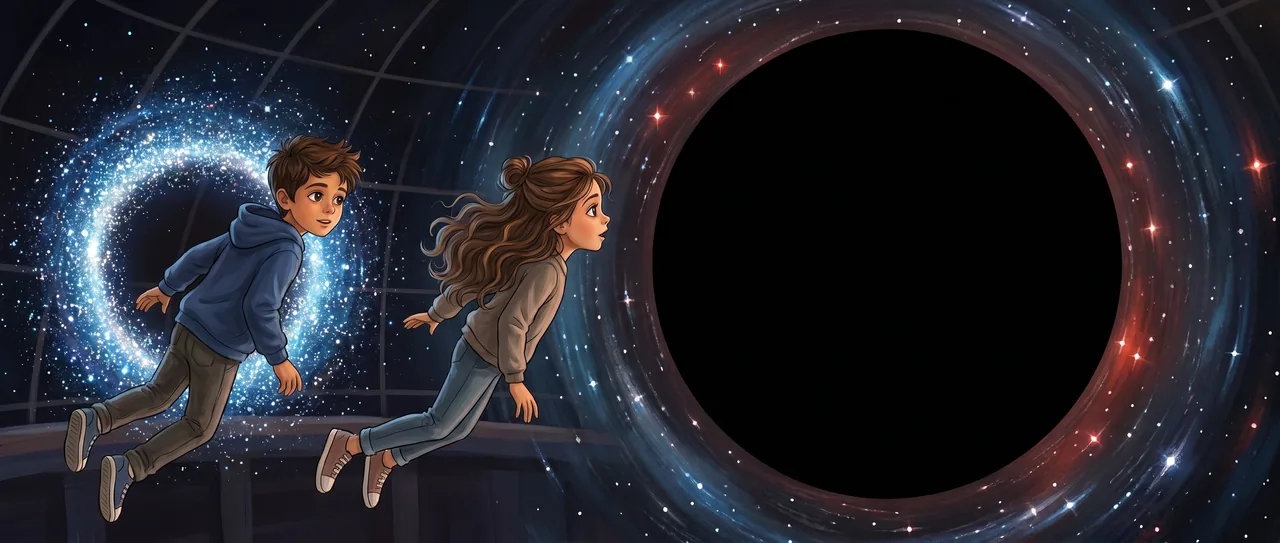
The stars jumped. Suddenly they weren't standing in a planetarium. They were floating. The simulation wrapped around them so completely that Maya's stomach dropped, the way it did on a fast elevator. Below them, if you could call it below, was a black circle. Not black like dark paint. Black like absence. A hole cut in the stars.
"That's it," Soren whispered.
Around the black circle, the stars were wrong. The ones near the edge were smeared, stretched into tiny arcs, their light bent around something so massive it warped the shape of space itself. Stars that should have been hidden behind the black hole were visible, their light curved around it like water flowing around a stone in a stream.
"Gravitational lensing," Soren said.
"It's bending the stars," Maya said at the same time.
Same observation. Different words.
The simulation let them move. Maya figured out the controls first, a slight lean in the direction you wanted to drift. She leaned toward the black hole.
"Maya."
"It's a simulation."
"I know, but let's think about this."
"I am thinking about this. I want to find the line."
That was the argument. The event horizon. The boundary. Maya was certain that something would mark it. A shimmer, a pressure, a change in temperature, something. Soren was certain, based on everything he'd read, that there would be nothing.
They drifted closer. The black circle grew. It didn't grow the way things usually grow when you approach them. It grew unevenly, eating more of the sky on one side, then the other, as if the geometry around it couldn't make up its mind.
Soren checked the simulation's data overlay. Distance, velocity, tidal force gradient. The numbers were changing, but slowly. This was a supermassive black hole, the simulation told them. Billions of solar masses. The tidal forces near the horizon were gentle because the thing was so unimaginably large. If it had been a small black hole, the difference in gravity between your head and your feet would pull you apart long before you reached the horizon. But this one was so vast that the curve of spacetime was almost flat at the boundary.
Almost flat. That was the part that made Soren's handwriting go shaky when he'd copied it down.
"Look behind us," Maya said.
Soren turned. The stars behind them were shifting blue. Bluer than they should be. And ahead, toward the black hole, the stars at the edge were reddening, their light stretched longer, losing energy as it climbed out of the gravity well.
"The light's being stretched," Soren said. "Coming toward us blueshifted from behind, redshifted from ahead."
"So we'd see it changing. We'd know we were close."
"We'd know we were in strong gravity. But we wouldn't know the exact moment we crossed."
Maya didn't answer. She leaned forward again.
The black circle now filled half the sky. Then more than half. The stars were crowding into a bright ring behind them, compressed and blue and beautiful, the entire visible universe squeezed into a shrinking circle of light at their backs.
Soren watched the distance reading. It was counting down. He tried to feel something. A tingle. A change. A sense of crossing.
The number went negative.
He stared at it.
"Maya."
"What?"
"We passed it. Fourteen seconds ago."
Maya stopped moving. She looked around. The stars were still there, still squeezed into that bright ring behind them. The black ahead was still black. Nothing had clicked. Nothing had changed. Nothing had announced itself.
"No," she said. "Run it back."
Soren found the replay function in the overlay. They watched themselves drift through the horizon from the outside, from a distant observer's perspective. From out there, their simulated figures slowed down, reddened, dimmed, and faded, never quite crossing, frozen at the edge in light that stretched toward infinity. But from the inside, from their own view, they'd sailed through like a boat crossing an invisible line painted on open water.
"It's not a wall," Maya said. Her voice was quiet. Not defeated. Something else.
"It's not a wall," Soren agreed.
"It's not anything you can touch or see or feel. It's just the place where the math changes. Where going forward is the only direction left because every path through spacetime points inward."
Soren felt the hair on his arms rise. She'd said it faster and more clearly than any of the four sources he'd read.
"That's worse," Maya said. "That's so much worse than a wall."
"Worse?"
"Soren, a wall you can see. A wall you can choose not to hit. This is a line you cross and you don't even know it, and by the time you check, it's already behind you, and behind you doesn't exist anymore as a direction you can travel."
The dome was quiet. The ring of stars at their backs was still shrinking, the universe getting smaller and farther away. Somewhere outside the simulation, Dr. Alvarado was arguing about budget allocations. Somewhere outside the planetarium, cars were driving and people were walking and nobody was thinking about invisible boundaries in spacetime.
"I want to know how many other lines like that there are," Maya said. "Not just in space. Lines you cross that you can't feel. Lines where everything changes and you don't even know."
Soren opened his mouth, then closed it. He didn't have an answer. He didn't think anyone did.
The ring of captured starlight behind them tightened, brilliant and blue, the whole universe collapsing into a single bright point that had not yet gone out.
Read the interactive version, listen to the narration, and earn a gold star →
A science-verified short story for curious kids · Curiosity Land