The Knot That Knows Itself
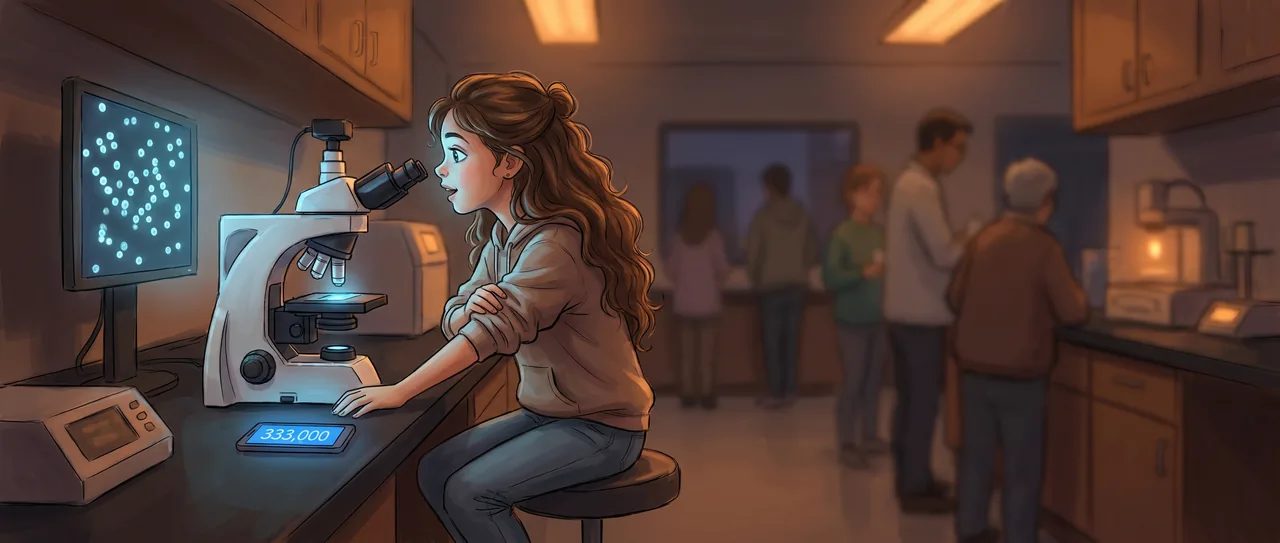
Maya had been staring at cheek cells for twenty minutes, and she could not get the knot out of her head.
Not a knot she could see. The fluorescence microscope showed her nuclei glowing blue-white under DAPI stain, each one a tiny lamp floating in the pale ghost of a cell. They looked calm. Simple. Like beads of light.
But Dr. Achebe, who ran the open house and who was currently across the room arguing with a graduate student about a broken centrifuge, had said something earlier that snagged in Maya's mind like a fishhook.
Two meters, she had said. If you stretched the DNA from just one of those nuclei into a single line, it would be about two meters long.
Maya was one hundred and forty-two centimeters tall. She knew this because she had measured herself on Tuesday. Two meters was taller than her father. Two meters was the height of a door.
And the nucleus she was looking at was six micrometers across.
She pulled back from the eyepiece and looked at the room. The lab bench was about two meters long. She held her hands apart, imagining it. Then she looked back through the microscope at the glowing dot.
It did not make sense. Not the fact of it. She believed Dr. Achebe. It was that the two things could not live in her mind at the same time. Two meters. Six micrometers. Every time she tried to hold both, one of them slid away, like trying to look at two stars that were too close together.
She sat back on the stool and pulled out her phone. She typed: how many times smaller is 6 micrometers than 2 meters.
The answer came back. About three hundred thirty-three thousand times.
Maya put her phone down on the bench, screen up, and stared at the number.
Three hundred thirty-three thousand. That was like fitting a rope the length of a highway into a thimble. No. Smaller than a thimble. Into a grain of sand.
She thought about tangled earbuds in her pocket. The way they knotted themselves into something impossible, and they were only a meter long in a pocket the size of her hand. But DNA was not tangled. She had seen the diagrams. It was organized. It had to be, because the cell read it constantly, found exactly the right gene at exactly the right time, like pulling one specific sentence out of an encyclopedia in the dark.
So it was not a knot. It was a fold.
She went back to the microscope and switched to the next slide, the one Dr. Achebe's graduate student had prepared. Chromosomes. Stained so they showed banding patterns, dark and light stripes along their length. These were the condensed form, squeezed tight for cell division, fat little X shapes.
Maya had seen chromosome pictures before. Everyone had. But she had never thought about what they actually were. Each one was a single molecule. One continuous thread of DNA, wound around proteins, wound around itself, wound again, and again, and again, until it was small enough to see as a shape under a microscope.
Levels of folding. That was the phrase she had read somewhere. Not one trick. Multiple tricks, layered.
She looked up from the eyepiece. Dr. Achebe was still arguing. The centrifuge apparently had a cracked rotor. Maya could hear her saying, It is not optional, Tomás, it is physics.
Maya walked over and waited. Dr. Achebe noticed her after a few seconds and turned, eyebrows up.
"The folding," Maya said. "Is it always the same? Like, does DNA always fold the same way in every cell?"
Dr. Achebe tilted her head. "No. Different cell types fold it differently. A liver cell and a brain cell have the same DNA, but different parts are accessible. The folding changes which genes can be read."
"So the shape is the instructions."
Dr. Achebe blinked. Then she smiled, but not the smile adults use when a child says something cute. It was the smile of someone who had just been handed a sentence she wished she had said first.
"That is not a bad way to put it," she said. "We have spent about twenty years figuring out that exact idea. The folding is not just storage. It is regulation. The structure is information."
She turned back to the centrifuge. Maya stood still.
The structure is information.
She went back to the microscope. She looked at the glowing nuclei again. And now they looked completely different.
Every single one of those blue-white dots contained two meters of DNA. Not crumpled. Folded. Folded with such precision that the folding itself was part of the code. The shape was not just a solution to a packing problem. The shape was a language.
And it was happening in every cell. Maya touched her own arm. Thirty-seven trillion cells, she had read that number once. Each one with its own two meters. If you stretched all of it out, laid it end to end, it would reach from here to the sun and back hundreds of times.
But that was not the part that made her breath catch.
The part that made her breath catch was that right now, in her own body, those threads were folded into different shapes in different cells, and the shapes were deciding what each cell would be. The same book, folded into different origami, and each fold was a different creature.
She thought about all the times she had tried to explain to someone how she thought. How a problem had a shape in her head before it had words. How the pattern came first and the logic came after, and people looked at her like she was skipping steps when really she was just reading a different fold of the same information.
Maybe that was not so strange after all. Maybe that was how everything worked, all the way down.
She pressed her eye to the microscope one more time. One nucleus. Bright. Whole. Containing two meters of thread folded so precisely that the fold was the meaning. A library compressed into a point of light that fit on the head of a pin.
Dr. Achebe called across the room. "Maya, we are closing in ten minutes."
Maya did not move. She was counting the glowing dots on the slide, each one a folded universe, and she was not anywhere close to finished.
Read the interactive version, listen to the narration, and earn a gold star →
A science-verified short story for curious kids · Curiosity Land