Every Cell Remembers the Whole Song
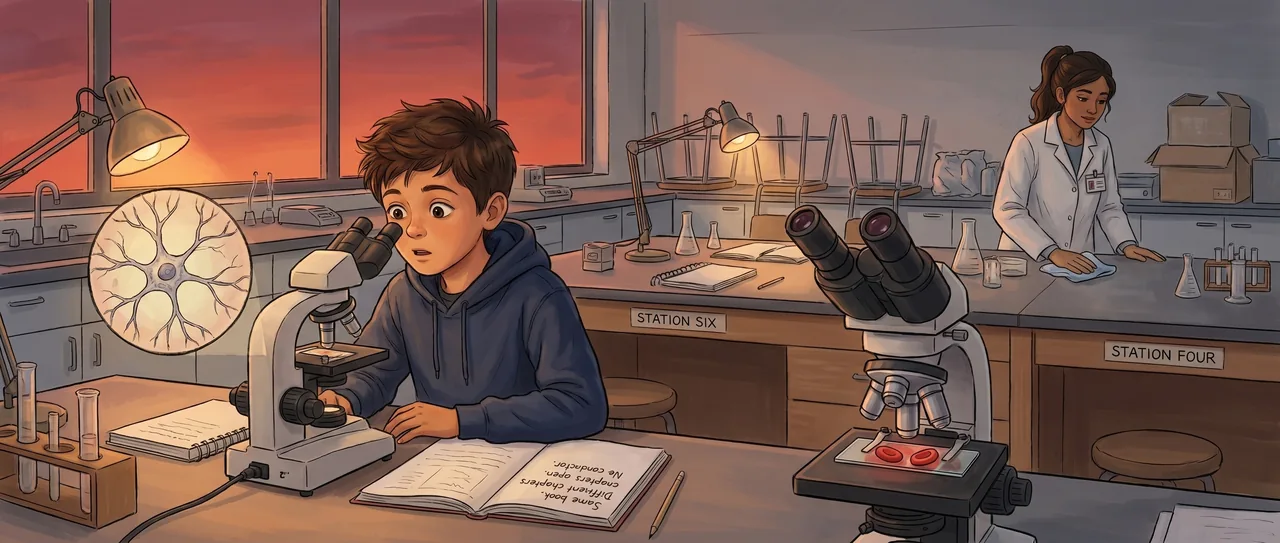
Soren had been staring at the neuron for four minutes, which was three minutes longer than anyone else had spent at Station Six.
The open house was winding down. Families drifted between microscope stations, taking turns peering at slides. Most people said "cool" and moved on. Soren had said "cool" too, but then he hadn't moved on. He'd adjusted the focus, read the placard again, adjusted the focus again, and now he was drawing the neuron in his notebook because something about it was bothering him and he hadn't figured out what yet.
It looked like a tree. Long branching arms reaching out in every direction, the cell body sitting at the center like a knot in old wood.
At Station Four, he'd looked at a red blood cell. Smooth. Round. A tiny disc with a dent in the middle, like a pillow someone had pressed a thumb into. No branches. No arms. Nothing at all like a tree.
He flipped back to his earlier sketch to compare them.
Same person. That's what the placard said. Both samples were cultured from cells donated by the same person. Same DNA in both.
Same instructions. Completely different shapes.
"We're closing up in about ten minutes," said the graduate student at Station Six. She was already wiping down the counter around the adjacent microscope, her movements quick and distracted. Her name tag said PRIYA. "Did you have questions, or..."
"How does the neuron know it's a neuron?" Soren asked.
Priya paused mid-wipe. "What do you mean?"
"The DNA is the same in every cell. That's what the sign says. So the red blood cell has neuron instructions in it, and the neuron has red blood cell instructions in it. How does each one know which instructions to use?"
Priya set down the cloth. "That's a real question," she said, and Soren could tell from the way she said it that she meant it was a question she actually thought about, not just a question she had a rehearsed answer for. "Okay. You know what a book is."
"I know what a book is."
"Imagine a book with thirty thousand chapters. Every cell in your body has a copy of that same book. Identical copies. But in a neuron, most of those chapters have been, not ripped out, but taped shut. Silenced. The neuron only reads the chapters about being a neuron. A red blood cell only reads the chapters about being a red blood cell. Same book. Different chapters open."
"Who does the taping?" Soren asked.
Priya laughed. Not at him. At the question. "That," she said, "is what I'm trying to figure out for my thesis. There are chemical signals. Neighboring cells. Timing. Position in the embryo. It's called gene expression, and it's honestly, it's like a concert where every musician has the same complete score but each one only plays their own part, and somehow the orchestra sounds right even though nobody is standing at the front conducting."
She stopped herself. "Sorry, I get going."
"No," Soren said. "Keep going."
But Priya glanced at the clock and started packing up slides. "I really do have to close the station. You're welcome to wander for the last few minutes though."
Soren walked back to Station Four. The red blood cell slide was still loaded. He looked at it again. The smooth disc. Then he walked back to Station Six and looked at the neuron again. The wild branching tree.
He opened his notebook to a fresh page and wrote: Same book. Different chapters open. No conductor.
Then he stood very still, because the thing that had been bothering him for the last four minutes at the microscope had finally arrived, and it was bigger than he expected.
He had always thought of DNA as a blueprint. A plan that got followed. Like instructions for a model airplane where you do step one, then step two, and at the end you have the airplane.
But that wasn't right. A blueprint makes one thing. His DNA made roughly two hundred different things. Two hundred completely different kinds of cells. Neurons and blood cells and the cells that line your stomach and the cells that make your bones hard and the cells in your eyes that catch light. All from one original cell. One fertilized egg that divided and divided, and at some point each daughter cell started reading different chapters of the same book and became something entirely new.
The blueprint didn't describe an airplane. The blueprint described an entire airport.
And every single cell in the airport still carried the complete plans for every other part of it.
Soren looked at the neuron again. Somewhere inside its nucleus, there were gene sequences for making hemoglobin. For making stomach acid. For making bone. All present. All silent. Taped shut, Priya had said. But still there.
Which meant the neuron hadn't lost anything. It had chosen. Or something had chosen for it. Something without a conductor.
He thought about himself. About how people decided what to be. How a kid who could become anything gradually became one particular thing, not by losing possibilities but by, what, expressing some and silencing others? Was that even a real parallel or was he reaching?
He didn't know. He wrote it down anyway.
Priya was stacking chairs now. Soren walked over to her.
"One more question," he said.
"Shoot."
"If every cell still has the complete DNA, the whole book, does that mean a silenced chapter could get opened again?"
Priya stopped stacking. She looked at him with an expression he'd seen a few times before on adults, the expression that meant she was deciding how honest to be.
"Yes," she said. "That's what reprogramming is. You can take a skin cell and reset it. Open all the chapters back up. Turn it into something like that original fertilized egg again, with the potential to become anything. We've done it. It works."
"So nothing is permanently silenced."
"That's the current understanding, yeah."
Soren felt the floor of the lab shift slightly under him, which was ridiculous because the floor was concrete and perfectly still. But the world had just gotten one size larger than it was a moment ago, and sometimes that felt like the ground moving.
Two hundred cell types. One book. No chapters ever truly lost.
He thanked Priya and walked toward the exit. The hallway was bright and empty. Somewhere in the building, someone was vacuuming. Outside the tall windows at the end of the corridor, the sun was going down and the clouds were stained the kind of red that only works once and never the same way twice.
Soren stopped at the window, opened his notebook flat against the glass, and started writing so fast his hand ached.
Read the interactive version, listen to the narration, and earn a gold star →
A science-verified short story for curious kids · Curiosity Land