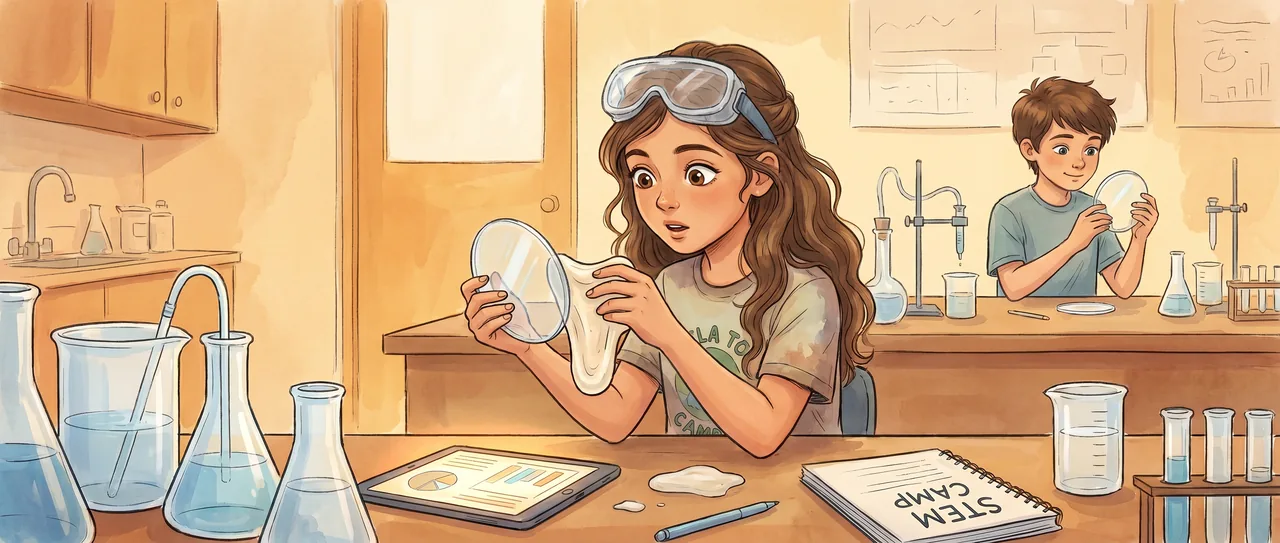
The Wrong Bracelet
Maya's plastic was wrong again.
Everyone else at the bench had produced a small, clear disc. Hard. Smooth. You could tap it against the table and it clicked like a button. Ms. Khatri walked between the stations saying "Beautiful, beautiful" and collecting the discs on a tray like cookies from an oven.
Maya's was a limp, stretchy blob.
She poked it. It sagged. She pulled the edges and it stretched like taffy, then slowly crept back into shape. It was kind of amazing, actually, how much it wanted to return to itself. But it was not a disc. It was not hard. It was not beautiful.
"Did you add the catalyst at the wrong temperature?" asked the boy next to her, Nico, not unkindly.
"Same temperature," Maya said. She had checked. She always checked.
"Hmm." Nico shrugged and went back to admiring his perfect disc.
Ms. Khatri arrived at Maya's station and looked at the blob. She didn't say beautiful. She said, "Interesting. Try again with a fresh batch. Same steps, same order." Then she moved on, already answering someone else's question about goggles.
Maya did not try again with a fresh batch.
She pulled on the blob. Slowly, steadily, like pulling gum. It stretched thin. When she let go, it pulled itself back, not all the way, but most of the way. She did this four more times. Each time, the blob returned to almost the same shape.
Then she picked up Nico's leftover monomer solution, the exact liquid she had started with, and held the two containers side by side. Same label. Same batch number. Same stuff.
"It's the same thing," she said, to nobody.
She said it again, quieter. "It's the same thing."
That was the part that didn't fit. Same liquid, same monomers, same little molecules waiting to be linked into chains. But hers had become rubber and Nico's had become glass.
She pulled up the instructions on the tablet and read them again. Step four said: stir continuously while adding catalyst. She had stirred. She remembered stirring. But she had also, halfway through, gotten distracted by a fly landing on the beaker next to hers. She had stopped stirring. Maybe ten seconds. Then started again.
Ten seconds.
She looked at her blob. She looked at Nico's disc.
"Ms. Khatri?" Maya carried the blob to the front of the room. "When I stopped stirring, did the chains grow differently?"
Ms. Khatri was logging results on her laptop and did not look up immediately. "What do you mean, differently?"
"I mean, the chains are made of the same pieces. But mine is stretchy and his is hard. So the pieces connected in a different pattern. Right? Because I stopped stirring."
Ms. Khatri looked up. She had the expression of someone whose afternoon schedule had just become more complicated. "That is, broadly, yes. The arrangement of the monomers along the chain, and how the chains relate to each other, determines the material properties. Same building blocks, different architecture."
"So you could make anything," Maya said. "From the same stuff. Just by changing how it goes together."
"In principle, that is what polymer science is," Ms. Khatri said. She turned back to the laptop, then stopped. "In practice, it is much harder than that. The number of possible arrangements is, well. It is very large."
Maya went back to her bench. She did not try the experiment again. Instead she sat looking at the blob and thinking about the word arrangement.
The same letters made the words "listen" and "silent." She had known that since she was seven. But this was different. This was the same letters making a rock and a trampoline.
She pulled the blob again. It stretched. The chains inside, she thought, must be tangled and coiled, sliding over each other like a bowl of spaghetti that could spring back. Nico's disc had chains that were packed tight, lined up, locked together. Same spaghetti. But frozen in rows.
And then the thought got bigger.
Because she knew, from the reading they'd done before camp, that DNA was a polymer too. A chain of repeating units. Four kinds of monomers, over and over, in different orders. And the order was the difference between a frog and a person and a pine tree. The same four pieces. Just arranged.
She sat very still.
Her blob and Nico's disc were simple. Two outcomes from one monomer type. DNA had four monomer types and three billion positions in a single human chain. The number of possible arrangements was not very large. It was a number she didn't think had a name.
And most of those arrangements would be nothing. Meaningless chains that folded into no useful shape. But some of them were frogs. And some were pine trees. And some were her.
Nico leaned over. "Are you going to redo it?"
"No," Maya said. She put the blob on the table in front of her and the disc next to it. Same monomers. One rigid, one elastic. One a failure, if you were following the instructions. One the most interesting thing that had happened all day, if you were not.
She thought about the chains inside her own body. Proteins, folding into shapes so specific that one wrong arrangement caused a completely different molecule with completely different behavior. And those shapes did things. They carried oxygen. They read light. They built bone.
All of it arrangement. All of it the same small set of pieces, organized past the point of comprehension.
"Ms. Khatri," Maya said. "Is there a number for how many different polymers you could make from just these monomers, if the chain was, say, a thousand units long?"
Ms. Khatri did not look up from the laptop this time. "For a single monomer type with variable tacticity and branching, the combinatorial space is effectively infinite."
Effectively infinite. From one type of building block.
Maya picked up the blob in one hand and the disc in the other. She pressed them together, edge to edge, hard to soft, glass to rubber. They didn't stick, of course. They were strangers made from the same thing.
She pressed harder, as if something might give.
Read the interactive version, listen to the narration, and earn a gold star →
A science-verified short story for curious kids · Curiosity Land