The Shape of What You Mean
The argument started over clay.
Maya had rolled hers into a thick ring, like a donut. Soren had shaped his into a cup with a handle. They were supposed to be making "different shapes" for the topology table at the math department open house, and the graduate student running the table had wandered off to get more coffee.
"Those are the same," said a boy from across the table. He was maybe thirteen, and he said it the way people say things when they want you to feel stupid.
"They're obviously not," Soren said. He held up his cup. He held up Maya's donut. "One holds liquid. One is a pastry."
"Topologically, they're identical." The boy crossed his arms.
Maya looked at her donut. She looked at Soren's cup. She poked her finger through the hole in the donut, then poked her finger through the handle of the cup.
"One hole," she said.
"So?" Soren said.
"So count the holes in everything else on the table."
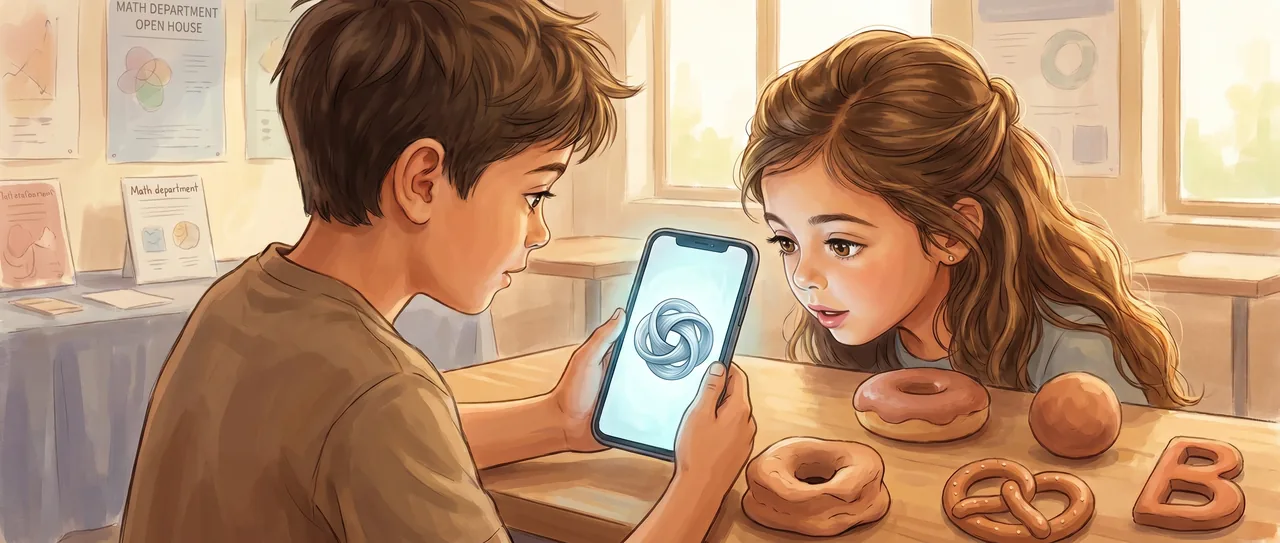
Soren looked. There was a clay ball. Zero holes. A clay pretzel shape with three openings. The letter B someone had made, with two holes. And then his cup. And Maya's donut.
"They're the only ones with exactly one," he said slowly.
"Right, but that doesn't make them the same shape. A rectangle and a triangle are both flat. That doesn't make them identical."
Maya picked up his cup. She started squeezing the clay. She made the cup part shallower, then flatter, then she just kept working the clay, thickening the walls, shrinking the bowl, until the cup part merged with the rest of the ring and she was holding a donut.
She hadn't torn anything. She hadn't poked a new hole or sealed one shut. She had just pushed.
"You broke my cup," Soren said.
"I turned it into my donut. Without cutting. Without gluing. That's what topology means. The hole is what matters. The hole survived."
The thirteen-year-old looked annoyed that Maya had gotten there herself.
Soren picked up the clay ball from the table. "So this is different from both of them. Because zero holes."
"Obviously," the boy said.
"Could you turn it inside out?"
The question surprised Maya. It surprised the boy too.
"Like a sock?" Maya asked.
"Like a sock. But it's a sphere. There's no edge to grab and pull through. You'd have to cut it."
The boy said, "Actually, you can. Mathematically. It's called sphere eversion. You can turn a sphere inside out without cutting or tearing."
"That's impossible," Soren said. Not dismissively. Genuinely.
"It's not. A mathematician named Smale proved it in 1958. But the rule is you're allowed to let the surface pass through itself. Like a ghost walking through a wall. The surface can intersect itself during the process, as long as you never make a sharp crease or tear."
Soren put down the clay ball. "That's cheating."
"Is it?" Maya said. She was staring at the ball now with the expression Soren recognized, the one that meant she was seeing something he hadn't gotten to yet.
"You're changing the rules," Soren said. "You're saying the surface isn't solid anymore."
"No. You're saying the surface is only its shape. Its math. If you stop thinking of it as a thing and start thinking of it as a set of rules about what you can and can't do, then passing through itself is fine. You just can't tear and you can't crease."
Soren sat with that. Maya watched him sit with it.
"So the answer to can you turn a sphere inside out is both no and yes," he said. "No if it's a real physical ball. Yes if it's a mathematical one that can self-intersect."
"Yes," the boy said, and for the first time he didn't sound like he was performing.
"What does it look like?" Maya asked. "The middle part. When it's passing through itself."
The boy pulled out his phone and found a video. They watched. The sphere began to push through itself, rippling, overlapping, sections of inside and outside occupying the same space simultaneously. It looked like something breathing. It corrugated into waves, folded through its own center, and emerged, smoothly, with what had been inside now outside.
No cuts. No creases. Just passage through itself.
"It's beautiful," Soren said, and he meant it in a way that had nothing to do with pretty.
Maya was quiet for a long time. Then she said, "The donut and the cup are the same because the hole is what matters. Not the walls. And the sphere can turn inside out because the shape is what matters. Not the stuff."
"Topology is geometry where you stop caring about distance and angles," the boy said. "You only care about what's connected to what."
"What's connected to what," Soren repeated. He wrote it in his notebook, then stopped and looked up. "So there's a whole kind of math where the question isn't how big or what angle, but just, does this have a hole in it, and what can I turn it into without breaking it."
"There's more than that," the boy said. "There are shapes in four dimensions, five, six. Surfaces that only exist mathematically. And they all have topology. They all have properties that survive being squeezed and stretched."
Maya picked up the clay donut. She picked up the clay ball. She held one in each hand.
"These are actually different from each other," she said. "Not because of how they look. Because no amount of squishing will give this one a hole or take the hole from this one. The difference is real. It's just not the kind of difference you can see with a ruler."
The graduate student came back with her coffee in a ceramic mug with a handle. She took a sip, looked at the table, looked at Maya holding the two clay shapes like she was weighing them.
"Having fun?" she asked.
"Your mug is a donut," Maya said.
The graduate student laughed. "Welcome to topology."
Soren was still watching the sphere eversion video. The sphere was collapsing through itself again from the beginning, and halfway through, in that impossible moment where inside and outside occupied the same space, he paused it.
He tilted the screen so Maya could see. The frozen shape hung there, a thing that could not exist in the physical world but was, mathematically, as real as the table under their hands.
Maya leaned in closer.
Read the interactive version, listen to the narration, and earn a gold star →
A science-verified short story for curious kids · Curiosity Land