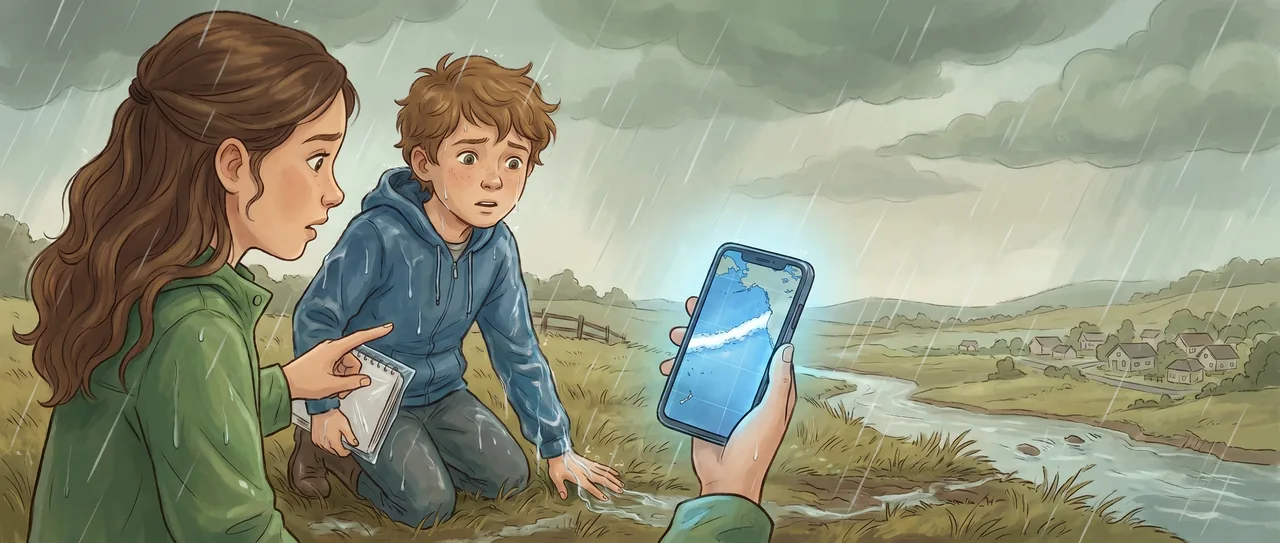
The River Nobody Sees
The sandbags were wrong.
Maya had been stacking them for two hours along Elk Creek, which was rising fast, chocolate-brown and furious. Everyone in town was stacking sandbags along Elk Creek because that was where the flooding always started. But she kept looking up the hill, toward the Garcias' old horse pasture, where nothing was flooding at all.
Something about the grass up there bothered her.
"Soren," she said. "Come look at this."
Soren set down his sandbag and wiped his face. Rain was falling so hard it was difficult to tell where the air ended and the water began. He followed her gaze up the hill.
"The pasture?" he asked.
"The grass is lying down."
He squinted. She was right. The grass in the Garcias' pasture was pressed flat in long, dark streaks, like something heavy had been dragged across it. But nothing had. There was no creek up there, no ditch, no drainage.
"Water's moving through there," Maya said. "Underground. Or just under the grass. Sheet flow."
"It can't be," Soren said. "That pasture drains east, away from town. I looked at the topo map last week for geography."
"Then why is the grass flat?"
He didn't have an answer for that, so he pulled out his notebook, which was wrapped in a plastic bag because he had learned the hard way that November in Northern California could destroy a notebook in twenty minutes. He sketched the hillside quickly, marking the direction the grass was lying.
Toward town.
Ms. Azevedo, the county hydrologist who was running the volunteer effort, walked past carrying a roll of plastic sheeting. She was talking into her phone and gesturing at the creek with the intensity of someone who had not slept.
"Ms. Azevedo," Maya said. "The pasture is draining toward town."
"Elk Creek is the priority," Ms. Azevedo said, not unkindly but not stopping either. "We've got eighteen inches of rain forecast in the next thirty-six hours. I need everyone on the sandbag line."
She was already past them.
Maya looked at Soren. "Eighteen inches."
"That's insane," Soren said. Then he paused. "Actually, where is all this water coming from? Like, specifically?"
This was the question Maya had been circling without knowing it. She pulled out her phone and opened the satellite weather image she'd bookmarked that morning. The white smear of cloud stretched from Hawaii to the California coast in a narrow band, bright and unbroken, like someone had drawn a line across the Pacific with a paintbrush.
"That," she said. "That's what they keep calling an atmospheric river on the news."
Soren took the phone. He stared at the image. "How narrow is that?"
"Maybe three hundred miles wide? But it's thousands of miles long."
"That's not a storm," he said slowly. "That's a river. An actual river. In the sky."
"They said on the radio it's carrying more water than the Amazon."
Soren looked up from the phone into the rain. Maya watched him do the thing he always did when something was too large, the slight unfocusing of his eyes like he was trying to fit something enormous through a small door in his mind. The Amazon River. The largest river on Earth. And there was more water than that over their heads right now, a corridor of vapor so concentrated it was like a firehose aimed at the mountains.
"It hits the hills," he said. "The air rises. Cools. And all that vapor has to come down somewhere."
"It's coming down here," Maya said. "Right here. And it's not going to stop."
She looked back up at the pasture. The streaks of flattened grass were wider now. She could actually see the sheen of water moving across the surface, a thin sheet that hadn't been there twenty minutes ago.
"Soren. If the ground is already saturated and this much rain keeps falling, the pasture is going to send all of it downhill. Not into Elk Creek. Into the houses on Maple Street."
"The sandbags are in the wrong place," Soren said.
They looked at each other.
"Ms. Azevedo won't listen," Maya said. "She's focused on the creek."
"She'll listen if we show her," Soren said. He flipped to his sketch. "I need to measure the flow. If I can show her actual water moving across the pasture, she'll get it. She's a hydrologist. She understands water."
They ran up the hill. The rain was warm, which was strange, and Maya remembered that atmospheric rivers pulled tropical moisture from near the equator. This water had been over Hawaii yesterday. Over the open Pacific before that. It had traveled two thousand miles as vapor, invisible, a river with no banks and no bed, and now it was falling on this one hillside in Northern California because the hills happened to be in the way.
Soren knelt in the pasture and pressed his hand flat against the grass. Water flowed over his fingers immediately, steady and purposeful.
"It's not runoff from one spot," he said. "It's coming up. The soil can't hold any more. The whole hillside is rejecting the rain."
He timed the flow with his watch. Measured the width of the nearest sheet with his outstretched arms. Wrote the numbers down.
Maya was already moving downhill, tracing the path the water would take. Past the old fence line. Down the slope. Across the road. Directly into the backyards on Maple Street, where the Nguyens lived, and the Beltrans, and old Mr. Kosta who never left his house.
"We need to divert it," she called back. "Not stop it. You can't stop a river. But if we cut a channel along the fence line, we can send it into the drainage ditch on the east side."
"With what?"
"There are shovels in Ms. Azevedo's truck."
Soren brought her the numbers and they brought the numbers to Ms. Azevedo, who this time stopped walking. She looked at the sketch. She looked at the measurements. She looked up the hill at the shining pasture.
"Oh," she said quietly. Then louder, into her phone: "I need six volunteers with shovels at the Garcia pasture. Now."
She turned to them. "How did you see this?"
"The grass was lying down," Maya said.
Above them, invisible and enormous, the atmospheric river kept flowing. Three hundred miles wide. Thousands of miles long. More water than the Amazon, pouring through a corridor of sky that touched nothing and held everything. It had no banks. It had no bed. It had been flowing for days and it would flow for days more, and almost no one on the ground ever looked up and saw it for what it was.
Soren opened his notebook to a clean page and wrote: Rivers we cannot see.
Then he closed it, tilted his head back, and opened his mouth to the rain that had crossed an ocean to find him.
Read the interactive version, listen to the narration, and earn a gold star →
A science-verified short story for curious kids · Curiosity Land