The Extra Turn
The earthquake hit during the boring part.
Maya was sitting in the back row of the university's Saturday Science Series, watching a graduate student named Tomás try to explain seismic waves using a Slinky. He was nervous. He kept losing his place in his notes and then laughing too loud at nothing. The other seven kids in the program were polite about it. Maya was trying to be.
Then her chair shifted sideways, just slightly, like someone had nudged it. The overhead lights swayed. A coffee mug on Tomás's desk walked itself to the edge and stopped.
Three seconds, maybe four.
"Whoa," said Tomás. He looked at the ceiling. "That was real."
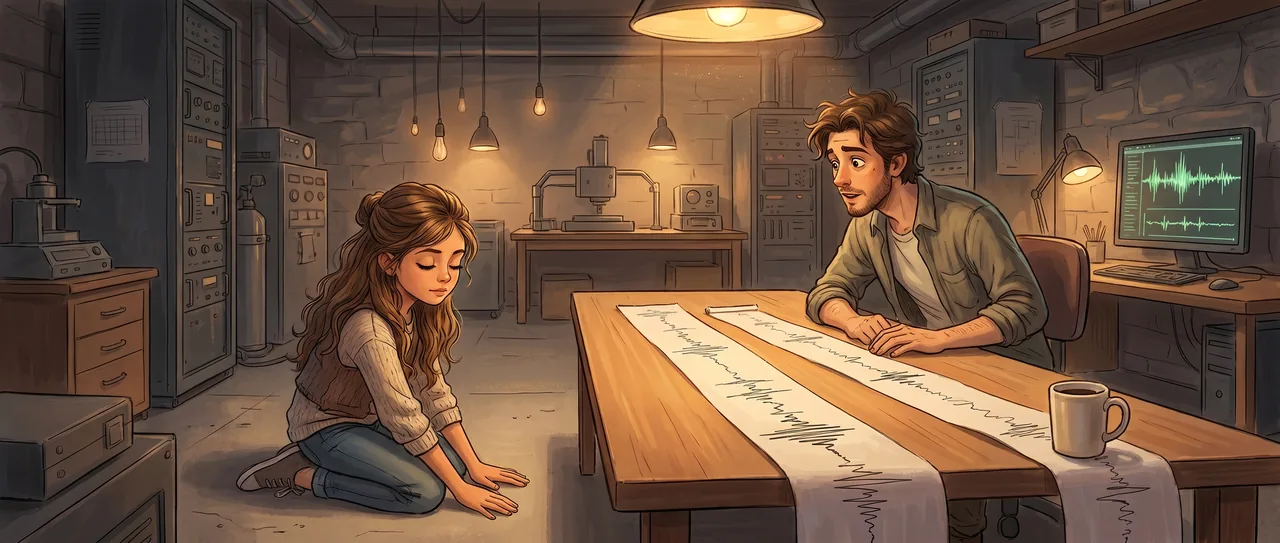
He scrambled to his computer and pulled up the seismograph feed from the basement instrument. The other kids crowded around, and Maya did too, but she wasn't looking at the screen. She was looking at the two seismograph printouts already taped to the wall behind his desk. Old ones. Teaching examples, probably. Two jagged lines on paper, labeled with dates and locations.
They didn't match.
Not the dates. She expected those to be different. But the shapes of the lines themselves. Both printouts were labeled as recordings from the same station, same distance from their respective earthquakes, same magnitude. One was from nineteen fifty-one. One was from two thousand eighteen. And the waves arrived at different times.
The newer one was faster. By just a little.
"Hey," she said. Nobody heard her. They were all watching Tomás refresh his screen.
"Hey," she said again, louder. "Why are these different?"
Tomás looked up, then at where she was pointing. "Oh. Those are just examples for my thesis defense next week. I'm practicing." He turned back to his screen.
"But they should be the same," Maya said.
Tomás paused. He had the expression adults got when they realized a question was going to take longer than they wanted. "They're, uh. They're not exactly the same setup. It's complicated."
"The labels say they are."
He opened his mouth, closed it. Then he did something she didn't expect. He pulled both printouts off the wall and brought them to the big table.
"Okay," he said. "Okay, you're right, they should be the same. Same station, same distance, same magnitude. So why aren't they?"
The other kids drifted over, earthquake already forgotten.
Maya stared at the two paper strips side by side. The seismic waves in both traveled the same path. Through the whole Earth and back. Through the mantle, through the core, out again. Same path. Different travel times. Sixty-seven years apart.
Something had changed along the path.
"Did the mantle change?" she asked.
"Rock moves," Tomás said. "But not fast enough to explain this. Not in sixty-seven years."
"So something inside moved."
Tomás said nothing. He just watched her.
Maya put her finger on the earlier printout, the one from nineteen fifty-one. She traced the wave's path in her mind. Down through the outer core, which she knew was liquid. Through the inner core, which was solid. Back up. And then the same thing, sixty-seven years later, but slightly faster.
Faster meant shorter path. Or denser material. Or the thing the wave passed through had shifted its position.
"It rotated," she said.
She said it before she understood it. The words were just there, ahead of her, and she had to run to catch up.
If the inner core was spinning at a different speed than the surface, then its crystal structure, its density variations, its shape would all present a slightly different face to a seismic wave depending on when you checked. In nineteen fifty-one, the wave passed through one angle of the inner core's iron. In two thousand eighteen, the core had turned. The wave hit a different grain. Traveled a different speed.
"How fast?" she asked.
Tomás pulled a chair over and sat down across from her, suddenly not nervous at all. "What do you think?"
"Slow. It has to be slow or you'd see it in every reading."
"It is in every reading. That's the point. That's my thesis."
"How slow?"
"One extra rotation roughly every four hundred years. Give or take. We're still arguing about it, honestly. Some data say it might even wobble back and forth. But the core is spinning ahead of us. Right now. Under our feet. A solid ball of iron and nickel the size of the Moon, turning just a little faster than everything standing on top of it."
Maya put both hands flat on the table.
The table was not moving. The floor under the table was not moving. The building was sitting on bedrock that was sitting on a tectonic plate that was riding on the mantle, and all of it was spinning together, one rotation every twenty-four hours, and three thousand miles below her palms there was a ball of iron hotter than the surface of the Sun and it was pulling ahead.
It had been pulling ahead since before anyone knew it existed.
"When did people figure out the inner core was even there?" she asked.
"Nineteen thirty-six. A Danish seismologist named Inge Lehmann. She saw waves arriving where they shouldn't, and she worked out that something solid was sitting inside the liquid core, bending the waves back."
"Nineteen thirty-six," Maya repeated.
"Before that, we didn't know. For all of human history, we had no idea there was a solid iron sphere inside the Earth."
Something about that sentence made the room feel different. Not the earthquake. Not the swaying lights. The idea that for thousands of years, people had walked around on the surface of the planet and the core had been turning beneath them, unknown, unguessed, extra rotation after extra rotation in the dark and the heat and the pressure, answering to no one.
And it had only taken one person, paying attention to waves that arrived where they shouldn't, to find it.
Tomás was watching her. "You okay?"
"How many other things are there," Maya said, "that we just haven't noticed yet?"
He laughed, but gently. "That's the right question. That's the only question."
A kid named Jordan, who had been quiet the whole time, leaned forward. "Wait. So right now, this second, the core is ahead of us?"
"By about a quarter of a degree," Tomás said. "Since this morning."
Maya lifted her hands off the table and looked at the floor, as if she could see through it, through the concrete and the crust and the boiling mantle, all the way down to the bright iron heart of the world, spinning in its own private time.
She pressed her palms flat to the floor and held still, listening.
Read the interactive version, listen to the narration, and earn a gold star →
A science-verified short story for curious kids · Curiosity Land