The Census
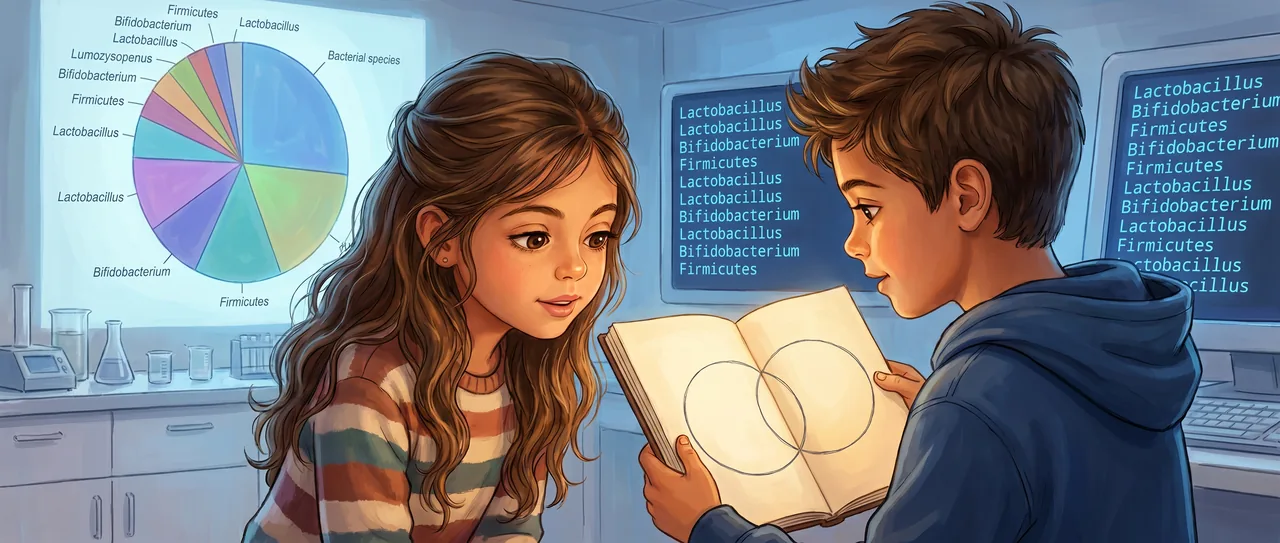
The argument started because of the pie chart.
It was projected six feet wide on the wall of Dr. Kapoor's lab, and it was wrong. Maya knew it was wrong before she knew why, the same way she sometimes knew a song was off-key before she could name the note.
"Those proportions don't add up," she said.
Soren was already counting. He had his notebook open and was tallying the labeled wedges of the chart, which was supposed to show the bacterial species found in Sample Donor Seven's gut. The pie chart was part of the live demonstration. Visitors wandered through the lab in small groups, peering at sequencing machines and asking questions about yogurt.
"She's right," Soren said. "The wedges total a hundred and twelve percent."
Dr. Kapoor was across the room, enthusiastically explaining fecal transplants to someone's horrified grandmother. Her graduate student, Lin, was running the sequencing software. Lin looked tired in the specific way of someone who had been awake for research reasons and was now required to smile at the public.
"The software auto-rounds," Lin said, not looking up. "It's cosmetic. The data underneath is fine."
"But the chart is what people are seeing," Maya said.
Lin shrugged. "Nobody's making decisions off a pie chart at an open house."
Maya let it go. But she didn't stop looking.
The demonstration worked like this: a volunteer had provided a stool sample earlier that week. The lab had extracted the DNA, run it through a sequencer, and was now sorting the results in real time, identifying which bacterial species were present and in what quantities. It was genuinely interesting, even with the pie chart problem, and Soren was writing down species names as they appeared on screen. Bacteroides. Firmicutes. Prevotella.
"How many total?" Maya asked.
Lin typed something. "For this donor, the estimate is around thirty-eight trillion bacterial cells."
"In one person," Soren said. Not a question. He was testing the number against his sense of things, the way he always did.
"In one person. Roughly the same as the number of human cells in the whole body."
Soren's pen stopped moving.
Maya watched his face. She knew that look. He was recalculating something fundamental.
"So," Soren said slowly, "if I have thirty trillion human cells and thirty-eight trillion bacteria, then by count, I'm not mostly me."
Lin almost smiled. "By count, you're roughly half. Depends on the day, honestly. You lose a lot of bacteria and human cells constantly. After a bowel movement the ratio shifts. It fluctuates."
"It fluctuates," Soren repeated, and wrote that down.
Maya was pacing now, three steps one way and three steps back, which she did when her brain was working faster than her mouth. "But the bacteria have different DNA than we do."
"Completely different genomes, yes," Lin said.
"So how many genomes are inside one person?"
Lin paused. This was apparently not a question visitors usually asked. "Well. Your own genome, one copy per cell, with some variation. Then each bacterial species has its own genome. There are maybe a thousand species in a typical gut. So, roughly a thousand additional genomes, each present in billions of copies."
"A thousand different instruction manuals," Maya said, "all running at the same time, in the same body."
"More like a thousand different languages being spoken in the same city," Soren said.
They looked at each other. It was one of those moments where they were thinking the same thing from opposite directions and could feel the overlap.
"But they're not just passengers," Maya said. "They do things."
"They do things," Lin confirmed. "Digest food we can't digest on our own. Synthesize vitamins. Train the immune system. Influence mood, maybe. The research on the gut-brain axis is still early."
"Influence mood," Soren said. He underlined it.
Maya stopped pacing. "So when I feel something, some of that feeling might be because of what my bacteria are doing."
Lin held up a hand. "That's an active area of research. We don't fully understand the mechanisms yet."
"But it's possible."
"It's being investigated seriously, yes."
Maya turned back to the pie chart, the wrong one, still glowing on the wall. She looked at it differently now. Each wedge was a population. Each population was alive, reproducing, dying, making chemicals, sending signals. Inside one person.
Soren closed his notebook and opened it again to a fresh page. He drew a circle. Then he drew another circle, the same size, overlapping the first.
"What is that?" Maya asked.
"It's a person," he said. "One circle is the human cells. One circle is the bacteria. And the part where they overlap is where you actually live."
Maya studied it. "The overlap is the part nobody fully understands yet."
"Right."
Across the room, Dr. Kapoor had finished with the grandmother and was heading their way, probably to check on the demonstration. Lin was already pulling up a new screen of data.
But Soren was looking at his Venn diagram, and Maya was looking at Soren, and for a few seconds neither of them was in the lab at all. They were somewhere inside the question.
Because if you were a city of a thousand species, a collaboration so old and so deep that you couldn't digest your own food without it, then what did it mean to say "I"? Not in a philosophy-class way. In a biology way. In an actual, measurable, thirty-eight-trillion-cells way.
"It means the question 'who am I' is a census," Maya said, as if answering something neither of them had spoken aloud.
Soren nodded slowly. "And nobody's finished counting."
Dr. Kapoor arrived, smiling broadly. "So, what do you two think? Anything interesting?"
Maya looked at the pie chart, then at Dr. Kapoor, then at the sequencing machine still sorting through a thousand genomes pulled from a single human body.
"How do you apply," Maya said, "to work here in the summer?"
Dr. Kapoor laughed. Lin did not laugh. Lin looked at Maya carefully, the way you look at someone when you recognize something.
Lin pulled over a stool and sat down at their level.
"What was the question you were asking," Lin said, "right before we interrupted you?"
Soren held up the Venn diagram, two overlapping circles, the space between them unlabeled and open.
Read the interactive version, listen to the narration, and earn a gold star →
A science-verified short story for curious kids · Curiosity Land