Seventy Answers
The list had seventy entries.
Soren had started it in April, after reading a single sentence in an old library book: Where is everybody? Three words, supposedly spoken by Enrico Fermi over lunch in nineteen fifty, and Soren had not been the same since.
The universe was thirteen point eight billion years old. There were more stars than grains of sand on every beach on Earth. Even if life was rare, spectacularly rare, the math said somebody should have shown up by now. Built something visible. Broadcast something. Left a mark.
But the sky was quiet.
Soren had started writing down every explanation he could find. Number one: they are here and we have not noticed. Number two: they destroy themselves before they can reach us. Number three: the distances are simply too large. Number four: we are the first. Number five: they are hiding.
By June, he had forty. By August, seventy. Each one was a different shape of universe. Each one was reasonable. Each one was terrifying or beautiful or both, and none of them could be eliminated.
That was the part he could not get past. Not the silence itself. The fact that seventy different explanations all fit.
His mother had found the overnight listening session at Haswell Observatory and signed him up without asking if he wanted to go, which was fine because he absolutely wanted to go and would have found a way to bring it up within the week.
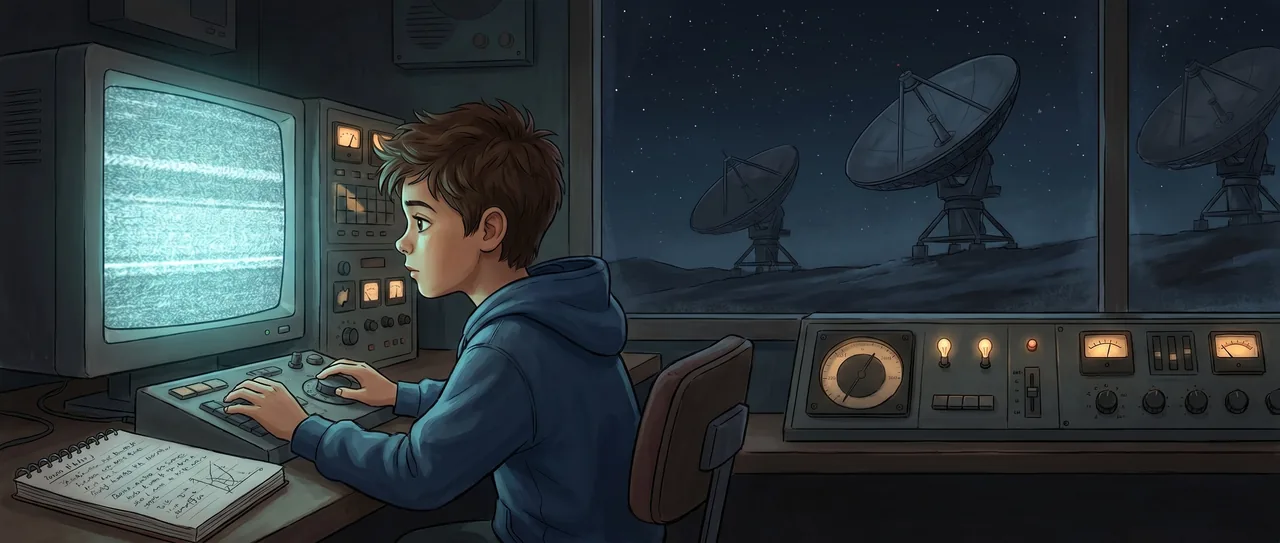
The observatory was three decommissioned radio dishes on a hillside two hours from anywhere. Fourteen visitors sat in folding chairs in the control room, which smelled like old carpet and hot electronics. Dr. Aldana, who ran the session, had a gray ponytail and a coffee thermos that she refilled from a larger coffee thermos.
"You will hear static," she told them. "Lots of it. That's the universe talking, just not in words. We'll sweep a few frequencies, listen to some pulsars, and I'll try to stay awake long enough to show you hydrogen at twenty one centimeters. Questions?"
A man in the front row asked if they might hear aliens.
"No," said Dr. Aldana.
She did not elaborate.
Soren liked her.
The first three hours were exactly as promised. Static, hissing, and the metronomic tick of a pulsar that sounded like a kitchen timer buried in sand. Dr. Aldana showed them how to read the waterfall display, the cascading graph of frequencies and signal strength. Most of the visitors drifted to the snack table. Two fell asleep.
Soren stayed at the console.
At eleven forty, Dr. Aldana let him adjust the dish bearing himself. He swept it slowly across a quiet patch of sky between Cygnus and Lyra, watching the waterfall scroll.
"You keep a notebook," Dr. Aldana observed. She was not asking.
"I have a list," Soren said. "Seventy explanations for why we haven't found anyone."
She looked at him. Refilled her coffee. "Seventy. That's thorough."
"None of them are wrong. That's the problem."
"Why is that a problem?"
"Because usually in science you test things and rule them out. But most of these, you can't test. You just have to sit with all of them being possible at once."
Dr. Aldana nodded slowly but said nothing. She was watching the waterfall display, and after a moment Soren realized she was not going to respond. She was just letting his sentence exist in the room.
He looked back at the screen.
Static. Noise. The faint hydrogen line, that thin bright stripe that meant atoms of hydrogen everywhere in the galaxy were all vibrating at the same frequency, calling out at twenty one centimeters like a bell that never stops ringing.
Soren stared at it.
"Dr. Aldana. How many radio telescopes are there on Earth?"
"Active? Maybe five hundred."
"And how long have we been listening?"
"Seriously? About sixty years."
"And the galaxy is a hundred thousand light years across."
"Give or take."
Soren pulled out his notebook. Not to write. To look at entry number forty three: We have not listened long enough, with sensitive enough instruments, pointed at enough sky, to have heard anything even if it were there.
He had written it months ago. Understood it intellectually. But sitting here, in front of one dish, pointed at one tiny patch of one sky, he suddenly felt the entry differently.
Sixty years. The galaxy was ten billion years old. Sixty years of listening was like dipping a thimble in the ocean and concluding there were no whales.
But here was the thing. The thing that made his hands go still on the console.
Number forty three did not cancel the other sixty nine. The silence could be because they were hiding. It could be because they destroyed themselves. It could be because the distances were too vast, or because we were first, or because they communicated in ways we could not imagine, or because our thimble was too small. All of these were still true. All at once. Stacked on top of each other like transparencies on an overhead projector, each one showing a different universe, and the real universe was somewhere in that stack, or maybe it was the whole stack, and nobody alive knew which.
He was not going to solve this tonight. He was not going to solve this in his lifetime. The Fermi paradox was not a question waiting for a clever child to crack it. It was a question that the entire human species had been holding for seventy years, and the silence had not broken, and that was the actual fact.
The universe was not withholding an answer. The universe was the silence. The silence was the data.
Soren looked at the waterfall display. Static poured down it like rain on a window, every frequency alive with noise that was not a signal, not a message, not a voice. Noise that was hydrogen and quasars and the cosmic microwave background and a hundred other real things that were not what he was listening for.
"Dr. Aldana," he said. "Has anyone ever made a list of all the proposed solutions? Like, a complete one?"
"Stephen Webb wrote a book. Seventy five solutions, if I remember."
Soren almost laughed. Seventy five. He had gotten to seventy on his own.
"He didn't solve it either," Dr. Aldana added. She said it gently. Not to discourage him. To welcome him to something.
"I know," Soren said. "I don't think that's the point."
Dr. Aldana finished her coffee, set down the thermos, and pulled over a second chair so she could sit beside him at the console.
The waterfall kept scrolling, static cascading in pale blue and green, and Soren leaned forward and turned the dish three degrees east, into a new, unlistened patch of sky.
Read the interactive version, listen to the narration, and earn a gold star →
A science-verified short story for curious kids · Curiosity Land