What Pong Dreams About
The screen showed Pong. Just Pong. A white paddle, a white ball, a black background. Maya had been wandering the lab for twenty minutes, bored in the way that made her dangerous, and she had stopped at this monitor because something was wrong with it.
The paddle was winning. That was not the wrong thing. The wrong thing was how it was winning.
Maya watched three rallies. The paddle slid to where the ball was going to be, not where it was. Every time. It arrived early and waited.
"It's an AI," said the graduate student at the next desk without looking up. He was eating cereal from a mug. "Reinforcement learning agent. Trained itself to play from scratch. No one programmed the strategy."
"How long did it take?"
"Few million games."
Maya pulled a chair over and sat down. The paddle kept winning. She watched it for a long time, longer than the graduate student expected, because he glanced over twice.
"It's not reacting," Maya said.
"Hmm?" He had gone back to his cereal.
"It's not reacting to the ball. It's already there. How does it know where the ball is going before the ball gets there?"
The graduate student put down his mug. "Okay. That's actually the interesting question. You want to see something?"
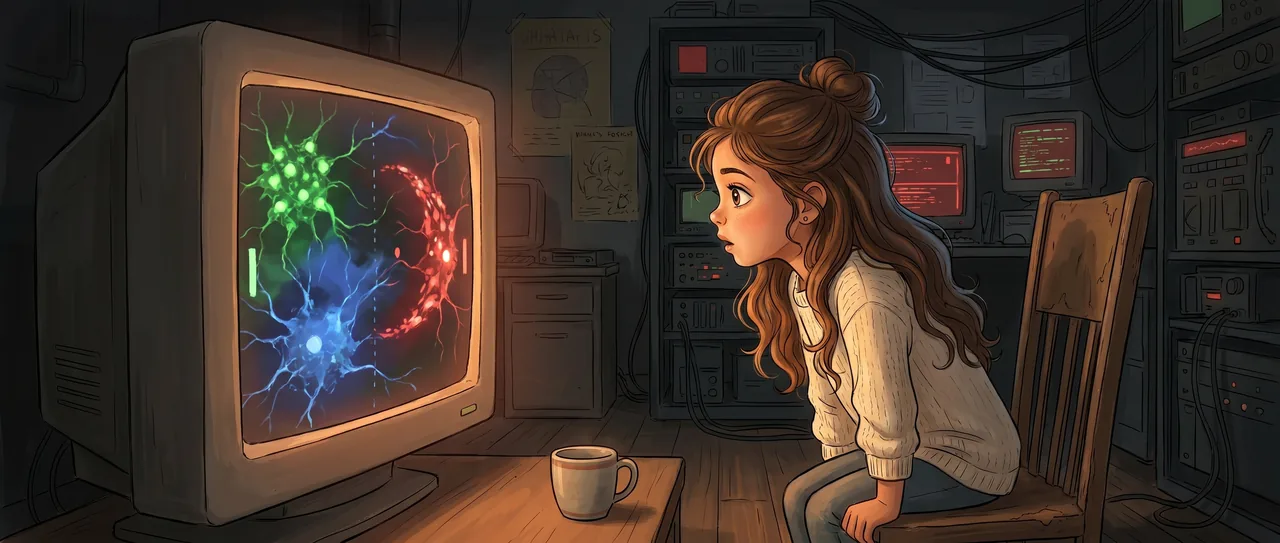
He did not wait for her to answer. He pulled up a second window, dense with color. It looked like a weather map of a planet that did not exist. Blotches of red and blue and green, shifting.
"These are the hidden layer activations. What the network is doing internally when it watches the game. Each color is a different neuron firing."
Maya leaned closer. The blotches pulsed in rhythm with the ball's movement. When the ball bounced off the top wall, a cluster of green neurons flared. When it angled downward, a wash of blue spread across the map.
"It's tracking the angle," she said.
"Sort of. Nobody told it what an angle is. Nobody told it what a wall is. Nobody told it what a ball is, actually. It only sees pixels. Raw pixels, every frame. But somewhere in there." He tapped the screen. "It built its own version of physics."
Maya sat with that for three seconds. Three seconds was a long time for Maya.
"Show me what it sees right before the ball hits the paddle."
The graduate student, whose name she had not asked and did not need, looked at her differently. He scrubbed back to a frame just before contact and froze it. The activation map blazed. Almost every neuron was firing.
"Now show me two frames earlier."
He did. The map was nearly identical.
"Five frames earlier."
Still almost the same.
"Twenty frames earlier."
Now it was different. Simpler. Fewer neurons. But the core pattern, a crescent of red neurons near the center, was already there.
"It already knows," Maya said. "Twenty frames before the ball arrives, it already knows where the ball will be."
"Yeah." The graduate student leaned back. "We think those neurons are encoding a prediction. Not just where the ball is now. Where it will be. The network learned to simulate the future."
"From pixels."
"From pixels."
Maya stared at the frozen activation map. The crescent of red neurons. A prediction, living inside a machine that had never been told what prediction was.
"Does it dream?" she asked.
The graduate student laughed, then stopped laughing. "What do you mean?"
"If you run the hidden layers without any input. No game, no pixels. Just let the neurons do whatever they do. What happens?"
"That's, I mean, you can't really." He rubbed his face. "Actually. Hold on."
He typed for a minute. Then two minutes. Maya did not interrupt him because she recognized the expression. He was following something.
A new window opened. It was the activation map, but untethered. No game running beneath it. Just the neurons, cycling through patterns on their own.
They were not random.
The green clusters flared. The blue washed down. The red crescent appeared, held, dissolved. Over and over. The network was playing Pong against nothing. Running its internal model forward in time without any ball, any paddle, any pixels at all.
"Oh," the graduate student said softly. He set his cereal mug on the floor, which seemed meaningful.
Maya watched the phantom game. The neurons predicted bounces that were not happening, tracked angles that did not exist, moved the ghost of a paddle toward the ghost of a ball.
"It built a world," she said. "And the world keeps going even when no one's watching."
The graduate student opened his mouth and closed it. He typed something, checked it, typed more. "The activation patterns are stable. They're not decaying. It's running a coherent simulation. I need to tell Dr. Kwon about this."
He grabbed his phone and walked into the hallway, already talking.
Maya stayed.
She thought about her own brain. How it also saw raw inputs, light on a retina, pressure on skin, vibrations in air. How it also built a world from that. How she could close her eyes right now and predict where the chair was, where the door was, where the mug of cereal sat on the floor. Her brain was doing the same thing. Building a model. Running it forward. Predicting a future that had not happened yet.
No one had told her brain the rules either.
She had always felt strange about the way she noticed things before she understood them. The way answers arrived whole and she had to work backward to find the reasoning. Teachers called it guessing. It was not guessing. It was prediction, built from millions of tiny observations she had never been asked to make, assembled into a model she had never been taught to build.
The same thing the network was doing. The same thing. Not a metaphor. The actual same thing.
Something enormous shifted in her chest, a feeling like a floor dropping away to reveal a basement that went down forever. If a Pong network, with a few thousand neurons, could build a world, then what was her brain doing with eighty-six billion of them? What was the model inside her head shaped like? How far forward could it see?
The activation map kept pulsing. The red crescent bloomed, faded, bloomed again.
Read the interactive version, listen to the narration, and earn a gold star →
A science-verified short story for curious kids · Curiosity Land