The Drop
The bowling ball was Soren's idea, and he was already regretting it.
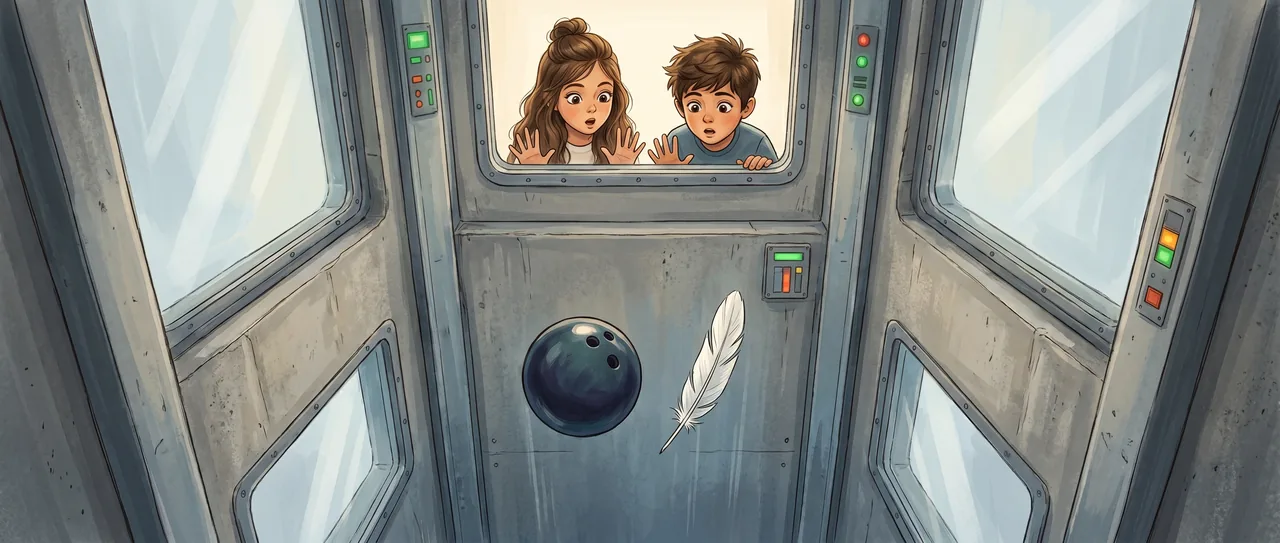
He stood at the top of the observation platform, arms burning, holding the ball against his chest. Below him, the old wind tunnel dropped straight down for thirty meters, a smooth concrete throat lined with windows every five meters so you could watch things fall.
"Why didn't we pick something lighter," he said.
"Because lighter is the whole point," Maya said. She was holding a single white goose feather between her thumb and forefinger, turning it slowly. "Light versus heavy. That's the question."
Dr. Achebe was somewhere below them, running the vacuum pumps. She had agreed to let them use the chamber for forty minutes, then she had a department meeting. She had said this three times. She had not explained anything about what they would see. When Soren asked, she'd just said, "I've told you what the chamber does. It removes the air. You'll have to tell me what happens next."
Soren had written in his notebook: Dr. A. knows what will happen but won't say. Then he'd underlined won't.
The pump noise changed pitch, dropping from a whine to a hum to something felt more than heard.
"We're at pressure," Dr. Achebe's voice crackled through the intercom. "You have your objects?"
"Bowling ball and feather," Maya confirmed.
"Load them in the release mechanism. Both clamps, same height. I'm starting the timer when you drop. You'll have cameras at each window. Don't blink."
Soren wrestled the bowling ball into the left clamp. It took both hands and a knee. Maya placed the feather in the right clamp, which was identical to the left one except it closed on nearly nothing.
They looked at each other.
"What do you think happens?" Maya asked.
"The bowling ball hits first," Soren said. "It has to. It's six kilograms. The feather is basically nothing."
"I know," Maya said. "Obviously."
"But you're making a face."
"I'm not making a face."
"You're making the face you make when you think we're going to be wrong."
Maya looked at the feather. She looked at the bowling ball. "Drop something heavy and something light off a building, the heavy thing wins. We've seen it. Everyone's seen it."
"Right."
"But that's in air. And the air is gone now."
Soren paused. He thought about what air actually did to a falling feather. He thought about it carefully. A feather didn't fall slowly because it was light. A feather fell slowly because air pushed back on it, and a feather was shaped like a thing designed to push air. Which it was. That was what feathers were for.
But if there was no air.
"Oh," he said.
"You're making a face now too," Maya said.
"On three?" Soren asked.
Maya nodded.
Soren counted. On three, Maya pressed the release.
The clamps opened simultaneously. The bowling ball and the feather dropped into the vacuum chamber together.
Soren pressed his face to the top window. The bowling ball fell exactly the way a bowling ball should fall, fast and decisive and heavy. And beside it, the feather.
The feather did not drift. The feather did not flutter or spiral or do any of the things a feather does. The feather dropped like a stone. It plummeted. It fell with the same shocking, instant urgency as six kilograms of resin and plastic.
They hit the bottom at exactly the same moment.
Exactly.
Soren heard it through the chamber walls, a single sound, not two.
"Again," Maya said.
"What?"
"We have to do it again."
They retrieved the objects. They loaded the clamps. They dropped them.
Same result. One sound at the bottom. Not two.
Soren pressed his forehead against the cool glass of the observation window. "That shouldn't look like that."
"But it does."
"I know, but." He stopped. He was trying to find the wrong thing. Not the wrong fact. The wrong assumption he'd been carrying. "We always thought heavy things fall faster. But heavy things don't fall faster. Heavy things just push through air better. The falling part was always the same."
Maya was quiet for a moment, staring down the shaft. "Soren. Think about what that means."
"It means air was hiding something."
"No. Bigger than that. If the bowling ball and the feather fall at the same rate, then gravity doesn't care about mass. It doesn't pull harder on heavy things."
"It does, though. Gravity pulls harder on the bowling ball. F equals m times g. More mass, more force."
"More force, but the same acceleration. Because more mass also means harder to accelerate. They cancel. Perfectly. Every time."
Soren opened his notebook. He wrote: Gravity pulls harder on heavy things. But heavy things are harder to move. These two facts cancel exactly. Why?
He stared at what he'd written. "Why do they cancel exactly? They don't have to. Those are two completely different properties. How heavy you are and how hard you are to push. Why would those be the same number?"
Maya sat down on the metal platform. Below them, the vacuum chamber held its silence. "That's what I'm saying. That's the thing that doesn't make sense yet."
Dr. Achebe's voice came through the intercom. "Fifteen minutes left. Did you see what you needed to see?"
"Dr. Achebe," Soren said. "Why is gravitational mass the same as inertial mass?"
There was a pause. A long one.
"Einstein spent ten years on that question," she said. "It became general relativity. And the honest answer is we still describe it better than we explain it." Another pause. "Good question, though."
The intercom clicked off.
Maya looked at Soren. "Einstein spent ten years."
"And the answer was general relativity."
"The answer was a better description. She said that. Not an explanation. Even Einstein didn't get to the bottom."
Soren looked down the thirty meter shaft. He thought about the feather falling like a hammer. He thought about two completely different properties of matter that happened to be identical for no obvious reason, and how that coincidence, if it even was a coincidence, was so fundamental that the geometry of space and time depended on it.
"We should drop something else," Maya said.
"What?"
"Anything. Everything. I want to see it again."
Soren pulled a pencil from his pocket. Maya found a washer in the tool bin by the railing. They loaded the clamps.
Below them, the vacuum waited, thirty meters of empty space with nothing to hide behind.
Read the interactive version, listen to the narration, and earn a gold star →
A science-verified short story for curious kids · Curiosity Land