The Combination Lock
The compost smelled wrong.
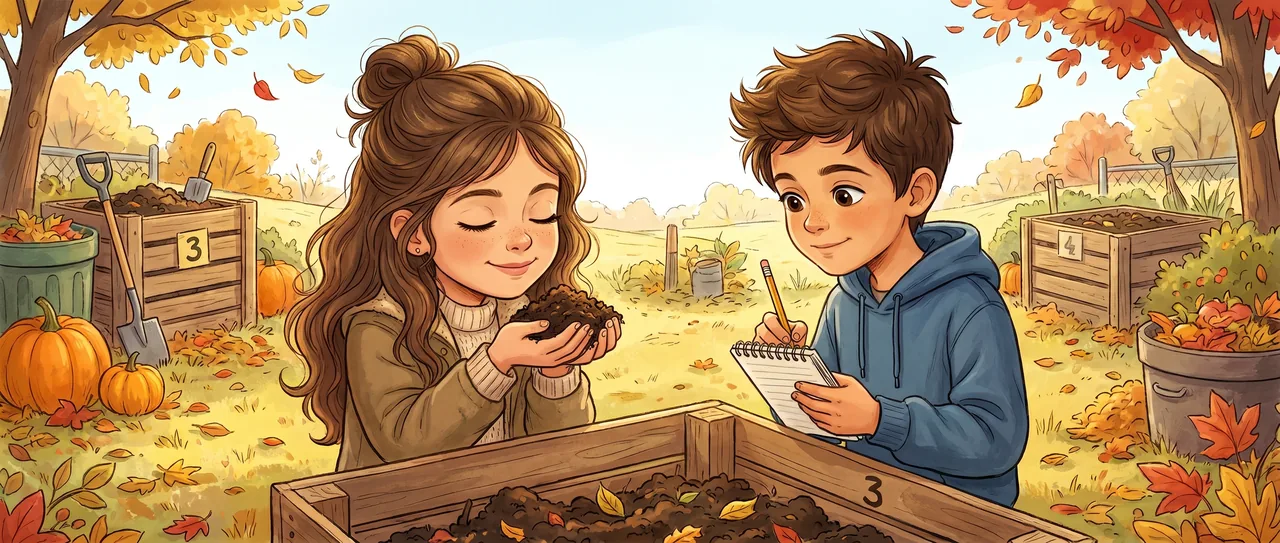
Maya had been standing over the bin for three seconds, maybe four, and she already knew. Not bad wrong. Not rotten wrong. Just not the way the other bins smelled, the ones Soren was turning with the big fork, the ones that smelled like wet leaves and coffee grounds and the warm brown scent of things becoming soil.
This one smelled like all of that, plus something sharp. Almost metallic.
"Soren."
He looked up from bin number six, sweat on his forehead despite the cold. "Yeah?"
"Come smell this."
He set down the fork and walked over. He leaned in. Leaned back. Leaned in again.
"That's different," he said.
"Different how?"
He closed his eyes. "It's got that same base smell. Decomposition. But there's something on top of it. Like pennies? No. Like pennies and cut grass had a baby."
Maya laughed, but he wasn't wrong. That was exactly it. Pennies and cut grass layered over decomposition. Three things at once, and somehow she could pick them apart and also smell them as one single thing that wasn't any of them.
"How do we do that?" she said.
Soren opened his notebook. Not to write anything yet. Just to have it open, like a net he was holding beneath his thoughts. "Do what?"
"Smell three things at once and know they're three things, but also smell them as one thing that's different from all three."
Ms. Khatri was across the garden, arguing with the hose. She was the workshop leader, a soil scientist who talked too fast and interrupted herself constantly and had already forgotten both their names twice. She'd told them to turn the bins, check the temperature probes, and write down anything unusual.
"Ms. Khatri," Maya called. "What would make a compost bin smell metallic?"
Ms. Khatri looked up from the hose, which was winning. "Could be anaerobic pockets. Could be too much citrus peel. Could be someone threw in a battery. People throw in batteries, Maya. You wouldn't believe what people throw in." She went back to the hose.
Soren was already writing. "She said my name," Maya noted.
"She said your name wrong. She called you Maia."
"Close enough." Maya leaned over the bin again. "Okay, so anaerobic pockets. Lack of oxygen changes the decomposition. Different chemistry, different molecules released. But here's the thing."
She paused. Soren waited. He had learned that Maya's pauses were not empty.
"I can tell this bin from every other bin by smell alone. And they're all compost. They're all basically the same stuff. How is my nose that specific?"
Soren looked at the row of twelve bins. "You think you could actually do that? Tell them apart blindfolded?"
"I think I already am. Every time I walk past one, it has its own smell. Not hugely different. But different."
"Let's test it."
This was why they worked. Maya said a thing that might be impossible, and Soren did not say no. He said let's test it.
They found an old scarf in the garden shed. Maya tied it around her eyes. Soren led her to a bin, and she leaned in, breathed, and said, "Seven. The one with all the eggshells."
He checked the label. Bin seven.
He led her to another. She breathed. "Four. It's the youngest. Still smells like actual food."
Bin four.
They did all twelve. She got ten right. The two she missed were bins nine and eleven, which she said smelled almost identical but not quite, and she'd guessed between them and gotten them swapped.
Soren sat on an overturned bucket and looked at his notebook. He'd written twelve tally marks and circled ten of them.
"So your nose can distinguish at least ten different versions of garbage," he said.
"Twelve. I could tell nine and eleven were different. I just couldn't tell which was which."
He stared at the bins. "These are all basically the same ingredients. Vegetable scraps, leaves, coffee grounds. And you can tell twelve of them apart. If you can do that with twelve piles of compost, how many total smells can you actually distinguish?"
Maya pulled off the scarf. Her hair was full of static. "A lot."
"But how? Seriously, how? We don't have a million different smell detectors in our noses. We'd need, like, one for every possible smell."
"Unless we don't," Maya said slowly. She was looking at the combination padlock on the garden shed. The one with four dials, each with digits zero through nine.
"Soren. How many combinations does that lock have?"
He calculated. "Ten choices on each of four dials. Ten to the fourth. Ten thousand."
"Ten thousand combinations from just four dials with ten options each."
They looked at each other.
"So if smell works like that," Soren said, speaking carefully now, building it as he spoke, "you wouldn't need a separate receptor for every smell. You'd need a set of receptors, and each smell would activate a different combination."
"Like a chord," Maya said. "Not one note. A chord."
Soren was writing fast. "Okay, so say you have a few hundred receptor types. Each smell triggers some specific subset of them. The brain reads which combination lit up and says, that's coffee, that's rain, that's bin seven."
"And every bin has a slightly different combination. Because the molecules are slightly different. Different ratios, different breakdown products."
Ms. Khatri had conquered the hose and was walking past. She overheard the last part and stopped. "About four hundred," she said.
"Four hundred what?" Soren asked.
"Receptor types. Olfactory receptors. Roughly four hundred different ones in the human nose." She said it the way she said everything, fast and already moving on to her next thought. "The math on the possible combinations is absurd. Trillions. Your nose is the most ridiculous combinatorial instrument you own and nobody ever talks about it."
She walked on.
Trillions.
Maya breathed in. She could smell the compost bins, all twelve of them, blurring into one rich warm cloud. She could smell the cold dirt beneath them. She could smell Soren's jacket, which smelled like laundry soap and his house, which smelled different from her house in a way she had never questioned until now.
Four hundred receptors. Playing chords. Trillions of chords.
Every smell she had ever recognized. Every smell she had ever almost recognized. Every time she had walked into a room and known something was different before she could say what. It was all combinations. It was all chords her brain was reading faster than thought.
Soren closed his notebook and breathed in too, deeply, like he was trying to hear it.
The wind shifted, and the garden smelled like twelve different kinds of decay, and cold stone, and somewhere far off, woodsmoke, each one a lock opening.
Read the interactive version, listen to the narration, and earn a gold star →
A science-verified short story for curious kids · Curiosity Land